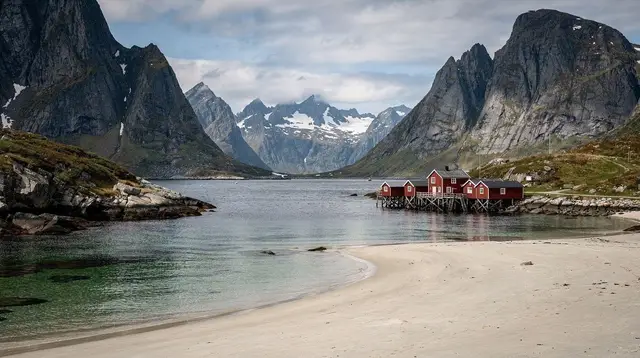
Why I Paddled Out at Unstad in February
I keep trying to explain Unstad to people who haven’t been, and I keep failing at the same part: not the cold, not the dark, but the fact that none of it feels like a hardship once you’re actually in the water. It should. It doesn’t, not entirely, and I still don’t fully understand why.
Getting there in February
Unstad sits on the north coast of Vestvågøya, a short but genuinely committed drive off the E10 from wherever you’re staying — I’d sorted a rental car before the trip specifically because I knew I’d want to chase whichever beach had the best conditions on a given morning, and Unstad isn’t somewhere public transport gets you. In February, that drive itself is part of the day — Lofoten’s weather can turn within the hour, and a clear morning sky is no promise about what the beach will look like by the time you’ve parked. I’d checked the forecast three times before leaving that morning and gotten three different answers, which by this point in the trip I’d stopped finding surprising.
Winter here isn’t as brutal as the latitude suggests it should be — the Gulf Stream keeps air temperatures hovering somewhere around freezing rather than plunging the way you’d expect this far above the Arctic Circle. That moderation is the whole reason surfing at Unstad is possible at all in February rather than being a purely theoretical idea. It doesn’t make the water warm. It just makes the exercise survivable, which turns out to be a different thing entirely.
The gear isn’t optional
I want to be direct about this part, because it’s the thing people ask about first and the thing I underestimated before my own first session: the suit here isn’t a comfort choice, it’s the whole trip. A proper winter wetsuit, thick enough to actually hold in warmth rather than just take the edge off, plus boots, gloves, and a hood, is the baseline for spending any real time in the water without your session ending in fifteen minutes out of pure discomfort rather than choice. I’d surfed cold water before and still found myself recalibrating what “cold water gear” meant once I was standing on Unstad’s sand in February, watching my breath.
None of this is a deterrent, exactly — it’s just the entry fee. Once you accept that the suit is doing serious work rather than being a formality, the actual surfing part becomes much less about enduring the cold and much more about just surfing. If you’re building a winter packing list from scratch, our general Lofoten packing guide covers the layers you’ll want on land; the surf gear itself is a separate, more specialized list on top of that.
What the light does to a session
This is the part that’s hardest to explain without having stood there. February isn’t the darkest stretch of the year — that’s the polar night window around December and early January, further back on the calendar — but daylight is still short and low, and it changes the entire character of being in the water. The sun, when it’s out, sits at an angle that turns the whole beach a kind of pale gold rather than the flat overhead light you’d get further south, and it doesn’t last long before the light starts dropping again toward evening.
There’s a strange quality to catching a wave under a sky that’s already halfway to dusk at what feels like mid-afternoon. It reframes the whole session as something with an obvious beginning and end, dictated by the sun rather than by how tired your arms are.
Why people actually do this
I’ve thought about this question more than any other part of the trip, because it’s the one non-surfers ask most directly, usually with a tone that suggests they think there’s a better answer than the one I actually have. The honest version is something like: the waves here are genuinely good, the crowds are nothing like what you’d find at any comparable break further south, and there’s a specific satisfaction in surfing somewhere this far north that has very little to do with the surfing itself and a lot to do with where you are while you’re doing it.
It’s not a spiritual answer, and I’m suspicious of people who make it sound like one. It’s closer to: the discomfort is real but manageable, the reward is real and not manageable in quite the same predictable way, and that imbalance is what keeps people coming back rather than treating a single winter session as enough.
It also helps that Unstad isn’t the only thing on this stretch of coast. On days when the swell wasn’t cooperating, I drove out to Eggum just to stand somewhere bare and wind-scoured for a while, or back toward Haukland Beach for a walk that didn’t require a wetsuit at all. Surfing was the reason I came, but it wasn’t the only reason I kept finding excuses to stay out on the coast.
After the water
Coming out of the sea in February, the priority isn’t lingering on the beach — it’s getting dry, warm, and into a hot drink as fast as reasonably possible. What I didn’t expect was how well a surf session sets up the rest of the evening. February sits inside aurora season, which runs roughly September through early April, and a clear afternoon that gave good surf conditions is often the same kind of clear sky that makes for a good aurora evening later on. I booked a guided northern lights tour departing from Svolvær for that same evening, on the logic that a day already built around watching the sky for surf conditions might as well continue after dark.
On a different evening, when clouds had rolled back in and surfing was off the table entirely, an aurora hunt tour that actively chases clear patches rather than waiting in one spot felt like the better bet, and it was — the guides seemed to have a clearer read on the sky than I did after a full week of checking forecasts myself. For a slower alternative that doesn’t depend entirely on aurora activity to feel worthwhile, a snowshoeing and northern lights tour gives you a reason to be outside regardless of what the sky ends up doing.
What I’d tell someone considering it
Bring gear that’s actually rated for the conditions, not gear that was fine somewhere else. Don’t expect the light to behave the way it would further south, and don’t fight that — build the session around it instead. And don’t assume a bad forecast rules out the day; the weather here changes fast enough that the version you see at breakfast is rarely the version you get by the time you’re actually in the water. It’s one of the more common mistakes people make planning a Lofoten trip generally — trusting a single forecast too far in advance — and it applies just as much to a surf session as to anything else on an itinerary here.
A few things people ask me about this
Is Unstad only for experienced surfers in winter? Winter conditions and cold-water gear management add a layer of difficulty beyond the surfing itself, so it suits confident surfers more than complete beginners, though that’s more about comfort than any hard rule.
Do I need my own wetsuit, or can I rent one locally? I brought my own, but the honest answer is that whatever you use needs to be genuinely rated for near-freezing water, not just “cold water” in a general sense.
Is February really surfable, or is summer easier? Both have surfers in the water; February asks more of your gear and tolerance for cold, while summer trades that for milder conditions and, some would argue, a slightly different quality of swell.
What do you do with the rest of the day after a morning surf session? For me, that’s usually where an evening aurora tour or a slower activity comes in — the day doesn’t have to end when the surf session does.
Beach experiences on GetYourGuide
Verified deep-linked GetYourGuide tours. Book through these links and we earn a small commission at no cost to you.
Photos show the destination, not the operator's own images.