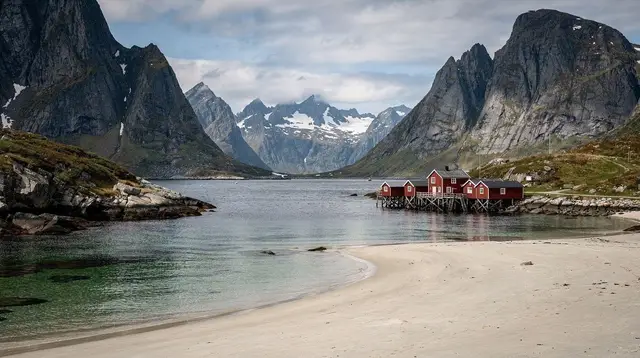
Lofoten's Best Beaches: Haukland, Uttakleiv, Ramberg, Kvalvika
Which Lofoten beach should I visit if I only have time for one?
Haukland is the easiest to reach by car with the most straightforward parking, making it the default choice for a single stop. Uttakleiv suits sunset and rock formations just next door, Ramberg suits a roadside stop with minimal walking, and Kvalvika is for hikers willing to walk in for a more remote setting.
Four beaches, four different visits
Lofoten’s beaches don’t behave like a warm-water coastline. The sand is often genuinely white and the water genuinely turquoise on a clear day, which photographs like somewhere tropical and feels like the Arctic the moment you touch the water. Four beaches account for most of the visits: Haukland and Uttakleiv on Vestvågøya, sitting almost next to each other; Ramberg on the road through Flakstadøya; and Kvalvika, reachable only on foot. Each has a different access story, a different crowd, and a different reason to choose it over the others.
Haukland: the easiest stop
Haukland is the beach most visitors see first, largely because it’s the most straightforward to reach: a paved road leads directly to a parking area right above the sand, with no hike required to see the view. The beach itself is a wide curve of pale sand backed by steep green hills, with clear, cold water that on a sunny day looks strikingly bright against the sand.
Because it’s the easiest of the four to reach, Haukland also tends to be the busiest, particularly around midday in peak summer. Arriving earlier or later in the day — easier here than most places thanks to the midnight sun season — thins the crowd considerably. A guided coastal walk that includes Haukland is a way to see it alongside a wider stretch of this coastline rather than as a single stop.
Uttakleiv: rocks, tide pools, and sunset
A short drive past Haukland, Uttakleiv trades some of Haukland’s clean sand for a more textured shoreline: driftwood, boulders, and rock formations scattered along the beach, including a well-known set of rocks often used as a foreground for photographs. The mix of sand and rock makes Uttakleiv better suited to wandering and exploring tide pools than to laying out on open sand, and its open western exposure makes it a favoured spot for sunset, especially outside the midnight sun months when there’s an actual sunset to see.
A photo-focused tour covering Haukland and the surrounding coastline often works this stretch specifically for the combination of dramatic light and varied foreground that Uttakleiv and Haukland together provide. For a wider set of vantage points beyond these two beaches, the photography guide to Lofoten covers timing and locations in more depth.
Ramberg: the roadside beach
Ramberg sits directly alongside the E10 on Flakstadøya, which makes it the easiest of the four to combine with a driving day rather than a dedicated stop. The beach itself is genuine sand, curving along the road with mountains behind it, and its main appeal is exactly that convenience: no hike, no detour, just a pull-off and a walk onto the sand.
Because it doesn’t require any special effort to reach, Ramberg tends to draw a more mixed, less beach-specific crowd than Haukland or Uttakleiv — people stopping for fifteen minutes on their way somewhere else as often as people planning a longer visit. It’s a reasonable default if you’re driving the E10 anyway and want a quick coastal stop without adding meaningfully to your day.
Kvalvika: the one you walk to
Kvalvika is the outlier among these four, and deliberately so: there’s no road to it. The beach is reached on a trail from Fredvang, the same access point used for the climb up Ryten, the peak that overlooks the beach from above. Depending on pace and how much time is spent at the viewpoint, the walk in takes a good part of an hour or more each way over uneven terrain, which filters out casual visitors far more effectively than a parking fee ever could.
What that walk buys is a broad, quiet sand beach with no road noise, no facilities, and — outside peak summer — often very few other people. Some visitors combine the walk with a wild camp on the beach itself, though that requires planning around weather and self-sufficiency rather than a simple day visit. For hikers weighing whether Kvalvika and Ryten fit into a trip, the best hikes in Lofoten puts this route in context against gentler and harder alternatives, and reading up on hiking safety first is worth doing given the more remote setting.
Best time of day for each beach
Light matters more at these beaches than at almost any other type of stop in Lofoten, since the appeal is largely visual — pale sand against dark mountains, water that shifts from turquoise to grey depending on the angle of the sun. Haukland and Ramberg both face in directions that take direct sun for much of the day in summer, which means midday visits still look good even if they’re busier. Uttakleiv, with its rockier shoreline, tends to reward the lower, more angled light of morning or evening, when shadows pick out the texture of the boulders and driftwood rather than flattening them under overhead sun.
Kvalvika is different again, since reaching it requires committing to a walk regardless of what the light is doing when you set out. Because the walk itself takes the better part of an hour or more each way, timing a Kvalvika visit around light is less about choosing a precise hour and more about choosing a day with a settled forecast, so the walk in isn’t wasted on a beach sitting under flat grey cloud.
What to actually bring for a day at these beaches
None of these are beaches in the conventional sense of sun loungers and beach bars — there’s no expectation of facilities at any of the four, and packing for the day should reflect that. A windbreak layer matters more here than sunscreen, since even a warm, sunny day can carry a cold wind straight off the sea with little to block it. A towel and a change of dry clothes are worth having in the car if anyone in your group plans to get in the water, since there’s nowhere at any of these beaches to change or dry off afterward.
For Kvalvika specifically, treat the visit like a short hike rather than a beach outing: proper footwear for the walk in, water, and enough daylight buffer that an unhurried visit doesn’t turn into a rushed walk back in fading light. None of the four beaches have lifeguard cover, so anyone planning to swim should check conditions themselves rather than assuming supervision exists.
Comparing the four
| Beach | Access | Surface | Best for |
|---|---|---|---|
| Haukland | Direct road access, parking at the beach | Wide pale sand | Easiest stop, families, short visits |
| Uttakleiv | Short drive past Haukland | Sand mixed with rock and boulders | Sunset, tide pools, photography |
| Ramberg | Directly on the E10 | Sand | Quick roadside stop while driving |
| Kvalvika | Foot access only, via Fredvang | Broad sand | Quiet, remote setting, paired with the Ryten hike |
Beyond the big four
Haukland, Uttakleiv, Ramberg, and Kvalvika get most of the attention, but they aren’t the only coastline worth a stop on this stretch of the islands. Unstad, further along on Vestvågøya, is known less for lounging on sand and more for its Arctic surf scene, with waves that draw a dedicated community despite water temperatures that would put off most casual swimmers. Eggum, nearby, offers a wilder, more open stretch of coastline with a different, starker character than the more sheltered curves of Haukland or Ramberg — a good stop for travellers who want coastal scenery without necessarily stepping onto sand.
Neither Unstad nor Eggum is a substitute for the four beaches this guide focuses on, but both are worth knowing about if you’re already spending a day exploring this part of Vestvågøya and want to see how the coastline changes character over a short driving distance.
Swimming: what the cold water actually means
At all four beaches, the water is Arctic-cold even in the height of summer, and that fact doesn’t change with how warm or sunny the air feels on the beach. Swims here tend to be short by necessity rather than by choice — cold-water shock can affect even strong, confident swimmers, and there’s no lifeguard presence at any of these beaches. A wetsuit, which some visitors bring specifically for this reason, extends how long a swim can comfortably last, and a guided snorkeling tour with proper cold-water gear is a more controlled way to spend real time in the water than an unassisted swim.
Conditions also vary day to day with wind and swell, in keeping with how quickly Lofoten’s weather generally shifts — a calm, swimmable morning at one of these beaches can turn choppy by afternoon, so checking conditions on the day, rather than assuming yesterday’s calm water, is worth the habit.
Parking and getting there
Haukland, Uttakleiv, and Ramberg are all reachable by car, which is the practical way to see more than one in a day. Getting around Lofoten covers the driving basics if you haven’t arranged transport yet. Parking capacity and rules at the more popular beaches have shifted over the years as visitor numbers grew, so treat any specific parking detail as something to confirm on arrival rather than something fixed, particularly in the busiest weeks of summer when a full car park can mean circling or waiting rather than parking immediately. Kvalvika, by contrast, has no vehicle access at all — plan for the walk in from Fredvang as part of the day, not an afterthought, and leave the car at the trailhead rather than expecting anywhere closer.
How each beach changes across the seasons
Summer, roughly the midnight sun stretch from late May to mid-July, is when all four beaches see their heaviest use, since near-constant daylight removes the usual pressure to arrive at a specific hour and lets visitors spread their time across the whole day rather than racing a sunset. Outside that window, the beaches don’t close in any sense, but the experience shifts: shorter daylight hours concentrate visits into a narrower window, and the cold that’s already present in the water extends to the air as well, making a long stay on open sand a genuinely colder proposition than a summer visit at the same hour.
Winter brings its own version of these beaches’ appeal. Haukland and Uttakleiv, with their open views toward the sea and relatively low light pollution compared to the archipelago’s towns, are among the locations mentioned for northern lights viewing when the aurora season runs roughly September to early April. That’s a genuinely different reason to visit than a summer swim, and it changes what to bring: warm layers and patience for the cold rather than a towel and a change of clothes. Kvalvika, given the walk involved, is a more serious undertaking outside summer, since shorter daylight and the possibility of snow or ice on the trail both narrow the realistic window for attempting it safely.
What sets these four apart, in one place
It’s worth stating plainly, after going through each beach individually, what actually distinguishes them from one another, since the four get grouped together often enough that the real differences can blur. Haukland’s advantage is pure convenience — road access and parking right at the sand, nothing else required. Uttakleiv’s advantage is texture and light — rocks and driftwood that reward a slower look and better evening photography than a flat sand beach offers. Ramberg’s advantage is that it asks nothing of you beyond a short pull-off from a road you’re likely already driving. Kvalvika’s advantage is the one none of the other three can offer at all: genuine remoteness, earned by a walk rather than bought with parking convenience. Choosing between them, in practice, is really a choice between what kind of effort you’re willing to trade for what kind of setting.
Building beaches into a wider trip
A single day can realistically cover Haukland, Uttakleiv, and Ramberg together, since they sit relatively close along the same stretch of road, while Kvalvika works better as its own half-day given the walk involved. A road trip covering this western stretch of the islands typically threads through this beach corridor on the way toward Reine and Å, making it a natural way to see several without backtracking. For broader trip planning, summer in Lofoten covers the season these beaches are most commonly visited in, and a look at easier, lower-effort walks elsewhere on the islands is worthwhile if the Kvalvika walk is more than you want to take on.
A realistic one-day loop
For visitors trying to fit several of these beaches into a single day, the practical order tends to follow the geography rather than any fixed itinerary: starting from the Leknes area, Haukland and Uttakleiv sit close enough together to visit back to back within an hour or two, before continuing along the E10 toward Ramberg as a quick roadside stop on the way further west. Kvalvika, given the walk involved, works better as a dedicated half-day than as a fourth stop tacked onto an already full beach day — trying to squeeze in the walk after two or three other stops usually means arriving with less daylight and less energy than the walk deserves.
A more relaxed alternative is to split beaches across two days rather than one, pairing Haukland and Uttakleiv with a morning or afternoon elsewhere on Vestvågøya, and treating Kvalvika as its own separate outing built around a clear forecast rather than a fixed date. Given how much all four locations depend on weather for both safety and the quality of the visit, building in that flexibility tends to produce a better set of memories than a tightly scheduled beach-a-day itinerary that pushes through regardless of conditions.
Lofoten beaches: common questions
Can you actually swim in the sea at these beaches?
Yes, but the water is Arctic-cold year-round, even in summer, so swims tend to be brief. Some visitors swim in summer for the experience rather than for warmth; a wetsuit extends how long you can comfortably stay in.
Is parking free at Haukland and Uttakleiv?
Parking arrangements at these beaches have changed over time as visitor numbers grew, so check current signage on arrival rather than assuming last year’s setup still applies.
How do I get to Kvalvika beach?
Kvalvika has no road access. It’s reached on foot, typically from Fredvang, along a trail that also connects to the Ryten viewpoint above the beach.
Which beach is best for sunset?
Uttakleiv is widely used for sunset, partly for its rock formations and open western exposure, though any west-facing beach on a clear evening works.
Are these beaches sandy or rocky?
Haukland and Ramberg both have genuine sand. Uttakleiv mixes sand with rock outcrops and boulders. Kvalvika is a broad sand beach reached only on foot.
Is it safe to swim at these beaches?
Conditions vary with wind and swell, and there are no lifeguards. Check conditions before swimming and be cautious of cold-water shock, which affects even strong swimmers.
Do these beaches get crowded during peak summer weeks specifically?
Haukland and Uttakleiv see the most visitors given their easy road access. Ramberg is quieter, being a roadside beach with less specific draw. Kvalvika, requiring a hike in, sees far fewer visitors than any of the others.
Beach experiences on GetYourGuide
Verified deep-linked GetYourGuide tours. Book through these links and we earn a small commission at no cost to you.
Photos show the destination, not the operator's own images.