The Midnight Sun in Lofoten: Dates, Daily Life, and Sleep
When is the midnight sun in Lofoten, and what does it actually change?
The sun stays above the horizon continuously from around May 26 to July 17 in Lofoten. During that window there is no true darkness at any hour, which extends the practical day for hiking, boating, and photography, but disrupts sleep for most first-time visitors until they adapt with an eye mask or blackout curtains.
A sun that never actually sets
For a period of roughly eight weeks each summer, the sun in Lofoten does not go below the horizon at any point in the 24-hour cycle. This is the midnight sun, and it’s a direct consequence of the archipelago’s position at around 68 degrees north, well above the Arctic Circle, where the tilt of the Earth’s axis during the northern summer keeps the pole (and everything within a wide band around it) continuously angled toward the sun for weeks at a time. It’s the seasonal mirror image of the polar night that grips the same region in deep winter, when the sun doesn’t rise at all — see our polar night guide for that opposite extreme.
Unlike the northern lights, which require darkness, clear skies, and genuine luck to see, the midnight sun is not a matter of chance. If you’re in Lofoten during the window, on a night with clear or partly clear skies, you will see it. Cloud cover can obscure the actual disc of the sun, but it doesn’t restore darkness — even under overcast skies during this period, the sky stays bright rather than reverting to a normal dusk-to-night cycle.
The exact dates, and why they’re not a hard cutoff
The commonly cited window for Lofoten’s midnight sun runs from approximately May 26 to July 17. These dates aren’t arbitrary — they mark the period during which the sun’s calculated position, accounting for the specific latitude of the islands, stays above the geometric horizon for the full 24 hours. In practice, the edges of this window are softer than the dates suggest: a day or two before May 26 and after July 17, the sun dips only barely below the horizon for a very short stretch, and atmospheric refraction (light bending as it passes through the atmosphere near the horizon) often means it stays visibly bright even when the sun is technically, geometrically just out of sight. Most visitors arriving a few days early or staying a few days late won’t notice a meaningful difference from the “official” window.
The exact dates also shift slightly depending on where within the region you are. The northern part of the archipelago and areas further north into Vesterålen — Andenes, Sortland — see a marginally longer midnight sun period than the southernmost tip of Moskenesøya near Å i Lofoten, simply because latitude, not any local geography, drives the calculation. The difference across the archipelago’s own north-south span is a matter of a day or so either direction, not weeks — Lofoten as a whole behaves as a single midnight sun zone for practical trip-planning purposes.
It’s worth being precise about a related point: this is a different phenomenon and a different destination from Tromsø’s midnight sun window, or the North Cape’s, both further north with a correspondingly longer period of continuous daylight. If your research mixes up dates from those places with Lofoten’s, expect a mismatch of a couple of weeks on either end of the season.
What a 24-hour day of light actually looks like
The midnight sun doesn’t produce one long flat “daytime” — it produces a slow, continuous cycle of light quality that loosely mirrors a normal day’s arc, compressed and never quite reaching true darkness. Around local solar noon, the sun sits at its highest point for the day, producing the brightest, most direct light of the cycle — comparable to a normal summer midday elsewhere, though softened somewhat by Lofoten’s high latitude, which keeps the sun lower in the sky even at its peak than it would be at the same time of year further south.
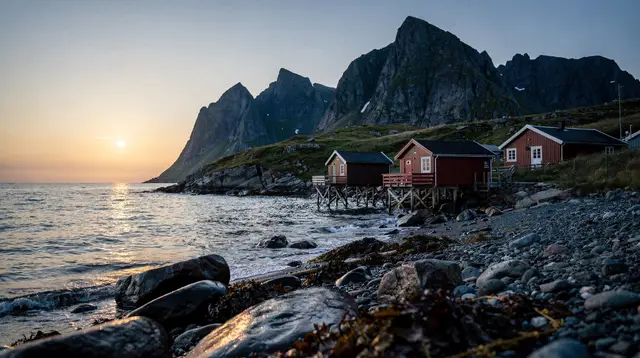
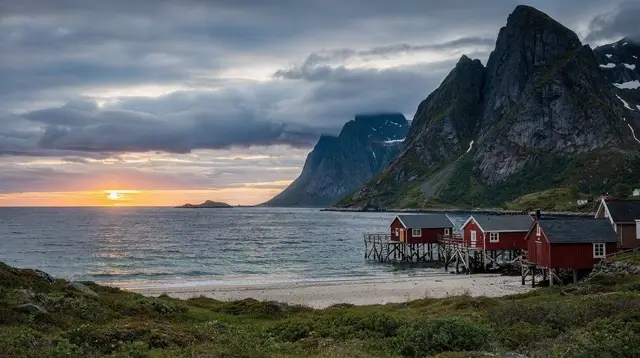
As the hours move past evening and into what would elsewhere be night, the sun doesn’t disappear — it continues its low arc toward the horizon, and somewhere around local midnight, it reaches its lowest point of the day, the closest it gets to actually setting. In this window, the light takes on the quality of an extended golden hour: long shadows, a warm, low-angle glow, colors deepened rather than washed out. Unlike a normal sunset, this “golden hour” doesn’t collapse into darkness after twenty minutes — it can last, in a slowly shifting form, for a couple of hours around the midnight low point, before the sun begins climbing back toward the next day’s peak.
This has a genuinely practical effect on how a day of travel can be structured. A hike that would be cut short by darkness at 9pm in a temperate-latitude summer can instead continue at 11pm in identical daylight. A boat trip that would normally end by early evening can run into what the clock calls “night” while the sky looks like late afternoon. Several operators build itineraries specifically around this, offering later evening departures than would make sense almost anywhere else in the world.
a guided tour timed specifically around the fjord light during the midnight sun glow, departing from Narvik is built entirely around this extended golden-hour effect, and a midnight sun kayaking trip paddling Reinefjord late into the “evening” takes advantage of the same still, glowing light on the water rather than racing a normal sunset. For a slower, drink-and-snacks version of the same late-light window, a midnight magic tour that combines the late-evening glow with food and drinks aboard treats the extended daylight as an occasion in itself rather than just extra shooting time.
The real challenge: sleep
Ask any first-time visitor what surprised them most about the midnight sun, and sleep usually comes up before anything else. The human body relies heavily on light cues — specifically, darkness — to regulate its sleep-wake cycle, and a sky that never dims meaningfully below “bright evening” disrupts that cue directly. Even travelers who feel physically tired at a normal bedtime often report a strange, wired alertness driven by ambient brightness leaking through curtains, or simply the disorienting sense that “it can’t be time for bed, it’s still light out.”
Blackout curtains are close to universal in Lofoten accommodation during the summer months, precisely because local hosts are well aware of this problem — it’s not a niche request, it’s standard seasonal equipment. Even so, curtains alone don’t always fully solve it: light can leak around edges, through gaps, or via skylights in older rorbu-style cabins, so many experienced visitors additionally pack a proper sleep mask as backup, treating it as essential summer gear in Lofoten in the same way that thermal layers are essential gear in winter.
A few other practical adjustments help:
- Keep a consistent bedtime even though your body has no external darkness cue to anchor it — an alarm and a fixed routine substitute for what daylight would normally regulate.
- Limit screens in the hour before sleep, since a bright phone or tablet screen compounds an already bright ambient environment rather than helping you wind down.
- Expect a few adjustment nights. Most travelers report the disruption easing after two or three nights, as the novelty of constant daylight becomes background rather than a distraction.
- Consider melatonin if your sleep is badly affected and you already use it elsewhere; this is a personal health decision rather than something this guide can advise on specifically, but it’s a common strategy travelers mention for this exact scenario.
Planning a day around extended daylight
Because there’s no darkness to force an end to the day, the midnight sun tends to expand what a single day of Lofoten sightseeing can include, provided you pace yourself rather than trying to do everything. A single 24-hour period during this window can realistically include a full daytime hiking or driving itinerary, an evening boat trip that would elsewhere have to end by sunset, and still leave hours of usable golden light afterward for photography around locations like Hamnøy or Reine.
a private photography tour around Hamnøy and Reine is one way to structure exactly that kind of late-light session, timed to take advantage of the extended low-angle glow rather than the harsher light of a normal midday. Our broader photography guide to Lofoten and dedicated guide to photo spots around Reine and Hamnøy go into more detail on how to use this light specifically, including which coastal or beach locations — Haukland among them — face the right direction to catch the low midnight sun over open water.
It’s worth flagging one limit here: local terrain matters. Mountains ringing a village can block the low midnight sun itself from view even while the surrounding sky stays bright, so a west- or north-facing open coastal spot generally gives a clearer view of the sun sitting on or near the horizon than a village tucked between peaks. If seeing the sun itself, not just the bright sky, is a priority, plan your evening location with that in mind.
How this fits into a wider summer visit
The midnight sun overlaps with — but isn’t identical to — Lofoten’s broader summer travel season. Summer in general (roughly June through August) brings the region’s mildest weather, most active tour schedules, and longest days overall, covered in our summer in Lofoten guide and our wider best time to visit overview. The midnight sun window (May 26 to July 17) sits mostly inside that broader summer season but starts a little earlier and ends a little earlier than the summer season as a whole, meaning late July and August visitors get long, bright days without quite reaching the true no-darkness effect described here.
Travelers building a trip specifically around this phenomenon may want our dedicated midnight sun summer itinerary, which times activities and driving days around the extended daylight rather than treating it as background trivia. For a first-person account of what those long days actually feel like on the ground, our blog piece on the night that never comes covers the same territory from a narrative angle, useful background for understanding why summer in Lofoten stays comfortable despite the high latitude.
A quick reference table
| Question | Answer |
|---|---|
| Midnight sun window | Approximately May 26 to July 17 |
| Polar night (opposite extreme) | Approximately December 6 to January 6 |
| Brightest point of the cycle | Around local solar noon |
| Dimmest point of the cycle (still not dark) | Around local midnight, a soft golden-hour glow |
| Main practical challenge | Sleep disruption — solved mainly with blackout curtains and a sleep mask |
| Weather caveat | Conditions can shift within an hour; cloud dims but does not restore darkness |
Whatever your travel style, keep in mind the region’s one universal rule: the sky staying bright doesn’t mean the weather stays calm. A gloriously lit midnight hour can be followed by wind and rain within the same stretch of “day,” so treat extended daylight as an opportunity for flexible timing, not a promise of good conditions — our week-of-weather account is a realistic look at how much a single Lofoten week can actually vary regardless of how much daylight is on offer.
Frequently asked questions about the midnight sun in Lofoten
What are the exact midnight sun dates in Lofoten?
Roughly May 26 to July 17, though the precise start and end dates shift slightly by a day or two depending on exact latitude within the archipelago and atmospheric refraction. Areas further north within Lofoten and into Vesterålen see a marginally longer window than the southern tip near Å.
Does the sun move or just sit still at midnight?
It moves continuously along a low arc near the horizon rather than sitting still; around local midnight it reaches its lowest point in the sky without actually setting, then begins climbing again toward the next “midday” peak. The effect is a slow, all-day wheel of light rather than a fixed sun.
Is it actually bright at 2am during the midnight sun?
Yes, though the quality of light changes: expect a soft, golden, low-angle glow rather than harsh midday brightness, similar in intensity to a late golden hour elsewhere, sustained for hours rather than minutes. It’s bright enough to read outdoors or continue hiking without a headlamp.
How do people sleep during the midnight sun?
Blackout curtains are standard in most Lofoten accommodation during summer, and many travelers additionally pack a sleep mask, since even blackout curtains sometimes leave light around the edges. Keeping a consistent bedtime and limiting late-night screen exposure to bright light both help the adjustment.
Is midnight sun the same everywhere in Norway?
No — the exact window depends on latitude, so Lofoten’s dates differ from Tromsø’s, the North Cape’s, or southern Norway (which doesn’t experience true midnight sun at all, only long summer daylight with a brief true sunset). Lofoten’s roughly 68 degrees north puts it solidly within the phenomenon but with a shorter window than areas further north.
Can I see the midnight sun from anywhere in Lofoten, or do I need a specific spot?
The sun stays above the horizon everywhere in the archipelago during the window, but local mountains and terrain can block the direct view of the low midnight sun itself from certain villages; open west- or north-facing coastal spots generally offer the clearest unobstructed view of the sun sitting low over the horizon or sea.
Does the midnight sun affect wildlife and activity schedules?
Yes — many boat tours, hikes, and kayaking trips run later into the evening than would make sense elsewhere, since full daylight remains available at hours that would otherwise be pitch dark. Some operators specifically market late-evening or “midnight” departures during this window, taking advantage of extended, no-rush daylight rather than racing a sunset.
Midnight sun experiences on GetYourGuide
Verified deep-linked GetYourGuide tours. Book through these links and we earn a small commission at no cost to you.
Photos show the destination, not the operator's own images.