Six Days Under the Midnight Sun in Lofoten
Sleeping Badly on Purpose
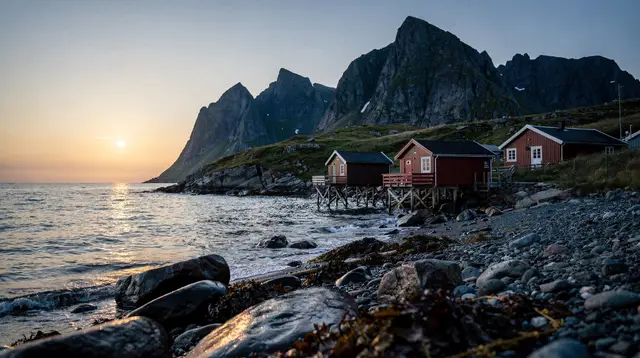
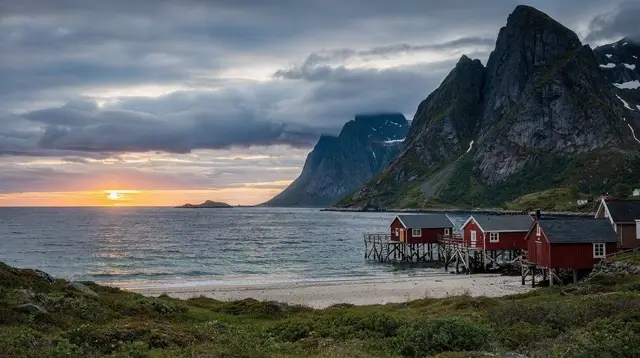
This itinerary is built around one specific fact: between roughly May 26 and July 17, the sun in Lofoten doesn’t set. That’s not a marketing line — it changes how a day actually works. Light at 2am looks the same as light at 2pm, which means the usual rhythm of “do things during the day, sleep at night” stops applying in any strict sense. Six days here means choosing, more than once, whether to sleep on a normal schedule or stay out for the kind of golden, low-angle light that in most places only lasts a few minutes at sunset.
The route below moves from Svolvær at the eastern end of the archipelago down to Reine and Kvalvika Beach on Moskenesøya, with a car needed throughout — public transport doesn’t cover this ground on a schedule flexible enough for midnight-sun spontaneity. Expect mid-range costs across the trip, roughly 3,190 NOK per person per day as a working baseline, more if you lean toward guided tours and less if you self-cater.
What This Season Trades Away
Midnight sun comes with real trade-offs worth knowing before committing to this exact window. There’s no chance of aurora at any point across these six days — the sky never gets properly dark between late May and mid-July, which rules out the region’s other headline attraction entirely. Travelers who want both experiences need a different trip in a different season, not this one. Accommodation in Reine and along Vestvågøya also runs at its most expensive and least available during these same weeks, since this is when most visitors come, and rooms booked at the last minute are far less likely to be available at any price.
The upside is the flexibility itself: with usable light at every hour, a delayed ferry, a cancelled boat trip, or a hike pushed back a few hours by rain costs far less than it would in a season with only a handful of daylight hours to work with. Weather here can still shift within an hour regardless of season, but a midnight-sun trip absorbs that unpredictability better than almost any other time of year, simply because there’s no darkness closing off the rest of the day.
Day 1: Arrive in Svolvær
Start in Svolvær, the archipelago’s main town and, for most itineraries, the natural place to land whether you’re arriving by air or after the Bodø ferry. Use the afternoon to get oriented — the harbor, the view up toward Svolværgeita, and a first sense of how the light behaves this far north in summer. Resist the urge to overplan the evening; part of the point of a midnight-sun trip is discovering how strange and useful the extra hours feel once you’re actually here.
If you want an early anchor for the trip, a guided evening out on the water works well on day one, before you’ve settled into your own rhythm. A Svolvær-based evening tour won’t show you aurora this time of year — the sky’s too bright for that — but similar boat-based evening trips are a good way to see the coastline in the long, soft light unique to this season.
Svolvær is reachable by air directly, or by the Bodø–Moskenes ferry route if you’re arriving that way instead and looping back east afterward; either way, plan for at least a half-day of travel before the itinerary itself begins, since this is a genuine arctic archipelago rather than a quick hop from a major hub.
Day 2: West to Haukland Beach
Leave Svolvær and head west along the E10 toward Vestvågøya, with Haukland Beach as the day’s destination. This is one of the archipelago’s better-known stretches of white sand backed by steep peaks, and in the long light of a midnight-sun evening it’s worth timing your arrival for later in the day rather than the middle of it — the crowds thin and the light improves as the hours stretch on into what would, anywhere else, already be night.
Base yourself somewhere on Vestvågøya for the night so you’re not driving back and forth across the archipelago more than necessary. If you have energy left after the beach, the drive itself between Svolvær and Haukland passes enough scenery to justify a slow pace rather than a direct transit. The route covers most of the length of Austvågøya before continuing onto Vestvågøya, crossing the bridges and tunnels that link the islands along the E10 — treat it as a half-day of driving with stops rather than a quick transfer, since this stretch of road is part of what the day is for, not just a way to get to the beach.
Day 3: Uttakleiv Beach and the Long Evening
Uttakleiv Beach sits close enough to Haukland that the two are often visited together, but each has its own character — Uttakleiv’s rock formations and more exposed westward orientation make it a strong choice for an evening spent watching the sun stay stubbornly above the horizon. This is the day to lean fully into the midnight-sun schedule: eat dinner late, walk the beach as the light turns gold, and don’t feel obligated to be back at your accommodation at any particular hour.
Because Haukland and Uttakleiv sit on the same short stretch of coast, many travelers treat day two and day three as one extended stay in the same base rather than moving accommodation in between — worth arranging in advance given how quickly rooms on Vestvågøya fill during the midnight-sun weeks.
If kayaking appeals more than another beach walk, this stretch of coast has options too — a guided sea kayaking outing from Ballstad is a reasonable variation if you want to be on the water rather than just beside it.
Day 4: South to Reine
From Vestvågøya, the drive continues south through Flakstadøya toward Reine, on Moskenesøya. This is a longer driving day than the previous two, and it’s worth treating the drive itself as part of the plan rather than a gap between destinations — the road through this stretch of the archipelago is one of the more photographed sections of the E10 for good reason.
The route south from Vestvågøya into Flakstadøya and on to Moskenesøya is the longest continuous drive of the trip, and it’s also where the E10 crosses some of its more dramatic bridges and tunnels between islands — a stretch that rewards not rushing, even with a mid-range budget in mind and Reine still an hour or more away depending on stops.
Settle into Reine for the next two nights; it’s centrally placed for the rest of the itinerary and has more infrastructure than the smaller villages further along. In the evening, a guided kayak tour on Reinefjord makes good use of the extended daylight, putting you on the water at an hour that would be unthinkably late anywhere without a midnight sun.
Day 5: The Hike to Kvalvika Beach
Kvalvika Beach is reachable only on foot, via the trailhead near Fredvang, and it’s the most physically demanding day of this itinerary. Budget real time for the walk in both directions, wear proper footwear, and check conditions before setting out — this is a genuine hike, not a beach stroll, and the region’s core rule that weather can shift within an hour applies here as much as anywhere.
Kvalvika sits on Flakstadøya rather than Moskenesøya itself, reached from the trailhead near Fredvang rather than from Reine directly, which means factoring a short drive back north into the day before the hike even starts. The beach has no facilities of any kind, in keeping with its no-road-access character, so food, water, and any extra layers have to come from wherever you’re staying in Reine — with the summit of Ryten rising above the beach for those with energy left for more climbing after the descent down.
The payoff is a beach with no road access and a setting that feels considerably more remote than anywhere else on this itinerary. With the long summer light, there’s no pressure to rush back down before evening — many visitors linger well past what would normally be sunset. Back in Reine that night, keep things simple; day five tends to be tiring even with the extra daylight to work with.
Day 6: Wind Down Around Reine and Hamnøy
Use the final day to slow down rather than add another major destination. Hamnøy, just up the road from Reine, is worth a slower morning visit if you haven’t already stopped there, and it’s a good place to let the trip’s pace ease off before travel logistics take over. If you’re departing via the ferry, double-check your Bodø–Moskenes ferry booking the day before rather than the morning of. For travelers departing this way rather than by air, the crossing to Bodø takes roughly three to four hours, and the Saltstraumen tidal strait sits some twenty minutes from Bodø on the other side — worth a stop if there’s time before a flight out, though not something to add on top of an already tiring departure day.
If you have any remaining appetite for one more outing before heading home, a shorter option like a Reinefjord kayaking trip out of Hamnøy fits well into a lighter final day without the commitment of day five’s full hike.
How the Six Days Fit Together
| Day | Base | Focus |
|---|---|---|
| 1 | Svolvær | Arrival, orientation, first taste of the long light |
| 2 | Vestvågøya | Haukland Beach |
| 3 | Vestvågøya | Uttakleiv Beach, late evening light |
| 4 | Reine | Drive south, settle in |
| 5 | Reine | Hike to Kvalvika Beach |
| 6 | Reine/Hamnøy | Slow morning, departure logistics |
This pacing assumes a car throughout and a mid-range budget, with room to adjust — swap a hiking day for more beach time, or add an extra night around Reine if the walk to Kvalvika leaves you wanting to stay put the next day. For the broader seasonal picture behind why this itinerary is built the way it is, see our guide to midnight sun in Lofoten and the wider rundown of Lofoten’s best beaches.
A Few Practical Notes
Getting around this route requires a rental car; see getting around Lofoten for the general picture of road conditions and driving distances between islands. Because this itinerary runs during the busier summer season, book accommodation in Reine and on Vestvågøya well ahead — rooms fill up faster in the midnight-sun window than in shoulder seasons. And because the sun genuinely doesn’t set, pack an eye mask if you think you’ll want to sleep on anything resembling a normal schedule; hotel curtains in this region don’t always block out the light as well as you’d expect.
Packing for a Trip Where It Never Gets Dark
An eye mask matters more here than almost anything else on a packing list, since curtains in guesthouses and rorbuer across the region aren’t always built to block out light that never actually disappears. Layers matter just as much as in any other season — daytime temperatures in summer typically sit in the 12 to 17°C range, comfortable for walking but not warm enough to leave a windproof layer at home, especially on exposed stretches like Kvalvika and the beaches on Vestvågøya. A single rain shell earns its space in the bag regardless of the forecast on any given morning, since conditions here can shift within an hour, turning a clear start into a wet afternoon with no real warning.
Frequently Asked Questions About This Itinerary
Do I need to stay up all night to experience the midnight sun?
No — the point is that you can choose to, not that you have to. Even keeping a fairly normal sleep schedule, you’ll notice the constant daylight throughout each day of this itinerary.
Is six days enough time for this route?
Yes, for the five destinations covered here at a comfortable pace, including one demanding hiking day. Adding Henningsvær or the Trollfjord would stretch this into a longer trip.
Do I need hiking experience for the Kvalvika Beach day?
Basic fitness and proper footwear are enough for most travelers, but treat it as a real hike — there’s no road access, and the trail crosses genuinely exposed, changeable terrain.
Is a car essential for this itinerary?
Yes. The distances between Svolvær, the Vestvågøya beaches and Reine, combined with the flexible midnight-sun schedule this itinerary assumes, aren’t practical without your own vehicle.
What budget should I plan for six days?
A mid-range daily budget of roughly 3,190 NOK per person is a reasonable working baseline, adjusted up or down depending on how many guided activities and how much dining out you add.
Midnight sun experiences on GetYourGuide
Verified deep-linked GetYourGuide tours. Book through these links and we earn a small commission at no cost to you.
Photos show the destination, not the operator's own images.