Trying to Sleep Under a Sun That Refuses to Set
Two in the Morning, and the Light Hasn’t Moved
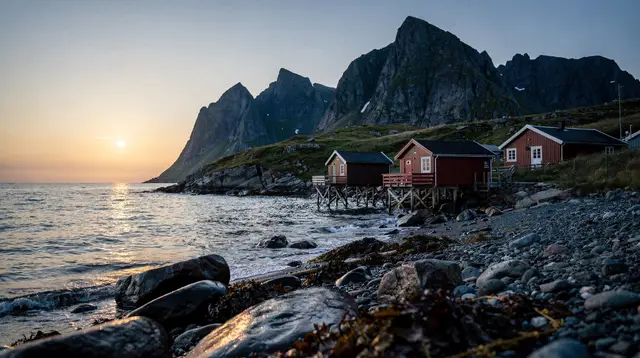
I checked my phone out of habit on the second night, half expecting it to be broken. 01:47, and the sky outside the window in Svolvær looked exactly like it had at nine in the evening — the same flat, pale gold light sitting low over the water, the same long shadows off the harbour cranes. Nothing had changed except the number on the screen. That was the moment the trip actually started to feel strange, in a way that no amount of reading the midnight sun guide beforehand had prepared me for.
I knew the fact going in: from roughly 26 May to 17 July, the sun in Lofoten does not go below the horizon at all. I had filed that under interesting trivia, the kind of thing you mention to friends before a trip. What I had not filed away was what it does to a body that has spent thirty-odd years associating darkness with sleep and light with being awake. Knowing a fact and living inside it turned out to be two entirely different things.
What the Body Does With a Sun That Won’t Set
By the third day I had stopped fighting it and started paying attention instead. Meals drifted later without anyone deciding they should. A walk that was meant to be a quick after-dinner stretch turned into two hours along the coast near Eggum, because there was no darkening sky to signal that it was time to turn back. Conversations in the rorbu kitchen ran past midnight more than once, not because anyone was trying to stay up, but because nothing in the environment was telling us to stop.
The tiredness, when it came, arrived on its own schedule rather than the sky’s. I would suddenly feel it hit mid-afternoon, or find myself wide awake at an hour that should have been the deep middle of the night. It is a strange kind of disorientation — not unpleasant, exactly, but a genuine scrambling of the internal cues most of us don’t realise we rely on until they’re gone. The Gulf Stream keeps the air here mild rather than harsh, twelve to seventeen degrees through summer, so it was never physically uncomfortable to be outside at any hour. That, if anything, made it worse for sleep: nothing about stepping outside at 2am felt like it should be avoided.
Sleeping Wrong, on Purpose
I had packed an eye mask on a friend’s advice and used it every night, pulling curtains that did not quite meet in the middle across a window that let a thin blade of light through regardless. It helped, but only partly — you can block the light from your eyes and still feel, somehow, that the day outside has not actually ended. A few nights I gave up on the mask entirely and just let myself wake at odd hours, reading for forty minutes at what my phone insisted was three in the morning, then falling back asleep as if it were a normal midday nap.
What surprised me most was how quickly this stopped feeling like a problem to solve and started feeling like the actual shape of the place. Locals I spoke to in Kabelvåg treated the whole thing with a shrug — summer here means less sleep and everyone just accepts it, the way people elsewhere accept jet lag as a cost of a trip rather than something to eliminate. It is one of several things a summer in Lofoten guide can warn you about but never quite prepare you for.
Reading the Day by the Tide, Not the Clock
Somewhere around day five I noticed I had stopped checking the time before deciding whether to do something. The question was never “is it too late,” because there was no late. One evening — or what would have been evening anywhere else — I went out on a boat trip watching for sea eagles along the coast, and the light on the water at what the clock called ten p.m. looked identical to late afternoon. Another day, a friend booked a snorkeling excursion out to see grey seals in the middle of what would have been a normal working afternoon back home, and it felt exactly as ordinary as if we’d gone at eleven in the morning.
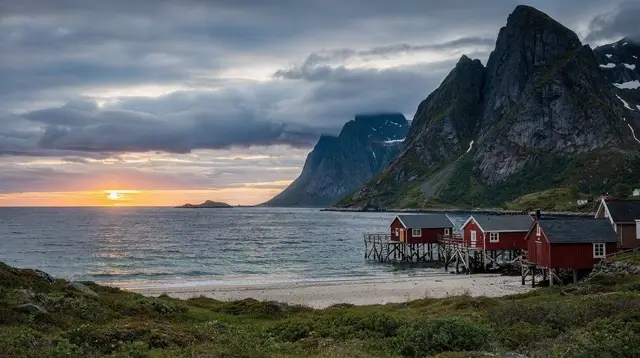
The strangest of these was a evening boat trip that leaned fully into the whole thing rather than working around it: an evening cruise timed around the midnight sun itself, with food and drinks on board, sailing out at an hour that exists, on paper, deep in the night. Sitting on deck under a sky that looked like six in the evening while the boat’s clock read half past eleven is as close as I’ve come to feeling time genuinely stop meaning anything. Anyone building a trip around this particular strangeness should look at the midnight sun and photography itinerary rather than trying to improvise it.
What Would Have Happened in Winter
I thought, more than once that week, about the opposite season — the polar night, running roughly from 6 December to 6 January, when the sun doesn’t clear the horizon at all and the whole day sits in a dim blue half-light. That’s when a trip here would be built around a guided evening chasing the northern lights instead, the exact inverse problem: too much night rather than none at all. I hadn’t planned to think about winter in Lofoten while sweating slightly under a duvet at three in the morning in June, but the two seasons kept bumping into each other in my head, each one making the other seem more extreme by comparison. A read through the guide to Lofoten’s weather afterward made it clearer why the two extremes exist at all.
Coming Home to Darkness
Landing back south a week later, the first properly dark evening felt almost aggressive — streetlights coming on, my body suddenly remembering that darkness is supposed to mean something. It took two or three nights to fully readjust, longer than I expected for something as simple as a sky doing what skies normally do. I don’t think I slept well, by any ordinary measure, for the entire week in Lofoten. I also don’t think I’d trade it. If you’re weighing when to go at all, the guide to the best time to visit lays out the trade-offs plainly; nothing in it, though, quite captures what it feels like at 01:47 with the sky still doing its nine p.m. impression.
There is something genuinely disorienting, in a good way, about a place that quietly refuses to let the day end — and about realising how much of what I thought was a fixed law of the body was really just a habit, waiting for a sky that never went dark to prove it wrong.
Midnight sun experiences on GetYourGuide
Verified deep-linked GetYourGuide tours. Book through these links and we earn a small commission at no cost to you.
Photos show the destination, not the operator's own images.