Lofoten Weather: Why It Changes Fast and How to Plan Anyway
How does the weather affect a Lofoten trip?
Lofoten's weather can swing from clear sky to wind and rain within an hour, in any season, because the islands sit exposed in the open Norwegian Sea. The Gulf Stream keeps temperatures mild for the latitude, but it does not make conditions predictable. Plans built with a backup for every outdoor block hold up far better than plans built around a single forecast.
The Forecast Is a Suggestion, Not a Schedule
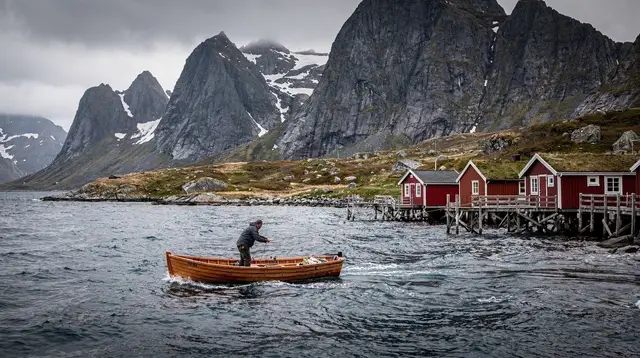
Anyone who has spent a week in Lofoten learns the same lesson: the weather here does not hold still long enough to plan around. A morning that opens grey and still can turn to a stiff onshore wind by ten. An afternoon written off as a washout can clear into flat calm water an hour before dinner. This is not bad luck or an unusually rough year — it is the ordinary behaviour of a narrow chain of mountains sitting exposed in the open Norwegian Sea, at roughly 68 degrees north, with nothing upwind to slow down whatever system is moving through.
The practical consequence is simple, and it should shape every day of a Lofoten itinerary: build slack into the plan rather than betting a day on a single outdoor block. That habit matters more here than the exact temperature or the exact season, and it applies whether you are chasing a hike near Reinebringen, a boat out of Svolvær, or simply trying to get a decent photograph of Hamnøy before the light shifts again.
Why the Islands Behave Like This
Lofoten sits fully exposed to the Norwegian Sea, with the archipelago acting as the first obstacle any weather system meets after crossing open water. There is no buffering coastline, no large landmass to break up incoming fronts, and the terrain itself — steep granite peaks rising straight from the water — forces air to rise, cool, and drop its moisture quickly. That is why a squall can arrive from a clear horizon with almost no warning, and why the same squall can pass just as fast.
The Gulf Stream complicates the picture rather than simplifying it. It keeps the sea, and therefore the air above it, milder than the latitude would suggest: winter temperatures generally sit around 0 to minus 3 degrees Celsius rather than deep Arctic cold, and summer temperatures run a mild 12 to 17 degrees. That is a genuine gift for a destination this far north — but it does nothing to calm the wind or reduce the moisture in the air. Mild and stable are two different things, and Lofoten only ever offers the first.
There is also a local wrinkle worth knowing: conditions on the eastern, sheltered side of the islands facing the mainland can differ noticeably from conditions on the exposed western coast on the same afternoon. A stretch of coastline open to the Norwegian Sea can be catching the full force of an incoming front while a fjord-side village a short drive away sits in relative calm. This is one reason locals rarely trust a single forecast for the whole archipelago — the practical habit is to think in terms of which side of the island you are on, not just what day it is.
A Season-by-Season Read
None of the four seasons here offers a stretch of guaranteed calm, but each has its own character, and each calls for a different kind of readiness.
Winter (roughly December through March)
This is the season of the polar night, running approximately from 6 December to 6 January, when the sun does not clear the horizon at all and daylight arrives only as a dim blue glow around midday. Snow settles on the peaks and often at sea level too, temperatures hover close to freezing, and wind chill does more to the felt temperature than the thermometer does. It is also the best window for the northern lights, because long dark nights give the aurora room to show — provided the sky actually clears, which is never guaranteed on any given evening. A half-day snowshoe outing works well in this season precisely because it can be timed around a clear window rather than committed to hours in advance.
a half-day snowshoe outing into the winter landscape is one of the few activities that stays enjoyable even when the wind picks up, since the effort of walking keeps you warm and the route can be shortened on the spot.
Spring shoulder (April into May)
Snow lingers on the higher ground while lower elevations green up, and daylight lengthens fast as the archipelago heads toward the midnight sun. Weather stays genuinely mixed — this is not yet a settled season, and layering matters as much here as in deep winter.
Summer (roughly June through August)
Midnight sun runs approximately from 26 May to 17 July, and even outside that exact window, daylight in June, July, and August is long enough that a rained-out morning rarely costs you the day. This is the mildest stretch of the year and the one most visitors choose, but it is not a calm one: wind off the sea remains a constant, and a forecast of sun by no means rules out a squall passing through by afternoon. A sea eagle cruise out toward the fjords is a good example of an activity built around this reality — routes and timing flex with the day’s conditions rather than a fixed schedule.
a sunset cruise watching for sea eagles along the coast tends to run in whichever window of calmer water the day actually offers, which is often not the window forecast twenty-four hours out.
Autumn shoulder (September into November)
Days shorten quickly and the first snow can appear on the peaks well before it reaches the villages. This is also when the aurora season begins in earnest, running from around September into early April, though it demands the same combination every year: a dark sky and a clear one, together, which is exactly the combination Lofoten weather makes no promises about.
Reading the Sky Instead of the App
After a few days here, most visitors pick up a version of what locals already do without thinking about it: watching the sky directly rather than trusting a screen. A band of cloud sitting low over the water to the west, rather than high and thin, usually means whatever it is carrying will arrive within the hour rather than pass by. Wind direction matters as much as wind speed — a wind coming off the open sea tends to bring moisture with it, while a wind coming off the mountains behind a village is often drier even at the same strength. None of this replaces a forecast entirely, but it explains why a fisherman or a boat guide will often glance at the horizon and adjust plans before a phone alert ever catches up.
Building a Day Around Uncertain Weather
The single most useful trip-planning habit here is sequencing outdoor plans so that a change in conditions costs you an activity, not the day. Mornings and afternoons often behave differently rather than the day simply being “good” or “bad”: a still, clear start can build into an afternoon breeze as the day warms, or a grey morning can burn off into a clear afternoon once cloud lifts off the peaks. Scheduling the activity most dependent on calm water or clear sky earlier in the day, and holding the more flexible options — a museum, a drive, a slower walk — for whichever slot the weather actually leaves open, tends to work better than committing everything to a morning or an afternoon in advance.
A boat trip toward Trollfjord, a walk near Kvalvika beach, or time on Haukland beach can each be swapped for an indoor alternative — a visit to the Lofotr Viking Museum at Borg, a look at stockfish drying racks, or simply a slower morning in Kabelvåg — without unravelling the rest of the schedule.
A rough guide to how weather interacts with the main categories of activity:
| Activity type | How weather affects it | Typical flexibility |
|---|---|---|
| Boat trips and cruises | Wind and sea state matter more than rain | Often rescheduled same-day by the operator |
| Hiking (including Reinebringen) | Wind exposure and visibility on ridgelines | Route can be shortened or postponed |
| Photography | Light and cloud change the result more than comfort | Best kept loosely timed, not fixed |
| Northern lights | Needs dark sky plus clear sky together | Chased by car to find a gap in cloud |
| Museums and indoor culture | Largely unaffected | Reliable backup for any weather |
| Kayaking | Wind and sea state, similar to boat trips | Guides adjust route on the day |
A guided sea kayaking route out of Ballstad is a good illustration of this: guides read the wind that morning and choose a sheltered stretch of water rather than forcing a fixed route regardless of conditions.
Photography and the Weather Problem
Anyone travelling for photographs — around Hamnøy and Reine especially — faces a particular version of this uncertainty: the best light is often the light right after a change, when cloud is breaking up or a squall has just cleared through. A rigid schedule built around “the golden hour at X o’clock” tends to disappoint here, while a looser plan that watches the sky and moves when it shifts tends to reward patience.
a private photography outing around Hamnøy and Reine benefits from exactly this kind of flexibility, since a guide familiar with the villages can reposition around whatever the sky is doing that afternoon rather than sticking to a script.
Fishing and the Sea State
Fishing is one of the oldest activities in the islands, tied historically to the skrei season from January to April, and it remains one of the most weather-sensitive on the water. Wind and swell determine where a boat can safely go far more than temperature does.
a guided fishing trip on the water is planned by the skipper around the day’s sea state, with sheltered fjord routes available when open water is too rough to fish comfortably.
What to Pack for Four Seasons in an Afternoon
Because a single day can move through several kinds of weather, packing here follows a different logic than packing for a destination with a fixed climate. Layers that can be added or shed quickly matter more than any one heavy item, and a genuinely waterproof and windproof outer shell earns its place in every season, not just winter. Solid, broken-in footwear that copes with wet ground matters whether the plan is a coastal walk near Uttakleiv or a stroll through Å i Lofoten.
A simple three-part system covers most of what changeable weather asks for: a moisture-wicking base layer that does not stay damp against the skin, an insulating mid layer that can come off the moment you warm up on a climb or a fast walk, and a shell layer that blocks wind and rain without needing to be waterproof and warm at the same time. Gloves and a hat earn their weight even in summer, since wind chill on an exposed boat deck or a ridge line can make a mild day feel considerably colder than the number on a forecast suggests. A fuller packing checklist sits in the Lofoten packing guide, organised by season.
Getting Around When Plans Shift
Because outdoor plans here often change on short notice, having your own transport gives a kind of flexibility that a fixed bus timetable does not. If a hike near the coast is blown out by wind, being able to drive twenty minutes to a more sheltered stretch of the E10 and try something else salvages the morning rather than losing it. Details on renting and driving the E10 sit in a separate guide, and the question of which town to base yourself in — weighed partly against how weather affects day trips from each — is worth working through before the trip rather than during it.
Common Questions About Lofoten’s Weather
Is Lofoten weather really that unpredictable?
Yes. The islands are a narrow strip of exposed rock and mountain in the open sea, with no landmass upwind to soften incoming systems. A clear morning can turn to horizontal rain by early afternoon, and the reverse happens just as often.
What is the best month for stable weather in Lofoten?
No month is stable in the sense of a guaranteed run of clear days. July and August tend to have the mildest temperatures and the longest stretches of usable weather, but rain and wind can still arrive without much warning.
Does the Gulf Stream mean Lofoten has a mild climate?
It moderates temperature, not conditions. Winters rarely drop far below freezing and summers rarely feel hot, but wind, cloud, and precipitation remain part of nearly every week of the year.
Should I check the forecast before booking a boat trip or hike?
Check it, but treat it as a same-day tool rather than something to plan a whole trip around. Forecasts beyond 48 hours change often; operators and guides watch conditions far more closely than any app.
What should I pack for changeable weather?
Layers that can go on and come off quickly, a proper waterproof shell, and wind protection matter more than any single heavy coat. Warm layers count for less than a windproof, waterproof outer layer here.
Do northern lights tours get cancelled for weather?
Aurora sightings need a dark, clear sky, so cloud cover is the main obstacle rather than cold. Guided chases move location by car precisely because clear patches often exist not far from where the cloud sits.
Is winter or summer weather more disruptive to plans?
Winter brings more wind, snow, and short daylight windows that compress what a day can include. Summer’s midnight sun offsets some of that by giving flexible light at almost any hour, even when a morning is written off by rain.
Food & drink tours in the Lofoten Islands on GetYourGuide
Verified deep-linked GetYourGuide tours. Book through these links and we earn a small commission at no cost to you.
Photos show the destination, not the operator's own images.