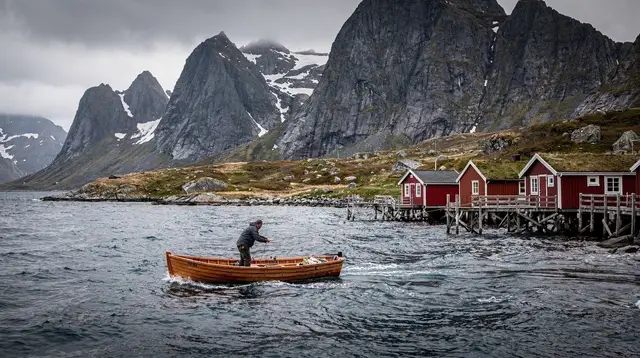
Stockfish and Skrei: The Economy That Built Lofoten
What is the connection between skrei and stockfish in Lofoten?
Skrei is the Arctic cod that migrates to Lofoten's waters to spawn between January and April. Stockfish is what that cod becomes once it's split and hung to air-dry on wooden racks called hjell — a preservation method that has supported the islands' fishing economy and export trade for centuries.
Two Words, One Economy
Skrei and stockfish are two ends of a single process, and understanding the difference clears up most of the confusion visitors have about what they’re actually looking at in a Lofoten fishing village. Skrei is the fish itself: mature Arctic cod that leaves the Barents Sea each winter and migrates south to spawn in the waters around these islands, arriving roughly between January and April. Stockfish is what happens to that cod afterward — split, cleaned, and hung to dry in open air, without salt, until it has lost most of its moisture and become something that keeps for years rather than days.
Everything else in this guide — the racks on the hillsides, the shape of the harbors, the layout of villages like Å i Lofoten — traces back to this single seasonal cycle repeated over centuries.
Why Cod Comes Here at All
The skrei migration isn’t random. Arctic cod spawn in specific waters, and the seas around Lofoten happen to sit at the right point for that cycle, which is the entire reason these islands built an economy around a single winter fishing season rather than year-round fishing. For a few months each year, the waters around villages like Ballstad and Stamsund fill with more fish, and more fishing activity, than the rest of the year combined.
That seasonal intensity shaped everything downstream of the catch: how quickly fish needed to be processed, why drying rather than salting became the dominant preservation method in a climate suited to it, and why villages built their entire physical layout — boathouses close to the water, racks on any available open ground — around handling a short, intense rush of fish rather than a steady trickle.
The climate itself is the other half of why this particular process took hold here rather than elsewhere. The Gulf Stream keeps winters milder than the latitude would suggest — typically somewhere around 0 to −3°C — cold enough to prevent spoilage during the drying process, but not so cold that the air itself became unworkable for months-long open-air exposure. That narrow climatic window, combined with steady coastal wind, is a large part of why air-drying rather than salting became the dominant method here specifically, in a way that wouldn’t necessarily transfer to a different, less consistently cool and dry coastline.
A Fishery Shaped by the Weather
None of this history unfolded on a predictable schedule. Lofoten’s weather can change within the hour, and that unpredictability shaped the skrei fishery as much as the migration itself did — boats went out when conditions allowed rather than on a fixed timetable, and the open, exposed waters around these islands, including the Moskstraumen maelström at the archipelago’s southern tip, added real risk to a season that fishermen nonetheless returned to year after year because the catch was worth it. The same volatility that makes a modern hiking plan provisional made the historic fishing season provisional too, just with higher stakes.
This fishing economy also sits alongside, rather than layered onto, the Sámi culture present in the wider Nordland region — a distinct tradition built around reindeer herding rather than cod, coexisting in the same general area without being the same story. Worth knowing if you’re trying to keep the region’s different cultural threads separate rather than blending them into one generic “Arctic heritage” narrative.
The Hjell: Drying Without Salt
The racks used to dry stockfish, known as hjell, are simple wooden frames, but the process they support is not casual. Split cod is hung over these frames in the open air, exposed to the cold, relatively dry arctic wind rather than direct sun, and left for an extended period — long enough that the fish loses the bulk of its water content and becomes stable at room temperature without any salt at all. That distinction matters: this is an air-drying tradition, not a salting one, and it’s part of why Lofoten’s version of the product developed its own reputation separate from salted preservation methods used elsewhere.
You’ll see hjell racks near working harbors throughout the archipelago, most visibly during and immediately after the skrei season when they’re in active use. Outside that window, many stand empty, but the structures themselves remain a fixture of the coastal landscape whether or not fish are currently hanging on them.
Rorbuer: Housing Built Around the Fishery
The red fishermen’s cabins on stilts that now serve as much of Lofoten’s tourist accommodation — rorbuer — originated as functional seasonal housing for fishermen who came from elsewhere in Norway to work the skrei season. Their position, built out over the water on pilings, wasn’t an aesthetic choice; it kept living quarters close to boats and processing areas during a season when time mattered more than comfort. Their conversion into guest accommodation is a relatively recent development layered onto buildings whose original purpose was entirely functional.
Staying in a rorbu today, particularly in a village with a working harbor, puts you inside the same physical arrangement that once housed seasonal fishing crews — worth knowing if you want more context than “traditional red cabin” while you’re there. Our broader guide to fishing villages covers where this heritage is most visible on the ground, and our rorbu guide goes further into the practical side of booking and staying in one.
It’s worth remembering, too, that a rorbu’s charm today comes precisely from function it was never designed to disguise — the pilings, the proximity to the water, the simple timber construction were all practical choices for people working a demanding season, not aesthetic ones made with a future guest in mind. That’s arguably why the buildings have aged into something visitors find appealing: nothing about them was built to impress, which is a different kind of durability than architecture designed to be looked at.
Visiting in Season Versus Out of Season
| January–April (skrei season) | Rest of the year | |
|---|---|---|
| Hjell racks | Actively hung with fish, visibly full | Empty structures, still visible as landmarks |
| Harbor activity | Busiest, boats and processing visible | Quieter, focused on other village activity |
| Daylight | Short, overlapping the tail end of the polar night | Longer for much of the rest of the year, including the midnight sun months |
| What you’re seeing | The process itself, active | The infrastructure the process left behind |
Neither window is a wrong time to learn this history — it’s simply the difference between seeing a still-active tradition and seeing its physical evidence. Visitors specifically drawn to the working side of the fishery should lean toward the January-to-April window; anyone visiting primarily for hiking, beaches, or the midnight sun will still encounter the same racks and harbors, just without fish currently hanging on them. Either way, the structures themselves are the constant — what changes with the season is simply whether they’re doing the job they were built for at that particular moment.
Villages Where the History Is Still Legible
Some Lofoten villages preserve this economy more visibly than others. Nusfjord, on Flakstadøya, is maintained specifically as a preserved fishing village, with an entry fee reflecting its status as something closer to a living heritage site than an ordinary working harbor. Further south, Å i Lofoten sits at the literal end of the E10 and centers its fishing-village museum directly around this same drying and export history. Both are worth treating as complementary rather than duplicate stops if you have time for more than one.
For culture that predates the stockfish trade specifically, the Lofotr Viking Museum at Borg covers an earlier chapter of how these islands were settled and used, though it’s a distinct historical thread from the medieval-to-modern stockfish trade this guide focuses on. Treating the two as separate stops on the same trip — one covering the fishery, one covering an earlier period of settlement — gives a fuller sense of the archipelago’s history than either visited alone.
What the Trade Left Behind
| Physical trace | Where to look |
|---|---|
| Drying racks (hjell) | Near working harbors, most active Jan–Apr |
| Rorbuer cabins | Villages throughout the archipelago, now largely converted to lodging |
| Fishing village museums | Å i Lofoten, and preserved sites like Nusfjord |
| Harbor layout | Tightly built waterfront in older villages, e.g. Ballstad, Stamsund |
A Trade Still Worth Understanding on the Ground
None of this history requires a formal museum visit to notice — walking the harbor in almost any older Lofoten fishing village, the arrangement of boathouses, racks and cabins tells much of the story on its own, once you know what you’re looking at. A guided walking tour through a working harbor, particularly one built around a historic fishing settlement, adds context that’s easy to miss on a self-guided visit, especially around what specific buildings were originally used for.
In Svolvær, the old Svinøya harbor district is where this is easiest to do with a guide rather than alone: a historic fishing-village storytelling tour of Svinøya walks through exactly the kind of boathouse-and-rack layout described above, with someone on hand to explain what each structure actually did. In Henningsvær, a village whose entire layout is shaped by the same fishery, a guided walking tour led by a local guide covers similar ground on a different island.
Further north, near Andenes, a guided walking tour that includes a photo session pairs the same kind of harbor history with time to actually photograph the racks and cabins properly, rather than rushing past them.
Seeing It for Yourself
If you’d rather explore independently, Nusfjord, Å i Lofoten, and the harbor at Ballstad or Stamsund all reward slow walking over a scheduled tour. None of these stops need a full day on their own — an hour or two is usually enough to take in the hjell racks, the rorbuer, and the general shape of a working harbor — which makes it realistic to combine two or three of them with other stops on the same day, particularly if you’re already covering fishing villages as a theme for that part of a trip. A rental car makes stringing several of these harbors together in one day considerably easier than relying on limited public transport between them; see getting around Lofoten for the wider picture.
What This History Isn’t
It’s worth being clear about what this economy didn’t produce, since the far-north setting sometimes invites the wrong associations. This is a fishing and drying tradition, not a glacier landscape, and there are no polar bears anywhere near these harbors — nor any conifer forest supplying timber of the kind you’d associate with more forested parts of Scandinavia; Lofoten’s vegetation runs to stunted birch. This isn’t Svalbard, and despite the Arctic latitude, it isn’t Iceland or Finnish Lapland either. The stockfish trade is a genuinely local story, built around a specific cod migration and a coastline suited to air-drying rather than salting — not a borrowed version of some other Arctic economy.
Practical notes
Norway’s currency is the krone (NOK), and card payment is accepted almost everywhere, including at small village shops near these harbors. Norway sits inside the Schengen area but outside the EU, uses European C and F power sockets at 230V/50Hz, and tap water is safe to drink throughout the country. The general emergency number is 112, and service is included in prices — tipping isn’t expected. Lofoten runs expensive by broader European standards, worth factoring in if a day of village-hopping also involves a guided tour or two.
Frequently Asked Questions About Stockfish and Skrei
When is skrei season in Lofoten?
Roughly January through April, when Arctic cod migrate to Lofoten’s waters to spawn. This is the period when active fishing and fresh cod are most visible around the fishing villages.
What exactly is stockfish?
Stockfish, or tørrfisk, is cod that has been split and hung to dry in open air on wooden racks, without salt, over a period of months. It’s a preservation method rather than a specific dish, and it has been used and exported from these islands for centuries.
Can I see stockfish drying racks in Lofoten today?
Yes. Wooden hjell racks are a common sight near working fishing villages, particularly during and after the skrei season, and some sit at heritage sites where the practice is presented alongside the history of the trade.
Is stockfish still exported from Lofoten?
The trade is long-standing and continues to be part of the islands’ fishing economy, though this guide focuses on the history and visible culture rather than current trade figures, which change and aren’t something we track precisely.
Do I need to visit during skrei season to understand the stockfish culture?
No. The drying racks, harbor infrastructure and fishing village architecture reflect this economy year-round, though visiting during the January-to-April season adds the sight and smell of active drying and fresh catch that isn’t present the rest of the year.
Where is the best place to learn about stockfish history?
Fishing villages built around historic harbors, including those at the southern end of Moskenesøya, tend to have the clearest physical trace of the drying and export infrastructure still standing.
Food & drink tours in the Lofoten Islands on GetYourGuide
Verified deep-linked GetYourGuide tours. Book through these links and we earn a small commission at no cost to you.
Photos show the destination, not the operator's own images.