Food in Lofoten: Seafood, Prices, and Supermarket Reality
Is eating out in Lofoten expensive?
Yes, Norway overall is an expensive country to eat in, and Lofoten is no exception. A mid-range daily budget of around 3,190 NOK per person typically includes food alongside other costs, and many travelers manage costs by combining restaurant meals with supermarket shopping rather than eating out for every meal.
The cost question, upfront
Norway is an expensive country to eat in, and Lofoten doesn’t offer an exception to that rule. A mid-range daily budget here runs around 3,190 NOK per person, food included alongside other costs, while a budget approach can bring that down closer to 980 NOK a day and a higher-end trip can run 7,500 NOK or more. Restaurant meals sit at the pricier end of that range, which is why a large share of visitors end up combining eating out with supermarket shopping rather than treating restaurants as the default for every meal. None of this is a complaint particular to Lofoten — it’s simply how food costs work across Norway, and worth budgeting for honestly before arriving. For a fuller breakdown of daily costs, see what a Lofoten trip actually costs and running a trip on a tighter budget.
What’s actually on the plate
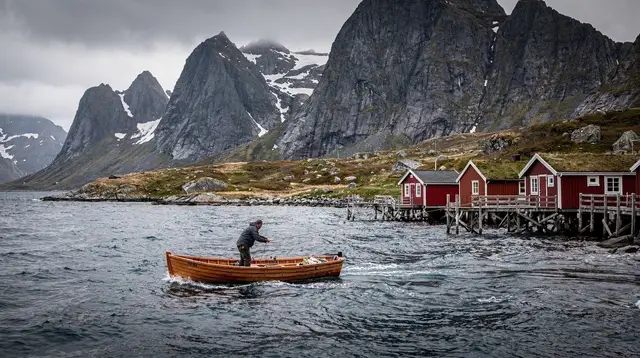
Seafood is the throughline of food culture here, tied directly to the fishing economy that built these villages. Stockfish — cod dried on wooden racks (hjell) rather than salted — has been produced and exported from this coast for centuries, and it shows up in various forms on local menus, from rehydrated and cooked dishes to snack-style dried pieces. Skrei, the migratory Arctic cod that arrives to spawn from January through April, is the seasonal counterpart: fresh rather than dried, and tied tightly to a window most visitors won’t be traveling in unless winter fishing season is specifically the draw.
Beyond cod, expect other local and Norwegian seafood on menus depending on the restaurant and season, alongside more general Norwegian dishes. What you won’t find, outside of tourist-oriented menus trying to cover every base, is a huge amount of variety — this is a food culture built around what the sea and a short growing season provide, not an international food scene.
a fishing trip with a local guide is one way to get closer to where this food actually comes from, and for travelers interested in the wider fishing culture and villages built around it, Lofoten’s fishing villages explain the history behind what ends up on the plate.
Why restaurant hours are shorter than you’d expect
Many of the smaller settlements — Henningsvær, Nusfjord, parts of Reine — have small year-round populations that swell dramatically in summer and shrink just as dramatically outside it. Kitchens in these places often keep limited hours, sometimes opening only for a few hours in the evening, and reduce or close entirely outside the main season. This isn’t an oversight; it reflects the actual size of the local customer base for most of the year. Booking ahead in peak season, or simply confirming a restaurant is open before making a special trip, avoids the common disappointment of arriving at a closed door.
Svolvær, as the largest town in the archipelago, keeps the most consistent and varied hours across the year, and is worth treating as the reliable option when smaller villages come up short.
Supermarket reality
For a meaningful share of travelers, the supermarket ends up doing more work than any restaurant. Grocery prices, while still higher than in much of continental Europe, are considerably lower than restaurant prices, and self-catering — particularly for breakfast and lunch — is the most common way visitors manage a multi-day trip without draining their budget on food alone. This matters more if you’re staying in a rorbu or any accommodation with a kitchen, which is common enough in Lofoten that it’s worth actively seeking out for exactly this reason. Larger towns like Svolvær and Leknes have the widest selection; smaller villages may only have a modest convenience-style shop, if anything at all, so stocking up before heading to a remote base is worth planning for. See getting around Lofoten for how far apart these shopping opportunities can realistically be.
Drinks and a rare craft option
Alcohol in Norway is taxed heavily and sold with restrictions — wine and spirits generally only through the state monopoly shop, with limited outlets in this region, while beer is more widely available in shops and restaurants. For travelers curious about the craft beer side of northern Norway, a night-time tour of a craft brewery in Harstad is a specific, focused option a little further afield from the main islands, worth folding into a trip that already passes through that gateway town.
Where food fits around the rest of your day
Food logistics tend to matter most on days built around a long drive or a hike, when meal stops are limited and timing needs planning rather than improvisation. On a broader highlights day trip through the islands or something like a guided highlights day trip from Reine, it’s worth confirming in advance whether food is included or whether you’ll need to plan a stop, since not every route passes through a village with reliable options at a convenient hour. For travelers building out a full week, a multi-day highlights and photo tour or a farm experience near Stamsund and Leknes both offer a break from the standard restaurant-or-supermarket choice, with food tied directly to the visit itself.
Common mistakes around food in Lofoten mostly come down to assuming continental-European restaurant hours and density — see mistakes to avoid in Lofoten for more on this and related planning missteps.
Grocery Budgeting in Practice
A typical self-catering day here breaks down fairly predictably: bread, cheese, and cold cuts for a packed lunch, pasta or a simple one-pot dinner cooked in a rorbu or apartment kitchen, and coffee brewed rather than bought. None of this eliminates the cost of eating in Norway, but it shifts most of a day’s food spending into the frugal end of the daily range rather than the mid-range or higher end that eating out three times a day would push you toward. Breakfast in particular is one of the easiest meals to self-cater regardless of where you’re staying, since most accommodation with any kitchen access at all can handle coffee, bread, and something simple without needing a full stove.
Where this breaks down is remoteness rather than price: a village with a single small shop may carry a narrower range than a traveler used to a full supermarket expects, and running out of a specific ingredient mid-week in a place like Å i Lofoten or further along the coast means either adapting the meal plan or driving back toward a larger town. Stocking up meaningfully in Svolvær or Leknes before heading toward smaller bases avoids most of this friction.
Eating Around a Long Driving or Hiking Day
Days built around driving the length of the E10 or tackling one of the region’s longer trails need a different kind of food planning than a day based in one town. Villages along the route often don’t have a restaurant open at the specific hour a hiker or driver passes through, so packing food for the day — rather than assuming a stop will present itself — avoids both hunger and the temptation to rush a hike to make a restaurant’s narrow opening window. This matters especially for anyone tackling one of Lofoten’s best hikes, where the nearest food might be a considerable drive from the trailhead in either direction, with no guarantee anything is open when you get there.
Carrying water is worth mentioning here too, even though it isn’t strictly a food question: tap water throughout the region is safe to drink, so refilling a bottle rather than buying bottled water at every stop is both cheaper and one less thing to plan around on a long day outdoors.
Coffee and Café Culture
Coffee culture in Norway runs strong, and Lofoten is no exception in the towns that support it — Svolvær and Leknes both have cafés serving the kind of coffee culture found across urban Norway, though smaller fishing villages may only have a café attached to a guesthouse or gallery, open on a schedule tied to the tourist season rather than year-round demand. A café stop functions as more than a caffeine break in a place where the weather changes as fast as it does here: it’s often the easiest way to wait out a squall without standing in the rain, and treating a café as a flexible weather shelter rather than a fixed item on an itinerary tends to work better than planning a specific coffee stop at a specific hour.
Seasonal Differences on the Plate
What’s realistically available shifts noticeably between the skrei season from January to April and the rest of the year. Winter menus in places that stay open lean into the fresh Arctic cod that defines that window, while summer menus — coinciding with the midnight sun and the busiest tourist season — spread across a broader mix of seafood and general Norwegian dishes, since the specific skrei run has already passed by the time most visitors arrive. Neither season is objectively better for eating, but knowing which one a given trip falls into helps set realistic expectations about what’s actually going to be on offer, rather than arriving expecting a specific dish that’s tied to a narrow calendar window that’s already closed.
A Practical Food Day, Summarized
Putting the pieces together, a workable pattern for most multi-day visitors looks like this: self-catered breakfast wherever the kitchen allows it, a packed lunch carried along on driving or hiking days, and one restaurant meal reserved for an evening in a town with reliably open kitchens — Svolvær being the safest bet on that front. Layering in one or two food-adjacent experiences, like a working farm visit or a fishing trip that puts dinner directly in your hands, breaks up the routine without requiring a restaurant reservation every night, and keeps the overall week closer to the frugal-to-mid-range end of the daily budget rather than the higher end that three restaurant meals a day would otherwise produce.
Vegetarian, Vegan, and Dietary Considerations
A food culture built this heavily around seafood and a short growing season doesn’t naturally lend itself to a wide vegetarian or vegan menu, and travelers with those needs should plan around self-catering more than around finding restaurant options built specifically for them. Supermarkets in the larger towns carry a reasonable range of plant-based staples, similar to what’s available across much of the rest of Norway, which makes cooking for yourself the more reliable route to a varied diet than hoping a small-village kitchen has a dedicated non-seafood option on a given night. Restaurants in Svolvær and Leknes are more likely than smaller villages to carry at least one non-seafood dish, simply because they serve a larger and more varied customer base year-round, but it’s worth asking directly rather than assuming before committing a group with mixed dietary needs to a specific restaurant.
Allergies work similarly: staff in most restaurants speak English and can usually answer direct questions about ingredients, but a menu translated only loosely from Norwegian is common enough in smaller places that anyone with a serious allergy should ask rather than rely on a printed English description alone. Carrying a written note of the specific allergen in question, even a simple one, tends to get a clearer answer than a general question about a dish’s ingredients, particularly in a smaller kitchen where the person taking the order isn’t always the one who cooked it.
None of this changes the overall shape of eating well here on a reasonable budget: know that restaurant hours are short and seafood-heavy, lean on supermarkets for the meals where self-catering is easiest, and treat one or two restaurant nights — ideally in a town with more consistent hours — as the deliberate splurge rather than the daily default.
Travelers arriving with a specific dish in mind from research done before the trip should hold that expectation loosely. What’s on a menu on any given evening depends on what a small kitchen chose to stock that week, what the season allows, and how busy the restaurant already is — a small operation can run out of a popular dish well before closing time, especially in peak summer weeks when a village’s population is at its highest relative to the number of tables actually available. Treating the whole food side of a Lofoten trip as something to adapt to day by day, rather than something to plan around a fixed list of must-eat dishes, tends to produce a much less frustrating week than arriving with a rigid checklist.
Food and eating in Lofoten — frequently asked questions
Is food expensive in Lofoten?
Yes. Norway is generally an expensive country for food, and Lofoten’s remote location adds to the cost of restaurant meals in particular. Supermarket shopping is noticeably cheaper than eating out for every meal.
What should I try if I want to eat local seafood?
Stockfish and, in season, skrei — the Arctic cod caught from January to April — are the two dishes most tied to this region’s food identity, though what’s available on any given menu depends on the restaurant and the season.
Why do restaurants in small villages keep such short hours?
Many villages have small year-round populations and rely heavily on the tourist season, so kitchens often open for a limited window in the evening and close early, particularly outside peak summer months.
Can you buy fresh fish directly from fishermen?
In some fishing villages this is possible informally, though it varies by location and season and isn’t something to plan around as a guaranteed option.
Is tap water safe to drink?
Yes, tap water is safe to drink throughout Norway, including Lofoten, which helps keep costs down since bottled water isn’t a necessary expense.
Do restaurants accept card payment?
Card payment is accepted almost everywhere in Norway, including small cafes and restaurants in Lofoten, so carrying large amounts of cash isn’t necessary.
Is service or tipping expected?
Service is generally included in the price, and tipping isn’t expected, though rounding up or leaving a small amount for good service isn’t unusual.
Food & drink tours in the Lofoten Islands on GetYourGuide
Verified deep-linked GetYourGuide tours. Book through these links and we earn a small commission at no cost to you.
Photos show the destination, not the operator's own images.