Lofoten's Fishing Villages: What a Rorbu Is, and Which Villages Are Worth a Stop
What is a rorbu, and why are Lofoten's villages built the way they are?
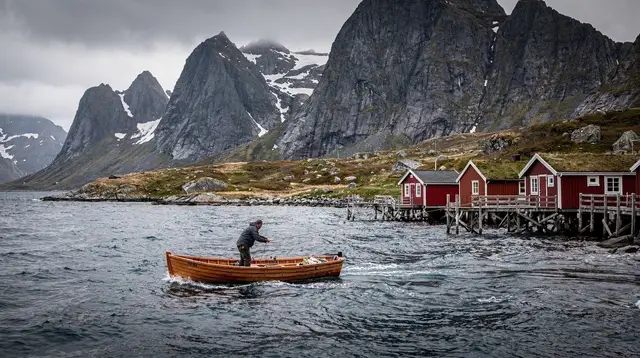
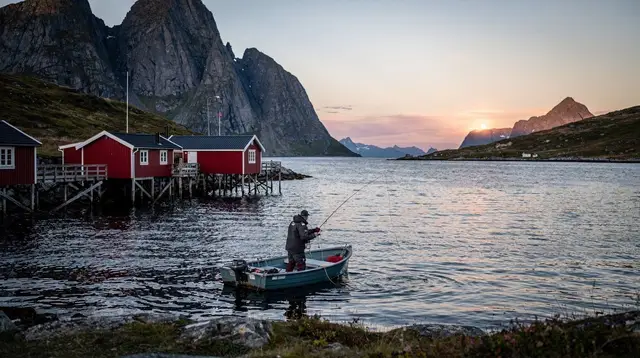
A rorbu is a timber fishing cabin built on stilts over the water, historically used by fishermen during the seasonal skrei cod migration. Lofoten's villages sit in sheltered harbours close to the fishing grounds for exactly this reason, and many of the same rorbuer now serve as visitor accommodation.
Why the villages sit exactly where they do
Every fishing village in Lofoten answers the same practical question: where is there shelter close to the fishing grounds. The islands’ economy for centuries centred on the skrei, the Arctic cod that migrates south from the Barents Sea to spawn off this coast between January and April, and villages grew up in whichever coves and harbours offered protection from open-sea weather while staying close to where the boats needed to go. That is why so many settlements — Henningsvær, Nusfjord, Hamnøy, Reine, Å i Lofoten, Ballstad, Stamsund — sit tucked into narrow inlets rather than along open coastline, and why the road connecting them, the E10, often has to detour around headlands rather than run in a straight line.
The pattern holds even for the larger towns. Svolvær grew from a fishing settlement into the region’s main port and administrative centre, but its older core, the Svinøya district, still shows the same layout as the smaller villages: rorbuer built close to the water, warehouses for gear and catch, and a harbour sized for small boats rather than large vessels.
What a rorbu actually is
A rorbu is a simple timber cabin, traditionally built on stilts directly over the shoreline or the water itself, used historically by fishermen — often men who had travelled from elsewhere on the Norwegian coast — during the intense weeks of the skrei season. The name comes from Norwegian words that translate roughly to “rowing dwelling”: a place to sleep and store gear close enough to the boats that no time was wasted getting to the water. These were working buildings, basic by design, not built for comfort.
What has changed is their use, not usually their structure. As the fishing industry modernised and needed fewer seasonal workers housed this way, many rorbuer were converted into visitor accommodation rather than left empty or torn down, which is why today’s traveller can sleep in a building with a genuine, centuries-old function rather than a themed replica. Some villages still use a portion of their rorbuer for actual fishing work alongside the tourist units, especially during the skrei season, when wooden drying racks called hjell reappear along the shore hung with cod.
The villages worth stopping for
Not every settlement along the E10 rewards a dedicated stop, and it helps to know what distinguishes one from another before planning a route.
| Village | What sets it apart | Access |
|---|---|---|
| Henningsvær | Spread across small islets, active harbour, well-known football pitch | Short detour off the E10 from Austvågøya |
| Nusfjord | Preserved historic village, entry fee, curated presentation | On Flakstadøya, signed from the E10 |
| Hamnøy | The classic photographed rorbuer-under-the-mountain view | Directly on the E10 near Reine |
| Reine | Larger harbour village with more services | Directly on the E10 |
| Å i Lofoten | The literal end of the E10, fishing village museum | End of the road on Moskenesøya |
| Ballstad | Active working fishing port, less visited | Short detour on Vestvågøya |
| Stamsund | Coastal express ferry stop, quieter | On the E10, Vestvågøya |
| Kabelvåg | Oldest settlement in the region, large wooden church | Just off the E10 near Svolvær |
Henningsvær and Nusfjord tend to draw the most attention, and for different reasons. Henningsvær’s appeal is atmosphere: a genuinely active harbour spread across a cluster of islets, with cafés, galleries, and a small-town feel that rewards an hour or two of unstructured walking. Nusfjord takes the opposite approach, presenting a more deliberately preserved historical village with an entry fee attached, and suits visitors who want context and explanation rather than simply wandering. Neither is objectively better; the choice depends on whether you want a living village or a curated one.
Hamnøy and Reine, close together on Moskenesøya, are usually visited as a pair, with Hamnøy supplying the classic photograph and Reine offering more in the way of services and a base to stay. Å i Lofoten, at the literal end of the road, functions partly as an open-air fishing village museum and is a natural final stop for anyone driving the E10 end to end.
Colour, and why it repeats
The red buildings that appear in almost every fishing-village photograph are not a coincidence or a modern styling choice. Red ochre paint, historically a byproduct of copper mining on the Norwegian mainland, was cheap, durable against salt air, and widely available along the coast, which made it the default choice for boathouses, rorbuer, and other working buildings for generations. Yellow ochre served a similar but usually less common role, occasionally marking a slightly higher-status building such as a merchant’s house. The colour scheme you see today across Henningsvær, Nusfjord, Hamnøy, and elsewhere is a genuine historical pattern, not a design applied for visitors.
Visiting during the working season versus the rest of the year
The villages look and feel different depending on when you arrive. During the skrei season, January to April, drying racks fill with cod, boats come and go on a working schedule, and the villages are at their most active — but daylight is limited, especially early in that window, close to the tail end of the polar night (roughly 6 December to 6 January). Outside those months, the same villages are quieter, with fewer working boats and no racks, though the buildings and setting remain. Midnight sun season, late May to mid-July, brings the opposite trade-off: long, soft light at any hour but a village going about its business without the seasonal fishing activity that defines the winter months.
Weather is the constant variable regardless of season — conditions here can shift within the hour, and a fishing village that looks postcard-perfect on arrival can be shrouded in mist an hour later. Building flexibility into a village-hopping day, rather than a tight schedule, tends to work better in practice. This applies as much to photography as to general sightseeing: a village that looks flat and grey at midday can transform within an hour if cloud cover breaks, and the reverse is just as common. Travellers with a fixed departure time and only one shot at a particular village are, in effect, gambling on the weather cooperating exactly when they need it to, which is worth acknowledging honestly rather than assuming a single visit guarantees the conditions seen in photographs online.
Getting between villages
Because the villages are spread across four separate islands connected by the E10’s bridges and tunnels, a car is by far the most practical way to string several together in a day. Svolvær, Henningsvær, and Kabelvåg cluster on Austvågøya; Ballstad and Stamsund sit on Vestvågøya; Nusfjord on Flakstadøya; and Hamnøy, Reine, and Å on Moskenesøya. Some villages, notably Henningsvær, are also reachable as an organised day trip from Svolvær for travellers who are not self-driving.
For a guided introduction to one of the oldest working harbours in the region, a historic fishing village storytelling tour of Svinøya in Svolvær covers the working history of rorbuer directly, with a local guide filling in the details a self-guided walk would miss. In Henningsvær itself, a guided walking tour with a local guide is a practical way to see the village’s layout and history without simply wandering and hoping to notice the right details. Further south, a private photo tour covering Hamnøy and Reine is aimed specifically at photographers who want help finding angles beyond the standard bridge shot, and travellers planning to drive the whole route themselves might instead consider a guided road trip exploring Reine and Å that takes the navigation and local knowledge off your hands for the day.
A note on scale, and why the villages stayed small
Part of what makes these villages photogenic is exactly what once made them economically marginal by mainland standards: there was never room, or reason, for them to grow much larger. A rorbu settlement existed to service a specific stretch of fishing grounds during a specific season, and once the skrei run ended each spring, many of the fishermen who had crewed the boats returned to homes elsewhere on the Norwegian coast, leaving a skeleton population behind until the following winter. Only a handful of locations — Svolvær chief among them — grew into something closer to a full town, generally because they combined good harbour shelter with a role as an administrative or trading centre beyond fishing alone.
This history explains a pattern visitors often notice without quite placing it: even the more substantial villages, like Reine, feel compact compared with an equivalent-sized settlement almost anywhere else, because they were never built around anything but the harbour and the boats. There is no separate commercial district set back from the water, no suburban sprawl inland, just the working core and, more recently, a scattering of guesthouses and rental cabins fitted into the same footprint. Understanding this helps set expectations before arriving: even villages billed as a highlight of a Lofoten itinerary are, almost without exception, walkable in under an hour, with the real value in the setting and the history rather than in a long list of things to see and do once you are there.
That compactness also means the villages reward a slower pace better than a checklist approach. Spending thirty unhurried minutes in Henningsvær or Nusfjord, actually looking at how the buildings sit against the water and the mountains behind them, tends to leave a stronger impression than driving through six villages in a single rushed day. If your schedule allows it, picking two or three villages that genuinely interest you, rather than attempting every stop along the E10, is usually the better trade-off.
Where to stay if the villages themselves are the draw
Sleeping in a rorbu rather than a standard hotel room puts you inside the same buildings this whole pattern of settlement produced, and several of the villages above — Hamnøy, Reine, Svolvær’s Svinøya district — offer this as an option. Expect rorbu accommodation to sit toward the mid-range to higher end of a typical daily budget, reflecting both the character of the buildings and steady demand for well-located ones. Our dedicated guides to where to stay in Lofoten and the rorbu guide go into pricing and what to expect from a night in one of these cabins in more detail, and our piece on stockfish and the skrei season covers the fishing history behind the drying racks you will see in several of these villages.
Fishing village questions before you go
What does the word rorbu mean?
Rorbu comes from Norwegian words meaning roughly “rowing dwelling” — a simple cabin built for fishermen to stay in during the fishing season, close enough to the water to reach their boats directly. Many are built on stilts over the shoreline itself.
Are the villages still working fishing communities, or are they mainly for tourists?
Most Lofoten fishing villages are still at least partly working communities, particularly during the skrei season from January to April, when boats land cod and hang it to dry on wooden racks. Some villages, like Nusfjord, are more actively preserved and charge an entry fee; others, like Hamnøy, remain unticketed and simply continue as they always have.
Which fishing village should I prioritise if I only have time for one?
Henningsvær is a common first choice for its setting spread across small islets and its more active atmosphere, while Nusfjord suits visitors who want a more curated, preserved look at the historic architecture. The right choice depends on whether you want atmosphere or history.
Why do so many villages have red buildings?
Red ochre paint was historically the cheapest and most durable option available, originally a byproduct of copper mining on the Norwegian mainland, and it became the standard colour for rorbuer and boathouses across the coast. The colour has since become closely associated with the region.
Is Nusfjord worth the entry fee?
Nusfjord is one of the best-preserved historic fishing villages in Lofoten and the fee reflects its status as a managed heritage site rather than an ordinary village. Whether it is worth it depends on how much you value a curated, well-explained historical setting versus a village you can wander freely.
Can I stay overnight in a rorbu in these villages?
Yes, many rorbuer across these villages, including at Hamnøy, Reine, Svolvær’s Svinøya, and elsewhere, operate as accommodation. Expect pricing toward the mid-range to higher end of Lofoten’s typical daily budget, particularly for cabins with a well-known view.
When is the best time to see the villages at their busiest, working best?
January to April, the skrei season, is when fishing activity and drying racks are most visible. Outside those months the villages are quieter and more focused on visitors than on active fishing.
Do I need a car to visit multiple fishing villages?
A car makes it far easier to string several villages together in one day, since they are spread along the E10 across different islands. Some, like Henningsvær, are also reachable as day trips from Svolvær without driving yourself.
Fishing trips on GetYourGuide
Verified deep-linked GetYourGuide tours. Book through these links and we earn a small commission at no cost to you.
Photos show the destination, not the operator's own images.