Visiting Nusfjord: A Practical Guide to Norway's Preserved Fishing Village
How long should I plan for a visit to Nusfjord?
Most visitors need one to two hours to walk Nusfjord's harbor and buildings at a comfortable pace. Staying overnight in one of the village's rorbuer extends that considerably, but isn't necessary to see what the village offers.
Before you arrive
Nusfjord isn’t a large stop, and treating it as one — allocating a full day, expecting a visitor center with staffed tours — sets the wrong expectations. It’s a small, preserved harbor settlement on Flakstadøya that charges an entrance fee to help maintain its wooden buildings, and the visit itself is a self-guided walk rather than a scheduled program. Knowing that in advance changes how you plan the rest of the day around it.
The other thing worth knowing before arriving: Nusfjord’s setting means it’s genuinely subject to Lofoten’s fast-changing weather. A visit doesn’t need to be planned around forecasts the way an exposed hike might, but it’s worth bringing a layer regardless of what the morning looks like.
What the fee covers, and what it doesn’t
The entrance fee funds ongoing maintenance of the village’s rorbuer, boathouses, and drying racks (hjell) — structures that face constant exposure to salt air and Lofoten’s weather. It does not function like a museum ticket with staffed exhibits at every stop; instead, information panels around the village explain what you’re looking at, and you move through at your own pace.
What this means practically: don’t expect a guided walkthrough unless you’ve specifically booked one as part of a wider tour. The self-guided format is part of what keeps a Nusfjord visit short and flexible rather than a fixed-length program.
A suggested walking route
There’s no single official route through Nusfjord, but a logical order looks roughly like this:
- Start at the quayside, where the harbor’s layout is easiest to take in as a whole.
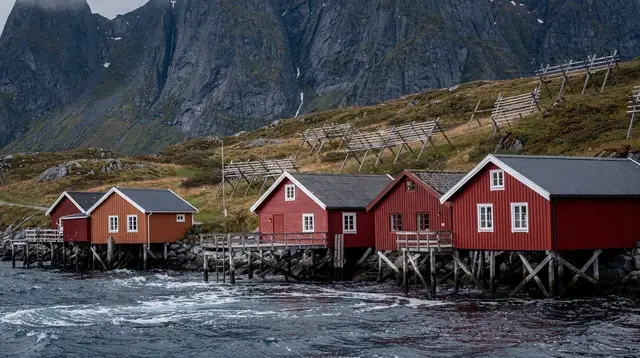
- Walk past the boathouses and preserved rorbuer, several of which are still used for overnight stays.
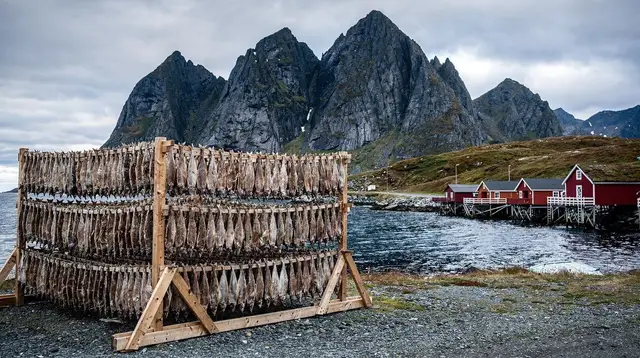
- Look for the drying racks — worth seeing as structures even outside the January-to-April skrei season, when they’re not actively in use.
- Finish at the small general store and café, which makes a natural endpoint for the walk rather than a mid-route stop.
None of this needs to take more than an hour at a relaxed pace, though photographers and anyone lingering over the details of the timber construction will reasonably want longer.
The village’s working history
Nusfjord isn’t a recreation built for visitors — its rorbuer, boathouses, and quayside structures are the genuine remains of a working fishing settlement, one of many along this coast that grew up around the skrei season each winter. For centuries, cod caught roughly from January through April was hung to dry on racks like the ones still standing here, producing stockfish that was exported well beyond Norway — a trade that predates almost anything else visitors associate with this coastline today. What sets Nusfjord apart from many of its neighbors isn’t that this history is unique to it, since versions of it played out in fishing villages across the archipelago, but that its buildings were preserved and maintained rather than replaced or left to decay, which is largely what the entrance fee sustains.
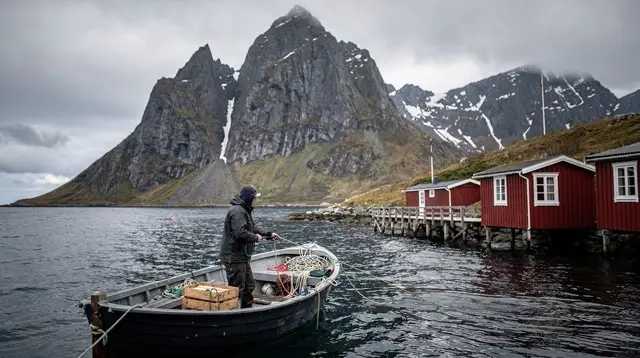
The rorbuer themselves are a good example of that continuity: originally basic seasonal shelter for fishermen working away from home during the skrei season, the same red-painted, pilotis-raised cabins now function as visitor accommodation across Lofoten, Nusfjord’s included. Staying in one here is as much a way to understand that history directly as it is simply a place to sleep.
Staying overnight instead of just passing through
A day visit covers what most people come to Nusfjord for, but staying overnight changes the experience meaningfully. Once the day’s visitors have moved on, the harbor empties out, and a quiet that’s hard to find during the middle of a summer day becomes the default. Because the number of rorbuer available for overnight stays is limited compared to larger bases like Reine or Svolvær, booking ahead matters more here than somewhere with more accommodation capacity to fall back on.
An overnight stay also solves a timing problem some travelers run into with light: during the midnight sun months, staying puts you in the village for the kind of soft, late evening light that a same-day visitor driving back toward Reine or Leknes simply doesn’t get to see, since there’s no fixed sunset to build a return drive around in the first place.
Photographing Nusfjord
Nusfjord’s compact scale works in a photographer’s favor — the harbor, drying racks, and rorbuer sit close enough together that changing light doesn’t require much repositioning to chase it. Overcast conditions, common enough here that it’s worth planning around rather than hoping to avoid, tend to flatten shadows in a way that actually suits the timber buildings’ texture rather than working against it, which is one reason Nusfjord holds up as a stop even on a grey day. Arriving outside the middle of the day matters for photography in the same way it matters for parking: fewer people moving through the frame, and softer light in the hours further from midday. Our general photography guide covers the wider set of considerations for shooting in this region, including how quickly conditions can shift mid-session.
Weather and what to bring
Because Nusfjord sits directly on an exposed inlet, conditions can shift within the hour even on a day that starts clear. A waterproof outer layer is worth carrying regardless of the forecast at the time you set out, and footwear that handles wet cobblestones and boardwalks comfortably matters more here than it would on an ordinary paved street. None of this requires serious hiking gear — Nusfjord’s walking route is short and flat — but underdressing for a squall that rolls in partway through the visit is one of the more common small mistakes visitors make here.
A rough daily budget around a Nusfjord stop
Nusfjord itself is a relatively low-cost stop on a Lofoten itinerary — the entrance fee is the main direct cost, and the village’s small café and shop cover food without requiring a special trip elsewhere. For general planning, the same order-of-magnitude daily figures apply across the region: a budget traveler self-catering and camping runs to roughly 980 NOK per person per day, a mid-range traveler closer to 3,190 NOK, and a higher-spending day around 7,500 NOK, at approximately 11.2 NOK to 1 EUR. Where a Nusfjord day actually lands within that range depends far more on the rental car, fuel, and any guided tour built around it than on the village stop itself.
Combining Nusfjord with the rest of your day
Nusfjord’s location on Flakstadøya puts it within reasonable reach of several other stops, which is the more efficient way to think about the visit rather than treating it as a standalone destination:
- Ramberg beach — a sandy stretch directly along the E10, easy to combine either before or after Nusfjord.
- Flakstad’s red church — a short stop that fits naturally into the same drive.
- Kvalvika beach — reachable only on foot from Fredvang, with Ryten’s summit above it, for those with more time and an interest in hiking.
- Reine — further along the E10, useful as a base for accommodation or a continuation of the day.
A single day covering Nusfjord alongside one or two of these stops is realistic with a rental car; trying to add all of them in one visit tends to feel rushed. Pairing Nusfjord with Ramberg or Flakstad’s church makes for a light, low-effort day; pairing it with Kvalvika and Ryten instead turns the day into something considerably more physical, since that combination adds a proper hike on top of the short village walk. Deciding which pairing suits your day is mostly a question of how much walking, beyond Nusfjord itself, you actually want.
Logistics: getting there and parking
A rental car is the practical way to reach Nusfjord — there’s no meaningful bus service that stops directly at the village, and the detour off the E10, while short, isn’t set up for walking from a distant public transit stop. Parking is limited by the inlet’s geography rather than by a formal reservation system, and arriving outside the middle of the day, particularly in the busier summer months, generally means an easier time finding space and a quieter walk once inside.
The detour itself is short enough that it rarely needs to be treated as a separate leg of a day’s driving — most itineraries that already run along this stretch of the E10 can absorb a Nusfjord stop without meaningfully changing the day’s overall shape. That’s part of why it pairs so easily with other stops on Flakstadøya rather than requiring a dedicated day of its own the way a longer hike or a boat trip further out might.
If you’d rather not self-drive
Not every visitor wants to manage a rental car and route-plan an entire Flakstadøya day. For travelers who’d rather have the driving and route handled for them, a three-day guided photo tour covering Lofoten’s top highlights is one option that folds Nusfjord into a broader itinerary alongside other well-known stops. A shorter alternative, a single-day highlights tour departing from Reine, suits travelers based closer to Nusfjord who want a lighter time commitment. For those who specifically want the driving handled while still getting out at each stop to photograph it properly, a guided sightseeing and road trip tour covers similar ground with more time built in at each location.
Seasonal timing
Nusfjord is walkable year-round, but the experience differs by season. In summer, the midnight sun period (roughly late May to mid-July) means there’s effectively no fixed evening cutoff, which suits travelers who prefer visiting outside the busiest midday hours. In winter, shorter daylight and the possibility of snow underfoot change the pace of a visit, though the buildings themselves remain just as visible and photogenic.
| Season | What to expect |
|---|---|
| Summer | Longest daylight, busiest midday hours, easiest walking conditions |
| Shoulder months (spring/autumn) | Fewer visitors, lower light for photography, still generally walkable |
| Winter | Shorter daylight, possible snow on paths, quieter overall |
What to skip if you’re short on time
If your Lofoten itinerary is tight, Nusfjord is easier to trade off against a second preserved village than against a hike or a wildlife tour — it overlaps conceptually with places like Henningsvær more than it competes with something like a sea eagle safari. Prioritizing one preserved fishing village over visiting several is a reasonable way to reclaim time for other parts of a first Lofoten trip, particularly one covered in a multi-day itinerary.
What Nusfjord doesn’t have
It’s worth setting expectations about what this part of Norway isn’t, since the far-north setting invites comparisons that don’t hold up. There are no glaciers anywhere in the archipelago, no polar bears, and no conifer forest — the vegetation here runs to stunted birch rather than pine or spruce. This isn’t Svalbard, and despite sitting well above the Arctic Circle, it isn’t Iceland or Finnish Lapland either; there’s no igloo tradition on this coast. Tromsø, sometimes assumed to be a short trip from here, is actually a separate destination roughly 400 km away. Nusfjord’s appeal is a genuinely preserved fishing settlement with real working history, not a stand-in for a different kind of Arctic landscape borrowed from somewhere else.
Practical notes
Norway’s currency is the krone (NOK), and card payment is accepted almost everywhere, including at Nusfjord’s small café and shop. Lofoten runs expensive by broader European standards — worth factoring into how many paid attractions you plan to visit in a day. Norway sits inside the Schengen area but outside the EU, uses European C and F power sockets at 230V/50Hz, and tap water is safe to drink throughout the region. The general emergency number is 112. Service is included in prices, and tipping isn’t expected — a small detail, but one that occasionally trips up visitors used to a different convention elsewhere.
Frequently asked: visiting Nusfjord
Do I need to book ahead to visit Nusfjord?
No advance booking is required for a standard day visit — entry is handled on-site rather than through a timed-ticket system.
What exactly does the entrance fee pay for?
It funds the ongoing maintenance of Nusfjord’s wooden buildings, drying racks, and quayside structures, all of which face real wear from Lofoten’s weather.
Is Nusfjord accessible by public transport?
Not directly. A rental car or an organized tour is the realistic way to get there, since there’s no bus service stopping at the village itself.
Can I see stockfish drying at Nusfjord?
Only during the skrei season, roughly January through April. Outside that window, the drying racks are visible but empty.
Is Nusfjord suitable for a rainy-day visit?
Reasonably — the village can be walked in short stretches, and the timber buildings hold up well as a subject under grey skies, which matters given how quickly the weather here can change.
How does a Nusfjord visit compare to a guided photo tour that includes it?
A guided tour bundles Nusfjord with other stops and takes care of the driving, which suits travelers without their own car. Visiting independently gives you more control over exactly how long you linger.
Fishing village tours on GetYourGuide
Verified deep-linked GetYourGuide tours. Book through these links and we earn a small commission at no cost to you.
Photos show the destination, not the operator's own images.