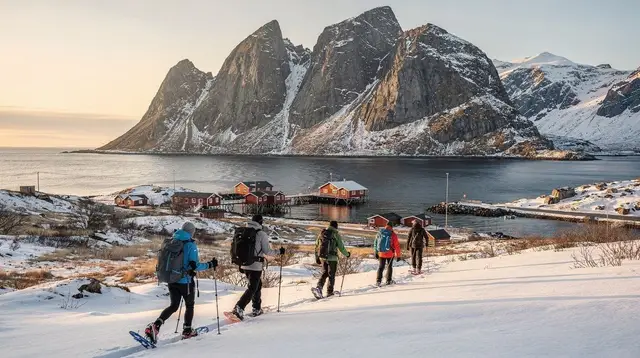
Snowshoeing in Lofoten
Why choose snowshoeing over regular winter hiking in Lofoten?
Winter snow cover changes the mountains here in ways that make ordinary boots impractical on the steeper, already unmarked trails - snowshoes spread your weight and add grip on slopes that would otherwise be exhausting or unsafe to cross. It also opens up terrain and light conditions, like low winter sun and a real chance at the northern lights, that summer hiking doesn't offer.
Why the terrain changes the equation in winter
Lofoten’s mountains rise steeply and directly from the sea, and the same unmarked, informal trails that work reasonably well in summer become a different proposition once snow settles over them. Depth, drifting, and the way snow hides the underlying ground all make ordinary hiking boots impractical on the steeper approaches - a boot alone sinks and slides on slopes that snowshoes handle by spreading weight across a wider surface and adding grip underfoot. Our hiking safety guide for Lofoten covers the broader hazards of hiking here in any season - changing weather chief among them - and most of that still applies once snow is added to the picture; snowshoes solve a terrain problem, not a weather one.
Where snowshoeing tends to happen
Snowshoeing outings in Lofoten generally move through the lower valleys and gentler slopes between the region’s steeper peaks rather than up exposed summit routes, taking advantage of terrain that would be a rough scramble in summer but becomes a manageable snow-covered walk in winter. Western Lofoten, around Reine and the fjords near Moskenesøya, is a common area for this kind of outing given its mix of open snowfields and mountain backdrops. A guided winter hike and snowshoeing tour through western Lofoten covers this stretch of terrain over roughly three hours with a guide setting the route and pace, which matters given how quickly conditions can change and how few of these routes carry any official markers even in summer.
What the equipment actually does
Modern snowshoes are lighter and simpler than the wooden, tennis-racket-shaped versions most people picture - a metal or composite frame with a stiff decking material, straps or a ratchet system to secure a winter boot, and metal teeth underneath that bite into icier patches the way crampons do on a smaller scale. The core mechanic is simple: more surface area under each foot spreads your weight over the snow rather than concentrating it, which is what stops you sinking through softer drifts the way an ordinary boot would. Poles are usually issued alongside the snowshoes themselves, mostly for balance on uneven or sloped ground rather than out of technical necessity, and most guided outings provide both rather than expecting participants to arrive with their own kit - a meaningful convenience for visitors who’d otherwise need to source and check unfamiliar equipment before a trip.
What a guided outing typically looks like
A typical guided snowshoe outing starts with a short briefing at a meeting point, covering how the bindings fit, the pace the group will move at, and what the plan is if weather or group fitness changes things partway through. From there, most routes move at a steady, unhurried walking pace
- there’s no rushing snowshoeing, since the equipment itself sets a natural rhythm - with the guide choosing terrain that avoids the steeper or more avalanche-prone slopes in favour of valleys and gentler inclines that still deliver mountain views. A stop partway through for a hot drink or a short rest is common on longer outings, particularly in genuinely cold conditions, and the group typically returns to the same starting point rather than requiring a car shuttle between trailhead and finish. None of this requires previous winter hiking experience - it’s built around being accessible to visitors trying the activity for the first time.
Guided versus independent: why guiding is often the better call here
| Independent snowshoeing | Guided snowshoeing | |
|---|---|---|
| Route knowledge | You judge terrain and snow conditions yourself | Guide knows current conditions and turnaround points |
| Equipment | You source and fit your own gear | Snowshoes and poles typically provided |
| Weather judgment | Full responsibility for the decision to continue or turn back | Guide manages the call given local experience |
| Best suited to | Experienced winter hikers with the right gear already | Most visitors, especially first-timers to snowshoeing |
Guided snowshoeing removes several of the specific unknowns that make independent winter hiking here harder than it looks from a summer visit: knowing which slopes hold stable snow, reading whether a route that seems short will actually take twice as long under snow, and making the turnaround call before, not after, conditions worsen. Given how unmarked most trails are and how quickly the weather here can shift, a guide’s local knowledge does real work rather than being a convenience layer on top of an otherwise simple activity.
Snowshoeing and the northern lights
Winter in Lofoten also means the aurora season, running roughly September through early April, and a snowshoe outing timed into the evening is a natural way to get away from village lighting on foot rather than by car.
a snowshoeing tour built around northern lights viewingpairs the two directly, moving a group into darker terrain during the walk itself. As with any aurora activity, results depend entirely on a clear, dark sky - no guide or itinerary can promise a sighting, only put you in a reasonable position for one if conditions cooperate. Our complete northern lights guide for Lofoten covers what actually determines whether a night produces a display.
A shorter option for a first try
For visitors unsure whether snowshoeing suits them, or fitting it into a day that includes other plans, a shorter half-day outing departing from a gateway town such as Bodø removes much of the commitment involved in a longer route, working as a standalone outing without needing a longer winter itinerary built around it.
What snowshoeing actually requires of you
Despite the specialised equipment, snowshoeing itself demands relatively ordinary fitness - it’s closer to a brisk walk than a technical skill, and the snowshoes do much of the work of managing depth and traction. What it does require is appropriate clothing: layered, warm clothing well beyond what a mild-looking forecast suggests, waterproof outer layers, and boots that fit securely in the snowshoe bindings. Lofoten’s winters run mild for the latitude thanks to the Gulf Stream, generally around 0 to -3°C, but wind and wet snow both cut through inadequate layering faster than the air temperature alone suggests. Anyone planning independent winter hiking beyond a guided snowshoe outing should also read our Lofoten in winter guide for what the season involves more broadly, including the short daylight hours that shape how much ground a day realistically allows.
Fitness demands are genuinely modest compared with the region’s more strenuous summer hikes - there’s no equivalent here to the steep, sustained climbs found on routes like Reinebringen, since guided snowshoe routes are deliberately chosen on gentler terrain. What replaces physical difficulty is a need for adequate insulation: cold exposure builds gradually and is easy to underestimate on a slow-paced outing where you’re not generating the same body heat a faster hike would, so layering that can be added or removed as the group’s pace and the weather shift matters more here than raw fitness ever does.
Snowshoeing alongside other winter activities
Snowshoeing sits alongside a handful of other snow-season activities across the wider region, each suited to a different appetite for pace and effort.
| Activity | Pace and effort | Best suited to |
|---|---|---|
| Snowshoeing | Slow, steady walking pace | Visitors wanting scenery and quiet exercise without technical skill |
| Dog sledding | Faster, mostly seated or standing on runners | Visitors wanting a more active, animal-led experience |
| Snowmobiling | Fast, motor-powered, covers more ground | Visitors wanting distance and speed over quiet walking |
None of these substitute for one another - snowshoeing’s specific appeal is the quiet, unhurried pace and the fact that it needs no previous experience or specialised fitness, which is also why it pairs so naturally with a northern lights outing timed for later the same evening, when a faster or noisier activity would leave a group less ready to simply stand still and wait for the sky to cooperate.
Fitting snowshoeing into a winter trip
A single guided snowshoe outing works well as one day within a broader winter visit, alongside northern lights viewing, a look at Svolvær or Henningsvær, and time built in for the inevitable weather-dependent schedule changes that come with an arctic winter trip. Our 5-day winter itinerary builds in this kind of flexibility across a full week, and our best hikes in Lofoten guide covers how the same terrain differs across seasons for anyone comparing a winter snowshoe trip to a summer hiking one. For a broader look at the islands that includes some walking without committing an entire day to a single activity, a three-day guided tour covering Lofoten’s top highlights is one way to combine snowshoeing with sightseeing rather than treating them as separate trips.
Beyond Lofoten’s four main islands
Snowshoeing terrain isn’t limited to the archipelago itself. The mountainous country around Narvik, on the mainland gateway route into Lofoten, offers similar snow-covered valleys and slopes, and outings based there work as an alternative for travellers arriving overland by train or road rather than flying directly into the islands. The activity itself doesn’t change much between locations - what changes is the specific terrain and how far a guide has to travel to reach good snow cover, which depends more on the season’s snowfall than on which town you’re based in. Anyone routing through Narvik on the way to or from Lofoten can reasonably treat a guided snowshoe outing there as equivalent to one further out on the islands, rather than a lesser substitute.
Snowshoeing in French, for francophone visitors
Guided options aren’t limited to English-language groups. A French-language snowshoeing tour offering an intimate discovery of Lofoten is available for visitors who’d rather have the route and safety briefing delivered in French rather than English, a detail worth checking for before booking if language matters to how comfortable you’ll feel on unfamiliar terrain. Language aside, the route and pace themselves don’t differ meaningfully from an English-language group - the value here is entirely in being able to ask questions and follow safety instructions in a language you’re fully comfortable in, which matters more on unfamiliar winter terrain than it might on a straightforward summer walk.
What a guide is reading in the snow itself
Beyond route choice and pacing, a guide leading a snowshoe outing is constantly reading the snow itself — how it’s bonded to the layer beneath it, whether recent wind has loaded a slope unevenly, whether a stretch that looked stable yesterday has shifted overnight. None of this is obvious to someone without local experience, and it’s a different skill from simply being fit enough to walk the distance. This is the real value a guide adds beyond the equipment: judgment about a specific slope on a specific day, built from repeated exposure to how snow behaves on these particular mountains, not a generic winter-hiking competence that transfers automatically from other snowy places.
Group size and pacing on a guided outing
Guided snowshoe trips in Lofoten typically move at the pace of the slowest comfortable member of the group rather than pushing toward a fixed schedule, which matters given how much energy postholing through deep or uneven snow can demand even over a short distance. Smaller groups tend to move faster and stop less, while larger groups build in more regular rest points, and either way, the route itself is often adjusted on the day based on how the group is managing rather than followed rigidly regardless of conditions. Anyone worried about fitness levels holding them back should ask an operator directly about typical group pacing before booking, since it varies meaningfully between a short introductory outing and a longer route into more remote terrain.
Overcast skies versus clear ones during a snowshoe outing
Winter light in Lofoten varies more than visitors sometimes expect, and it changes what a snowshoe outing actually looks and feels like. Under low winter sun with a clear sky, snow-covered slopes take on a strong blue-and-gold contrast that photographs well and makes for dramatic views back down toward the fjords. Under overcast conditions, that contrast disappears, replaced by flatter, more even light that can make judging distance and terrain features harder underfoot, even though the walking itself isn’t meaningfully more difficult. Neither condition cancels a guided outing on its own — operators run trips in both — but it’s worth adjusting photography expectations specifically to whichever the day actually delivers rather than assuming the clear-sky version is guaranteed.
Building a full winter day around one snowshoe outing
Because guided snowshoe trips generally run a few hours rather than consuming an entire day, they pair naturally with other activities scheduled either side of them. A morning snowshoe outing followed by an afternoon in Svolvær or Henningsvær, or an evening snowshoe trip timed to end right as an aurora watch begins, both make efficient use of short winter daylight rather than treating the snowshoe outing as the entire day’s plan. The main scheduling risk is stacking two weather-dependent activities too tightly against each other — if the snowshoe trip runs long because of conditions, a tightly booked second activity afterward has little room to absorb the delay.
Snowshoeing in Lofoten: common questions
Do I need previous snowshoeing experience?
No. Snowshoeing is generally accessible to hikers of ordinary fitness with no prior experience, since the equipment itself does most of the work of managing snow. A guided outing removes the remaining unknowns - route choice, snow conditions, pacing - for anyone new to it.
Is snowshoeing safer than regular winter hiking in Lofoten?
It’s more appropriate for snow-covered terrain, since snowshoes provide flotation and grip that ordinary boots lack once snow is deep or the ground underneath is uneven. It doesn’t remove the underlying risks of winter mountain travel here - short daylight, fast-changing weather, and unmarked trails - which is why guided options are common.
What time of year can I go snowshoeing in Lofoten?
Snow cover is most reliable through the core winter months, when short daylight and the possibility of the northern lights shape how a day is structured. Conditions vary year to year, so a guide or local outfitter’s read on current snow cover is more useful than a fixed calendar date.
Can snowshoeing be combined with northern lights viewing?
Yes, and it’s a common pairing - a snowshoe outing timed into the evening moves hikers away from village lighting on foot, dovetailing naturally with an aurora watch if the sky cooperates. Results still depend entirely on clear, dark conditions, which no guide can guarantee.
Is snowshoeing suitable for families or first-timers?
Shorter, guided outings on gentler terrain suit most fitness levels and ages, since the pace is set by the group rather than requiring technical skill. Longer or more exposed routes are better suited to hikers comfortable with winter conditions generally.
What should I wear snowshoeing in Lofoten?
Warm, layered clothing well beyond what a mild-looking forecast suggests, waterproof outer layers, and sturdy winter boots that fit securely inside the snowshoe bindings. Norway’s winters here run mild for the latitude thanks to the Gulf Stream, generally around 0 to -3°C, but wind and wet snow both cut through inadequate layering quickly.
Do I need to bring my own snowshoes?
No - guided outings typically provide snowshoes and poles as part of the booking, fitted to your winter boots at the start of the outing. This removes the need to source or transport unfamiliar equipment for what, for most visitors, is a one-off activity within a longer trip.
How physically demanding is snowshoeing compared with Lofoten’s summer hikes?
Considerably less demanding than routes like Reinebringen, since guided snowshoe outings are deliberately routed over gentler terrain rather than steep summit approaches. The main challenge is staying warm at a slower pace, not sustained physical exertion, which makes it a reasonable choice even for visitors who wouldn’t otherwise attempt a demanding summer hike in the same region, and it’s part of why guides recommend it so readily to first-timers rather than reserving it for experienced winter hikers only.
Snowshoeing tours on GetYourGuide
Verified deep-linked GetYourGuide tours. Book through these links and we earn a small commission at no cost to you.
Photos show the destination, not the operator's own images.