Snowmobiling in Northern Norway: Where It Happens and What to Expect
Can you go snowmobiling in Lofoten?
Not really within the Lofoten islands themselves — the archipelago's narrow, mountainous terrain and dense village-to-village road network leave little open snow country for it. Guided snowmobile outings run instead from mainland gateway towns such as Bodø, on open terrain suited to the activity, typically through the winter months when snow cover is reliable.
First, a clarification worth making early
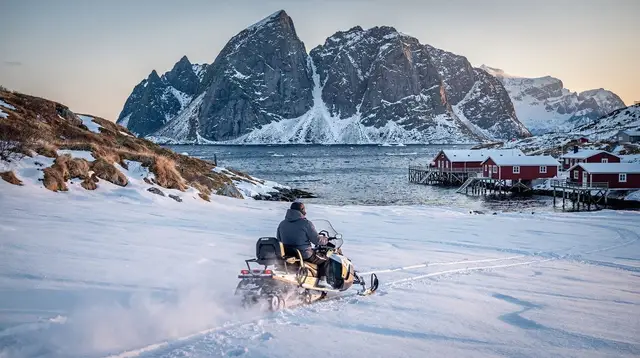
If you picture snowmobiling in Arctic Norway as something you do inside the Lofoten islands themselves, weaving between the red rorbuer and jagged peaks you see in photos of Reine or Hamnøy — that’s not really how it works. The islands’ terrain is the same feature that makes them so photogenic and so constrained for this particular activity: narrow strips of land squeezed between steep mountains and fjords, threaded by a single main road (the E10), with villages built close together along the coast. There simply isn’t much open, unbroken snow country within the archipelago for a marked snowmobile route, and the density of settlement and infrastructure limits where a guided operation can realistically run.
Snowmobiling in this part of Norway is, instead, primarily a mainland activity, based from gateway towns with more open terrain around them. Bodø, on the mainland across the water from Moskenes, is one such base, and it’s the departure point for the snowmobile tour referenced in this guide. If snowmobiling is a priority for your trip, plan around a mainland leg rather than expecting to find it inside Lofoten’s four main islands.
Where it actually happens
Beyond Lofoten proper, the broader Nordland and northern Norway region includes considerably more open, snow-covered terrain suited to this kind of guided activity — plateaus, valleys, and forested or open ground away from the tight coastal squeeze of the islands. Towns that function as road, rail, or air gateways to Lofoten — Bodø, Narvik, Harstad, and the area around Evenes airport — sit closer to this kind of terrain and are the more realistic bases for snowmobiling as part of a wider northern Norway trip.
a guided snowmobile adventure departing from Bodø is the clearest example of how this actually works logistically: a short flight or a multi-hour drive connects Bodø to Lofoten’s gateway ferry at Moskenes, meaning a visitor can reasonably build a trip that includes a day or two around Bodø — Saltstraumen, snowmobiling, moose safaris — bookending a Lofoten-focused core itinerary rather than trying to squeeze the activity into the islands themselves. Our guide to getting to Lofoten covers how these gateway towns connect to the archipelago in more detail, and the Bodø-Moskenes ferry guide and Saltstraumen day trip guide cover what else fills a Bodø stopover.
Bodø’s role as a mainland gateway means winter visitors passing through it before or after a Lofoten stay have a genuinely different activity menu available than they would inside the islands: alongside the snowmobile outing, the area also supports guided moose safaris and other mainland-specific wildlife trips that simply don’t have an equivalent within Lofoten’s more compact, coastal terrain. None of this needs to compete with time in Lofoten itself — the point of routing through a mainland gateway is that it adds a distinct layer to a trip rather than substituting for the archipelago’s own strengths in hiking, photography, and fishing-village scenery.
The season
Snowmobiling depends entirely on having enough consolidated snow cover to run a machine safely over a set route, which means the activity is strictly seasonal and tied to actual conditions rather than a fixed calendar. In broad terms, the operating window runs from around December through into spring (commonly into March or April, depending on the specific winter), overlapping closely with the region’s polar night and aurora season, and with the deepest part of the Arctic winter more generally.
Exact opening and closing dates shift year to year based on how much snow falls and how it holds up, and individual operators set their own season based on ground conditions they can actually assess, not a fixed date on a website. If snowmobiling is a priority activity for your trip, booking within the core of the season (January through March) rather than at either edge reduces the risk of thin or inconsistent snow cover affecting availability.
This timing places snowmobiling firmly in the same seasonal bracket as several of the region’s other cold-weather activities — see our guides to snowshoeing and dog sledding near Lofoten for comparable winter options, and our overview of Lofoten in winter for how the season shapes a trip more broadly.
What a guided outing actually looks like
A typical guided snowmobile tour follows a fairly consistent structure regardless of exact operator or location:
- Check-in and briefing. Expect a safety introduction covering how the machine handles, hand signals or radio communication used during the ride, and the planned route. This is also when operators typically confirm licensing requirements and hand out any provided gear.
- Suiting up. Full winter gear matters here more than almost any other outdoor activity in the region, since you’re moving at speed through cold air rather than walking through it — see the clothing section below.
- A guided convoy. Groups typically ride in a single-file line behind (or interspersed with) a guide, who sets the pace, calls stops, and manages the route in real time based on conditions.
This isn’t unsupervised backcountry exploration; it’s a structured, guided experience even when the terrain feels remote. 4. Stops. Guides commonly pause the group at points of interest along the route — a viewpoint, a place to rest, sometimes a warm drink or a short break — breaking up what would otherwise be a continuous ride. 5. Return and debrief. The group returns to the starting point, machines are handed back, and gear is returned if it was provided rather than personal kit.
Duration varies by operator and by the day’s conditions — snow depth and weather can shorten or lengthen a planned route — but a few hours is typical for a standard guided outing, rather than a full-day expedition.
Licensing: pilot or passenger
Whether you need a driving license to operate a snowmobile yourself depends on the specific tour and its rules, which vary by operator. Some tours are structured so each participant (holding a valid license) drives their own machine, following the guide in convoy; others offer a passenger seat behind a guide or another participant, removing the license requirement entirely for anyone who wants the experience without piloting. Because this varies, confirm directly with whichever operator you book rather than assuming either arrangement applies — this guide won’t state a specific rule here precisely because it differs by tour.
What to wear and bring
Cold exposure at speed is the single biggest practical factor in snowmobiling, more so than in most other winter activities in the region, because wind chill compounds with the machine’s speed on top of already low Arctic winter air temperatures. A baseline kit looks like:
- Base layers — moisture-wicking, not cotton, since cotton holds sweat and loses insulating value when damp.
- Insulating mid layer — fleece or a light insulated layer for warmth.
- Windproof, insulated outer shell — this is the layer doing most of the work against wind chill at speed.
- Insulated, waterproof boots — cold feet are one of the most common complaints from underprepared riders.
- Insulated gloves or mittens — thick enough for warmth but still practical for handling controls.
- A hat or balaclava that fits under a helmet, since a helmet alone doesn’t provide meaningful insulation.
Many operators supply a snowsuit, helmet, and sometimes boots and gloves as part of the tour package specifically because visitors rarely travel with true snowmobile-grade gear. Check exactly what’s included when booking rather than assuming you need to source a full kit yourself — see our Lofoten packing guide for how this fits into a broader winter packing list, since much of what you’d already be bringing for cold-weather sightseeing overlaps with snowmobile-specific needs.
Pairing a snowmobile day with an evening aurora hunt
Snowmobiling and northern lights viewing aren’t usually sold as a single combined product, but they share the same underlying seasonal conditions: cold, reliable snow cover, and long hours of darkness, roughly September through early April for the aurora, with the snowmobile season sitting within the darker, colder core of that same window. Because of that overlap, a common way to structure a day in the Bodø area or elsewhere on the mainland is a daytime snowmobile outing followed by a separate evening chase for the lights, treating them as two activities suited to the same trip rather than one bundled tour.
a small-group northern lights hunt by minibus around Lofoten and a bus-based northern lights tour departing from Narvik are both built for exactly this kind of pairing: guided evening chases that reposition toward clearer sky, run separately from — but on the same trip as — a daytime activity like snowmobiling. Bear in mind that seeing the aurora is never guaranteed on any given night; it requires both a genuinely dark sky and active solar conditions, which no guide or operator controls. Our complete guide to the northern lights in Lofoten covers the underlying mechanics in more depth.
Building it into a wider trip
Because snowmobiling sits outside the Lofoten islands proper, it works best as part of a trip that deliberately includes mainland time rather than one built purely around the four main islands. A route that flies into Bodø, spends a day or two there (Saltstraumen, a snowmobile outing, perhaps a moose safari), then crosses by ferry to Moskenes to begin a Lofoten-focused itinerary, keeps the logistics straightforward: one direction of travel, one gateway used for both the mainland activities and the Lofoten crossing.
Our 5-day winter itinerary is built around the core Lofoten winter experience — northern lights, snow-covered villages, short winter daylight — and can be extended at either end with a Bodø stopover for snowmobiling without disrupting the rest of the plan. Adding a day or two on the mainland side doesn’t need to compress the Lofoten portion of the trip; treat it as a genuine extension rather than time carved out of the archipelago itself, especially given how much a short winter day already limits what fits into a single day of sightseeing further into the islands. For the practicalities of the gateway crossing itself, see our car rental guide for what changes once you’re driving on snow and ice rather than summer roads.
Regardless of which activities you build a winter trip around, the region’s one constant caveat applies here as much as anywhere: conditions can change within an hour, and operators — snowmobile guides very much included — reschedule or adjust routes for safety reasons more often in winter than in summer. Building in flexibility, rather than a tightly fixed schedule, is the realistic way to plan a winter-activity-heavy trip in this region.
Quick reference
| Question | Answer |
|---|---|
| Available inside the Lofoten islands? | Very limited — terrain doesn’t suit it |
| Where it’s actually based | Mainland gateway towns, e.g. Bodø |
| Season | Roughly December to spring, conditions-dependent |
| License needed? | Depends on operator — driver seat vs. passenger seat |
| Typical duration | A few hours, route and conditions dependent |
| Pairs well with | Evening northern lights chase (same season, separate activity) |
Frequently asked questions about snowmobiling in northern Norway
Can I go snowmobiling directly in the Lofoten islands?
Options within the archipelago itself are limited, since the islands’ terrain is narrow, mountainous, and closely built up along the E10 corridor, leaving little open ground for marked snowmobile routes. Guided snowmobiling in the wider region is more commonly based from mainland towns such as Bodø, a short flight or drive from Lofoten.
What season is snowmobiling available?
Guided snowmobile trips depend on reliable, consolidated snow cover, generally available from around December through into spring, though exact opening and closing depends on the specific winter’s snowfall and is set by each operator rather than a fixed calendar date.
Do I need a driving license to operate a snowmobile?
Licensing requirements vary by operator and by whether you’ll drive solo or ride as a passenger behind a guide; some tours require a valid driving license to pilot your own machine while others offer a passenger seat with no license needed. Confirm the specific requirement directly with the operator before booking.
What should I wear for a snowmobile tour?
Warm base and mid layers under a windproof, insulated outer shell, plus insulated boots, gloves, and a hat that fits under a helmet are the baseline; wind chill at snowmobile speed in Arctic winter conditions is substantial even on a calm day. Many operators provide a snowsuit, helmet, and boots as part of the package — check what’s included before assuming you need your own full kit.
Is snowmobiling suitable for beginners?
Yes, in the sense that most guided tours are designed for first-timers: a safety briefing, a slow initial pace, and a guide leading the group at a manageable speed rather than an unsupervised backcountry ride. Comfort with winter conditions and basic physical ability to handle the machine and dress appropriately matter more than prior experience.
Can I combine snowmobiling with northern lights viewing?
Not typically as a single combined product, but the two activities share the same winter season and dark evenings, so many visitors book a daytime snowmobile outing and a separate evening northern lights tour during the same trip. Both depend on the same winter conditions — cold, snow, and long hours of darkness — that make the season practical for each.
How long does a typical snowmobile tour last?
Guided outings commonly run a few hours, covering a set route with stops rather than open-ended backcountry exploration; exact duration and distance vary by operator and by conditions on the day, since snow depth and weather can shorten or extend a planned route.
Snowmobile tours on GetYourGuide
Verified deep-linked GetYourGuide tours. Book through these links and we earn a small commission at no cost to you.
Photos show the destination, not the operator's own images.