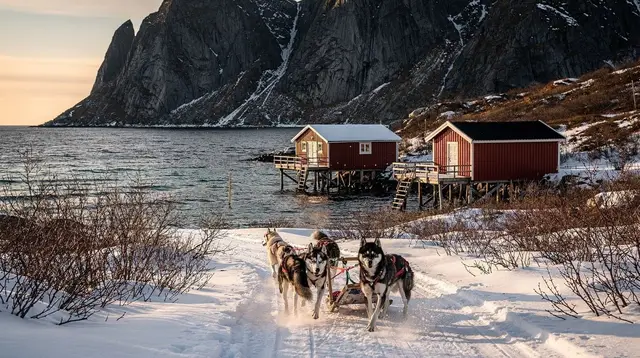
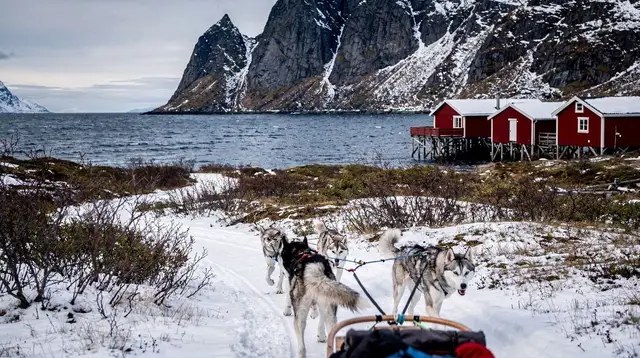
Dog Sledding Near Lofoten: Where to Go and What to Expect
Where can you go dog sledding near Lofoten, and when?
Dog sledding tours run out of Bodø and Narvik, both gateway towns rather than islands within Lofoten itself. The season follows reliable snow cover on the mainland, roughly the darker and colder months, and outings typically combine time with the dogs, a safety briefing, and a stretch on the sled itself.
First, a correction to expectations
Search for dog sledding and Lofoten together and you’ll find plenty of pages happy to imply huskies are waiting somewhere on Austvågøya or Moskenesøya. They aren’t. The bookable dog sledding excursions that actually run in this part of Arctic Norway are based out of Bodø and Narvik — mainland gateway towns that travelers use to reach the islands, not islands themselves. If a husky run is on your list for a Lofoten trip, it’s an add-on day built around one of these access points, not something you’ll stumble across in Reine or Svolvær.
That’s not a knock on the experience — it just changes how you plan it. The rest of this guide covers where these tours actually operate, what season makes them possible, what a day with the dogs typically involves, and how to fit one into a trip that’s mostly spent among the islands.
Where the tours actually run
Three general areas around the wider region host dog sledding operations that travelers based in Lofoten can reach:
Saltdal, inland from Bodø, is one departure point, reachable as an add-on from the Bodø side of a Lofoten trip — useful if you’re already routing through Bodø for the ferry to Moskenes or flying in and out of its airport. A dog sledding adventure departing from Bodø, out in the Saltdal valley is one way to build this into a day near the ferry terminal.
Sulitjelma, also accessed from the Bodø side, is a former mining area now used for kennels and sledding routes. A husky sledding excursion out to Sulitjelma from Bodø covers this option specifically, and it’s worth comparing against the Saltdal alternative before booking, since the two depart from the same town.
Narvik, reached by road along the E10 corridor or by the Ofoten railway, hosts sledding tours on the opposite side of the region from Bodø. A husky sledding outing with the Isogaisa operation near Narvik is the option there. Narvik also sits near Evenes airport and within range of Harstad, which matters if your itinerary flies in or out on that side rather than through Bodø.
None of these three departure points sit inside the Lofoten archipelago proper — all involve treating dog sledding as a detour from the islands rather than a stop within them.
The season
Dog sledding depends on dependable snow on the ground, which on the mainland near Bodø and Narvik generally means the colder, darker stretch of the year. This region sits above the Arctic Circle, so that period overlaps with the run-up to and the tail end of the polar night, when daylight is limited and temperatures — helped somewhat by the Gulf Stream, which keeps winters here milder than the latitude would suggest — still drop well below freezing on many days. Exact snow cover varies from one winter to the next, so any specific date range is a general guide rather than a guarantee.
If your trip falls outside the snowy window, snowshoeing in Lofoten or a half-day snowshoe tour within the islands themselves is a comparable winter activity that doesn’t depend on a separate trip to the mainland — a half-day snowshoe outing in Lofoten covers that ground.
Weather at this latitude is unpredictable at short notice regardless of season — the single most useful planning fact for any outdoor activity here — so operators build flexibility into their schedules and may adjust routes or timing on the day.
What a dog sledding outing actually involves
Format varies by operator, but most sledding excursions in this part of Norway follow a similar shape: an introduction to the dogs and the harnessing process, a safety briefing covering how to control a sled and what to do if something goes wrong, and then time out on the trail itself, either driving your own team or riding as a passenger behind a guide. Some tours let participants take the reins for at least part of the route; others keep visitors as passengers throughout a guide-driven sled. Warm outerwear is frequently provided given how cold conditions get, but this differs by operator, so it’s worth confirming directly rather than assuming a particular tour’s inclusions.
None of the three tours above are within Lofoten, which means the day typically also involves travel time to and from the departure town — factor that into how a sledding day fits around the rest of a Lofoten itinerary, especially in winter when daylight hours are short.
Comparing the three departure points
| Departure area | Reached from | Typical trip shape |
|---|---|---|
| Saltdal | Bodø | Day trip inland from Bodø |
| Sulitjelma | Bodø | Day trip inland from Bodø, former mining area |
| Narvik (Isogaisa) | Narvik / E10 corridor | Day trip from Narvik side of the region |
This is a rough shape, not a fixed schedule — actual routes, timing, and inclusions depend on the specific operator and are confirmed at booking.
Fitting a sledding day into a Lofoten trip
Because none of these tours sit inside the islands, the practical question is how to route a trip so a sledding day doesn’t eat disproportionately into island time. Travelers flying via Bodø, or taking the Bodø–Moskenes ferry, are naturally positioned for the Saltdal or Sulitjelma options before or after the crossing. Those arriving or departing via Evenes airport or driving the mainland stretch of the E10 sit closer to the Narvik option instead. Either way, this becomes a bolt-on day rather than something to squeeze between island stops — check car rental options if you’ll need your own transport to reach the departure point, and see the weather guide for how much buffer to build into a winter driving day.
For travelers who’d rather anchor an entire winter trip around this kind of add-on before returning to the islands, a five-day winter itinerary shows how a mainland detour like this can sit alongside island time without dominating the schedule. Other cold-season activities within the islands themselves, and the broader dog sledding category and day trips from Lofoten pages, cover further options if a mainland excursion doesn’t fit the itinerary. Bodø itself also offers the Saltstraumen tidal current as a second reason to build in a stop there beyond the ferry connection.
What to wear and what to bring
Even with warm outerwear frequently supplied by the operator, a dog sledding day still means standing outside for extended stretches in temperatures that regularly sit below freezing during the snow-reliant season — the Gulf Stream keeps this region’s winters milder than the latitude suggests, but “milder” here still means real cold, not a comfortable chill. Base and mid-layers worth wearing under any provided outerwear include thermal layers next to skin, an insulating mid-layer, and warm, waterproof boots rather than anything with a thin sole — standing on packed snow for a safety briefing and harnessing session adds up before the sled even starts moving. Gloves warm enough for genuinely cold-weather standing, not just brief exposure, and a hat or hood that covers the ears are worth having regardless of what an operator supplies, since fit and warmth vary between rented and personal gear.
A face covering for wind exposure while the sled is moving is also worth packing, particularly for anyone taking the reins rather than riding as a passenger, since speed adds a wind-chill effect on top of the ambient temperature.
Combining a sledding day with other cold-season activities
A single mainland detour rarely needs to be built around dog sledding alone. Bodø-based travelers who’ve already planned a Saltdal or Sulitjelma outing can reasonably add the Saltstraumen tidal current to the same stay, since both sit within reach of the town without requiring a second separate trip out from the islands. On the Narvik side, the same logic applies: a sledding day near Isogaisa pairs naturally with time spent around Narvik itself, given its own transport connections back into the islands.
Back within Lofoten, the same cold-season stretch that makes dog sledding possible on the mainland also supports snowshoeing, snowmobiling, and — weather and darkness permitting — a run of aurora viewing in the evenings. A trip built around one mainland sledding day bracketed by several island-based winter activities tends to feel more balanced than treating the sledding excursion as the entire point of the visit, particularly given how much travel time the mainland detour itself already consumes.
Booking considerations specific to this region
A few practical points are worth confirming directly with whichever operator you book, since none of them are consistent enough across this region to state as a general rule. Group size varies between operators and affects how much individual time you get with the dogs during the harnessing stage. Minimum age and any weight restrictions for driving your own sled differ by company, which matters directly for families weighing the passenger-versus-driver question raised earlier. Cancellation and rebooking policies around weather are also worth checking before paying, given how routinely conditions here shift at short notice — an operator used to operating through genuinely difficult Nordland winters usually has a clear policy for this, but it’s not something to assume without asking.
Because all three of the departure points covered here sit a genuine drive or transfer from the Lofoten islands themselves, it’s also worth confirming pickup and return logistics specifically: whether the tour includes transport from a central point in Bodø or Narvik, or whether you’re expected to arrive under your own arrangements. This detail changes whether a rental car is required for the sledding day itself, separate from whatever vehicle arrangement you’re using for the rest of a Lofoten trip.
Why this detour is worth the travel time
It’s fair to ask whether a mainland day trip is worth the driving, ferry, or flight time it takes out of a Lofoten-focused itinerary. The honest answer depends on what you’re actually after: if huskies and a genuine winter dogsledding experience are a firm priority, the detour is the only way to get there, since nothing equivalent exists within the archipelago itself. If the priority is simply “a memorable cold-season activity” without a specific attachment to sledding, the islands’ own winter offerings — snowshoeing, snowmobiling, aurora viewing — deliver a comparable sense of the season without the added travel.
Where the detour earns its keep most clearly is for travelers already routing through Bodø or Narvik for transport reasons rather than treating either as a special trip. A traveler already taking the Bodø–Moskenes ferry or flying via Evenes is spending time in these towns regardless of whether sledding is on the agenda — adding a half-day excursion to time that’s already being spent there costs far less in net itinerary disruption than a traveler who’d otherwise have no reason to visit Bodø or Narvik at all.
Dog sledding near Lofoten: your questions answered
Is there dog sledding inside the Lofoten islands?
Not as part of this guide’s bookable options — the tours covered here operate from Bodø and Narvik, both mainland gateway towns to Lofoten rather than the archipelago itself. Travelers base themselves in Lofoten and add a dog sledding day via one of these towns.
How do I get from Lofoten to Bodø or Narvik for a dog sledding tour?
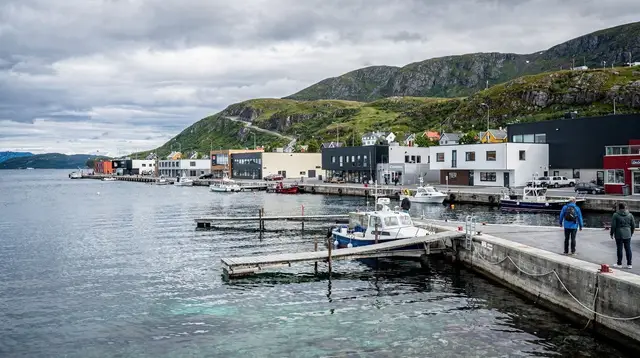
Bodø connects to Moskenes by a ferry crossing of roughly three to four hours, and also has its own airport. Narvik is reached by road along the E10 and connecting highways, and has both a rail line — the Ofoten line — and a nearby airport at Evenes.
What season is dog sledding available?
It depends on reliable snow cover, which on the mainland near Bodø and Narvik generally lines up with the colder, darker part of the year. Snow conditions vary year to year, so treat any specific date range as approximate rather than guaranteed.
What does a typical dog sledding outing include?
Most operators in this region structure a visit around meeting and helping harness the dogs, a safety briefing, and time on the sled — either driving your own or riding as a passenger behind a guide. Warm outer clothing is often provided given how cold conditions can get, but always confirm directly with the operator rather than assuming.
Can I drive the sled myself?
Some tours let participants handle their own sled and dog team for at least part of the route, while others keep guests as passengers throughout. This varies by operator and by group experience level, so it’s worth checking the specific tour’s format before booking.
Is dog sledding suitable for children?
Passenger-style sledding, where a guide drives and guests ride along, tends to suit families better than tours that require guests to control their own team. Confirm minimum ages and format directly with the operator, since policies differ.
Is dog sledding an expensive add-on to a Lofoten trip?
Lofoten and the surrounding region already sit at the pricier end of European travel, and a half- or full-day guided excursion involving specialist animals and equipment adds to that. Treat it as a splurge day within a broader trip budget rather than a routine outing.
Dog sledding adventures on GetYourGuide
Verified deep-linked GetYourGuide tours. Book through these links and we earn a small commission at no cost to you.
Photos show the destination, not the operator's own images.