The Football Pitch With No Stands
I saw the photo before I saw the place
I’d seen the picture long before I ever drove into Henningsvær: a small green rectangle of grass, hemmed in tight by rock and sea, with jagged peaks stacked up behind it like the whole scene had been arranged for a camera. I was staying in Svolvær at the time, on a loop that had already taken me through Kabelvåg that morning, and the drive down to Henningsvær was short enough that I nearly treated it as a footnote to the day rather than the main event. I assumed, the way you do with a photo that’s been reposted a thousand times, that it must have been shot from a drone at a flattering angle, cropped to hide something ordinary just outside the frame. It wasn’t. I walked to the edge of that pitch on my own two feet, and the surrounding scenery didn’t stop at the edge of the photo — it just kept going.
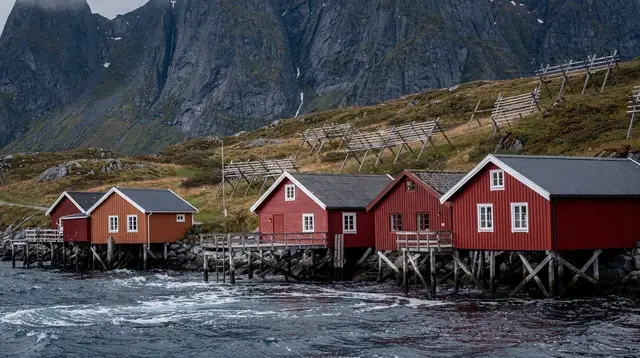
Henningsvær is a fishing village scattered across a handful of small islets on Austvågøya, connected by narrow bridges and roads that thread between houses built almost on top of the water. The football pitch sits at the edge of the settlement, squeezed onto a strip of flat land that, by any normal standard, shouldn’t exist here — everything around it is either mountain or ocean, and this pitch is neither.
Why there are no stands
The first thing that struck me, once I got over the view, was what wasn’t there: no bleachers, no grandstand, not even a proper fence separating the field from the water on one side. It isn’t a design oversight. There simply isn’t room. The pitch occupies close to all the flat ground available on this stretch of the islet, wedged between the sea on one side and the base of the surrounding peaks on the others. Building permanent seating would mean building over water or into rock, neither of which makes sense for a village football ground serving a small fishing community rather than a stadium crowd.
That absence turns out to be the whole reason the place photographs the way it does. Without stands blocking the view, the pitch reads as a flat green shape set directly against open water and vertical rock, with nothing artificial breaking the composition. It’s a football ground built for a community, not for spectacle, and the spectacle happened anyway, almost by accident, because there was nothing in the way of it.
Standing at the edge of the pitch
I got there in the early evening, when the light comes in low and sideways this far north and the water goes a shade of blue-grey that doesn’t photograph the same at midday. A few kids were kicking a ball around near one goal, paying no attention to the view the rest of us had driven a long way to see — which is, I think, exactly the point. This is a working pitch in a working village, not a museum piece roped off for tourists, and the ordinary use of it is part of what makes it feel real rather than staged.
I walked the perimeter slowly, trying different angles the way everyone who comes here apparently does, and kept landing on the same conclusion: there isn’t a bad angle. Whichever side you stand on, the mountains are there, the sea is there, and the pitch sits in the middle of both like it was dropped in from somewhere else. I didn’t need a drone. I didn’t need to climb anything. I just needed to be standing on solid ground in Henningsvær with a functioning pair of eyes.
Beyond the pitch
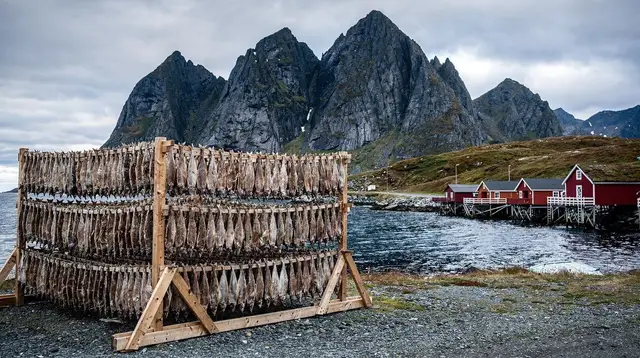
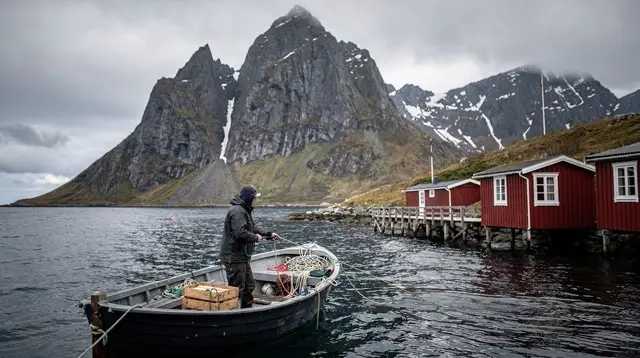
The pitch is what draws people to look up Henningsvær in the first place, but I stayed longer than I planned to because the rest of the village kept pulling me further in. It’s the kind of stop that a lot of multi-day Lofoten itineraries budget as a quick photo break between longer drives, and I understand the instinct — I’d planned the same thing myself that morning. Narrow lanes wind between old fishing buildings, some now housing small galleries and cafés, and every turn seems to open onto another slice of water framed by peaks. It’s the kind of place that rewards wandering without a fixed plan more than it rewards a checklist, and a guide to the fishing villages of Lofoten covers how Henningsvær compares to the archipelago’s other historic harbours if you’re deciding how much time to allot it.
If you’re here for photography specifically, and the pitch is only one item on a longer list, the photography guide to Lofoten is worth reading before you arrive, since the same low, raking evening light that made the pitch look the way it did for me works just as well on the boats in the harbour and the older buildings along the water.
What I did with the rest of the evening
Once the light started to flatten out and the kids had gone home for dinner, I wandered down toward the harbour and found myself weighing an evening boat trip instead of heading straight back. A sea eagle and nature safari departing from around here turned out to be a good way to see the same jagged coastline from the water rather than from the pitch’s edge, watching the peaks I’d been staring at all evening recede as the boat pulled out into open channel.
If you’re visiting in the warmer months and fancy something in the water rather than just on it, a summer snorkeling trip that includes time with grey seals is one of the more unexpected activities based out of this part of the islands — not something I’d have guessed existed before this trip, and a genuinely different way to spend a few hours than another round of photographs on dry land. For anyone curious what else shares these waters, wildlife in Lofoten covers the animals you’re actually likely to encounter, seals included.
Later, once it was properly dark and the season was right for it, I ended up on a guided northern lights hunt out of Svolvær, which felt like a natural bookend to a day that started with a football pitch and ended with the sky doing something the pitch never could.
A pitch that doesn’t need an explanation
I ended up staying in the village itself that night rather than driving back — see where to stay in Lofoten if a fishing-village base like this one appeals more than a bigger town — and I’ve thought since about why this small, unglamorous football ground has ended up as one of the more shared images of the whole archipelago, more than almost any of Lofoten’s actual landmarks. I think it’s because it isn’t trying to be anything. Nobody built it for a photograph. It’s a place where local kids play football, set down on the only flat ground available, and the mountains and sea happened to already be there.
If you’re driving the E10 through Henningsvær and only have twenty minutes to spare, it’s still worth the stop — but budget more than twenty minutes, because once you’re standing at the edge of that pitch, the rest of the village has a way of keeping you there longer than you planned.
Fishing village tours on GetYourGuide
Verified deep-linked GetYourGuide tours. Book through these links and we earn a small commission at no cost to you.
Photos show the destination, not the operator's own images.