Wildlife in Lofoten: What You Can Actually See
What wildlife can you see in Lofoten?
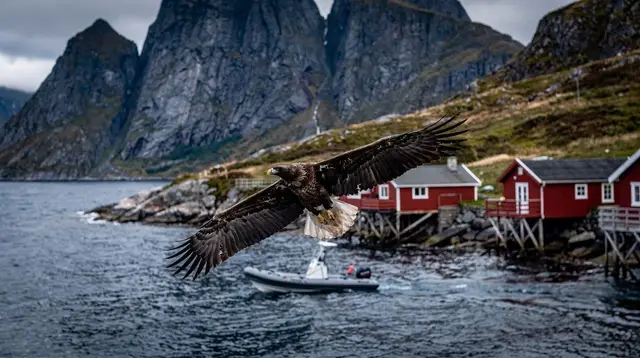
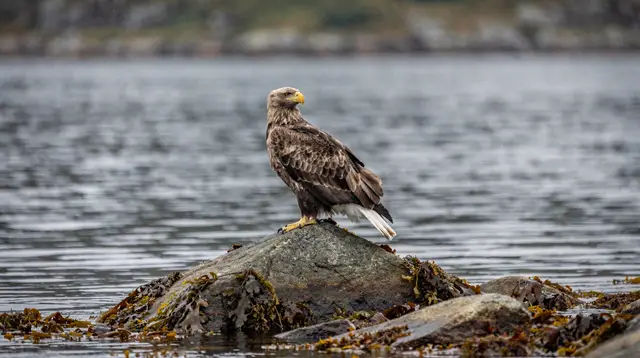
White-tailed sea eagles are commonly seen along the coast year-round. Seals and otters appear near shorelines and fjords, seabird colonies including puffins are seasonal (roughly late spring to summer), and moose are more associated with the wider Vesterålen area to the north than the main islands.
Wildlife in Lofoten is often oversold in one direction and undersold in another. There are no polar bears, no glaciers hiding herds of Arctic mammals, and nothing resembling a safari-park density of animals. What’s actually here is a working coastal ecosystem — sea eagles, seals, otters, and vast seasonal seabird colonies — that rewards patience, the right season, and, in most cases, a boat.
It helps to reset expectations coming in. This isn’t a destination built around guaranteed, close-range animal encounters the way some more classic safari destinations are — there’s no equivalent of a game drive where sightings are close to certain within a short window. What you’re looking at instead is a normal, working northern coastline where wildlife exists on its own terms, some of it visible with real reliability (sea eagles, seasonal seabirds) and some of it genuinely a matter of chance (otters, in particular). Framing a trip around curiosity and patience, rather than a checklist of guaranteed species, tends to produce a more satisfying experience than framing it around expectations this coast was never going to meet.
Sea eagles: the most reliable sighting
White-tailed sea eagles are the wildlife most visitors actually encounter, and unlike a lot of what gets promised on wildlife trips elsewhere, they’re genuinely common along this coast. They’re resident year-round, which means sightings aren’t tied to a narrow migration window the way some other species are. The coast around Svolvær and toward Trollfjord is a particularly consistent area, and a dedicated trip built around finding them — covered in detail in the sea eagle safari guide — has meaningfully better odds than a general sightseeing cruise.
Sightings usually happen from the water rather than from shore, since eagles range along the fjords and skerries where fish are easiest to catch, often circling above a boat’s wake or perching on a rock face waiting for scraps from the day’s fishing. A RIB cruise into Trollfjord built around spotting wildlife along the way covers some of the same ground as a dedicated eagle safari but moves faster and sits lower on the water, which changes both the pace of the trip and how close you get to the cliffs where eagles perch.
Morning departures tend to have an edge, since boat traffic is lighter and eagles are typically already active feeding by then, but this isn’t an absolute rule — a good guide reads recent activity and local conditions rather than following a fixed schedule. As with everything on this coast, sea conditions can shift within the hour, and a route planned around calm water in the morning may need adjusting if wind or swell picks up later in the day.
Local fishing activity plays a role too: eagles and gulls alike often follow working boats hoping for scraps, which means a fishing trip out from one of Lofoten’s harbours can double as an unplanned wildlife outing, especially if eagles are active in the area that day. It isn’t a guaranteed wildlife experience — the trip is built around fishing, not sightings — but it’s a genuine secondary benefit worth knowing about if you’re deciding between a dedicated eagle safari and a more general day on the water.
Seals and otters: coastal, quieter, less predictable
Seals turn up around fjords, skerries, and quieter coastal stretches throughout the archipelago, sometimes visible from shore near fishing villages, sometimes only from a boat. Otters are present too, but they’re shier and less often seen — a genuine sighting tends to happen by chance rather than by design, usually near quiet shoreline at dawn or dusk rather than during a scheduled tour. Neither species has the same dedicated tour infrastructure that sea eagles or whales have; seeing them is more a matter of being on or near the water regularly than booking a specific “seal safari.”
For a different way to experience the same coastal ecosystem, a guided snorkeling outing suitable for families puts you in the water rather than on it, which shows a side of this environment — kelp forests, fish, the texture of the shoreline below the surface — that a boat trip never reaches. It isn’t a reliable way to encounter seals or otters specifically, since neither species is habituated to swimmers here the way marine mammals sometimes are in warmer, more tourism-developed waters, but it reframes the coastline as something to look into rather than only across, and works well as a complement to a boat-based wildlife day rather than a replacement for one.
Seabird colonies and puffins: strictly seasonal
The archipelago’s seabird colonies, including its puffins, are the wildlife spectacle with the narrowest window. Røst and Værøy, toward the outer end of the chain, hold some of the larger colonies, and during the nesting season — roughly late spring through summer — the numbers involved are genuinely large. Outside that window, the colonies thin dramatically as birds disperse back to open sea, so a visit planned around puffins specifically needs to respect that calendar rather than treating it as a year-round possibility. The dedicated guide to puffins and seabirds goes into the seasonal pattern and viewing spots in more depth.
Reaching Røst or Værøy generally means a boat trip in its own right, longer than a same-day excursion from the main Lofoten islands, which is part of why a dedicated puffin trip is often planned as its own day rather than tacked onto a broader sightseeing itinerary. Anyone building a trip specifically around the nesting season should check timing carefully rather than assuming any summer date works equally well — the window narrows on both ends, and arriving too early or too late in the season can mean colonies that are either not yet active or already thinning out.
Moose: a Vesterålen story, not a Lofoten one
Moose are commonly associated with Norway generally, and they do appear in this wider region — but the more reliable area for them is Vesterålen, the group of islands north of the main Lofoten archipelago, rather than Lofoten itself. Towns like Sortland run dedicated moose safaris, often by car along known feeding routes at dawn or dusk, sometimes combined with other wildlife themes. A scenic wildlife tour along the Andøya route from Sortland is one way to see this landscape with a chance of a moose sighting built in, without expecting the same odds within the main Lofoten islands themselves.
| Animal | Where | Season | Realistic odds |
|---|---|---|---|
| White-tailed sea eagle | Coastal, especially near Svolvær/Trollfjord | Year-round | Good, with a dedicated safari |
| Seals | Fjords, skerries, quiet coastline | Year-round | Moderate, opportunistic |
| Otters | Quiet shoreline, dawn/dusk | Year-round | Low, mostly by chance |
| Puffins/seabirds | Røst, Værøy, outer skerries | Late spring–summer | High, in season only |
| Moose | Vesterålen (Sortland area) | Year-round, best dawn/dusk | Moderate, with a dedicated safari |
Reindeer are also part of the wider region’s wildlife picture, tied to Sámi culture and herding practices across northern Norway rather than to wild, unmanaged populations the way moose are. They’re not a defining feature of a Lofoten wildlife trip specifically, but travelers curious about the cultural context around reindeer herding in this part of the country will find more relevant detail in the Sámi culture guide than in anything built around spotting animals independently. Treat reindeer as a cultural thread that runs alongside the region’s wildlife story rather than as another species to add to a wildlife checklist.
Whales: a different region within reach
Whale watching is a related but distinct activity, based further north around Andenes on Vesterålen rather than within the Lofoten islands themselves. It’s covered separately in the whale watching guide, but it’s worth mentioning here since travellers planning a wildlife-focused trip often combine a Lofoten stay with a detour north specifically for whales.
How weather shapes a wildlife trip
Every wildlife activity on this coast is downstream of the weather, and it’s worth planning with that in mind rather than treating a booked departure time as fixed. A calm, clear morning can turn choppy and grey within the hour, and operators running eagle safaris, RIB cruises, or moose-spotting drives will adjust routes, shorten trips, or reschedule rather than push through conditions that make wildlife harder to find and less pleasant to look for. That’s a safety and quality decision, not an inconvenience — a boat pitching in rough water is a worse platform for spotting an eagle on a distant cliff than a calm one, regardless of how determined the guide is.
Build slack into any day built around a wildlife activity, particularly if you only have one attempt scheduled during a short trip. A second morning held in reserve, even informally, is worth more than a tightly packed itinerary that leaves no room to try again if the first outing gets cancelled or cut short by conditions.
Photographing wildlife on this coast
Distance is the main practical constraint. Sea eagles, seals, and moose are all realistically photographed only with a telephoto lens of real reach — a phone camera or a standard kit lens captures the experience of being there but rarely the animal itself at any meaningful size in the frame. If wildlife photography specifically is the goal rather than a general souvenir of the trip, it’s worth bringing equipment suited to that before arriving, since specialist gear isn’t something you can easily rent locally.
Light matters as much as distance. The long, low-angle light around the midnight sun season or the extended twilight of the shoulder seasons can produce genuinely striking images of a bird in flight or a seal hauled out on a rock, more so than the flatter light of an overcast midday. The photography guide to Lofoten covers the wider technical picture — settings, gear, and light — beyond wildlife specifically, and is worth reading alongside this guide if photography is a priority for the trip rather than an afterthought.
Combining wildlife with the rest of a Lofoten trip
Wildlife rarely works as the sole organizing theme of a Lofoten trip, if only because the best sightings for different species pull in different directions — sea eagles are most reliable near Svolvær and Trollfjord, puffins demand a detour to Røst or Værøy, and moose require heading north into Vesterålen. A realistic itinerary treats wildlife as one strand among several rather than the entire plan, built around whichever one or two species matter most to you rather than trying to fit all of them into a short trip.
For most first-time visitors, that means picking sea eagles as the anchor, since they’re the most reliably seen species and the safaris built around them fit naturally alongside the rest of a standard Lofoten itinerary based around Svolvær or the western villages. Puffins and moose are worth the added detour only if the season lines up and the itinerary has the extra day or two to spare — otherwise they’re better treated as a reason to come back on a separate, dedicated trip rather than squeezed into a schedule that doesn’t really have room for them.
Setting expectations before booking
The single most useful thing to know before booking any wildlife activity here is that nothing is guaranteed, and any tour or article implying otherwise is overselling. What can genuinely be promised is a well-chosen season, a guide with local knowledge of recent activity, and realistic odds that vary by species — high for sea eagles and seasonal puffins, moderate for seals and moose, low for a deliberate otter sighting. Planning around that honestly produces a better trip than chasing a guaranteed encounter that doesn’t exist.
That also means it’s worth deciding, before you book anything, which species actually matter to your trip and which are a bonus if they happen. A visitor who books an eagle safari hoping incidentally for a moose, a seal, and a puffin in the same outing is setting up a disappointing benchmark for what is, on its own terms, a genuinely good eagle safari. Treating each activity as being about the species it’s actually built around — and treating anything else spotted along the way as a bonus — keeps expectations aligned with what a working coastline can realistically offer on any given day.
Common questions about Lofoten wildlife
Are there polar bears in Lofoten?
No. There are no polar bears anywhere in the Lofoten archipelago. That species is associated with Svalbard, far to the north, not with mainland Norway or Lofoten.
What’s the easiest wildlife to see without a tour?
Seabirds and, in some areas, seals can sometimes be seen from shore or a coastal walk without a boat, though a guided trip generally improves the odds and gets closer to known spots.
When can you see puffins in Lofoten and nearby islands?
Roughly late spring through summer, when seabird colonies including puffins are active on nesting cliffs and skerries, such as around Røst and Værøy. Outside that window, most birds have dispersed to open sea.
Where are moose most likely to be seen?
Moose are more associated with the wider Vesterålen region, north of the main Lofoten islands, than with Lofoten itself, and dedicated moose safaris tend to operate from towns like Sortland.
Do sea eagles and other wildlife appear in winter?
Sea eagles are resident year-round, so winter sightings do happen, but fewer boat tours operate then and daylight is far shorter, especially during the polar night.
Is a guided safari necessary to see wildlife in Lofoten?
Not strictly necessary for every species, but a guided boat safari with local knowledge substantially improves the odds for sea eagles and other coastal wildlife compared to unguided attempts.
Wildlife & nature tours on GetYourGuide
Verified deep-linked GetYourGuide tours. Book through these links and we earn a small commission at no cost to you.
Photos show the destination, not the operator's own images.