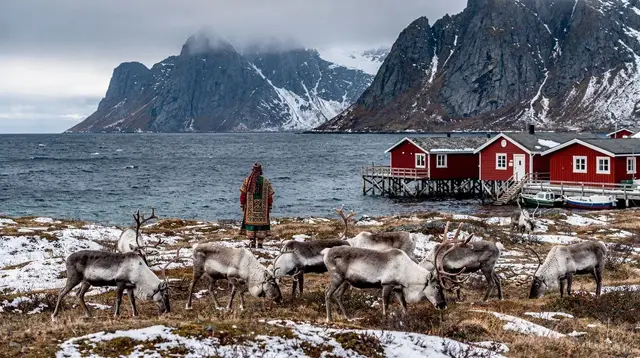
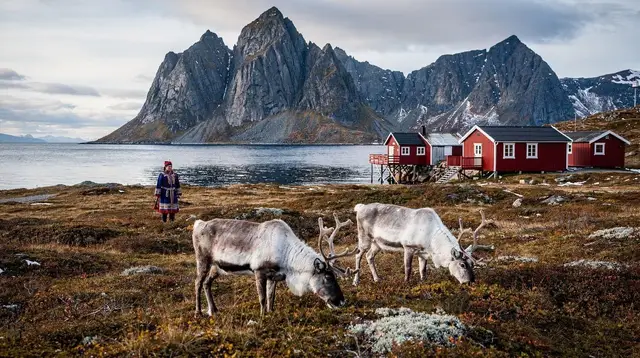
Sámi Culture in Northern Norway: What a Visit Can and Can't Teach You
Can I experience Sámi culture in Lofoten itself?
Not really as a primary destination. Sámi culture and reindeer herding are rooted in the wider northern Norway region rather than the Lofoten archipelago specifically, though a small number of organized experiences bring aspects of it within reach of Lofoten-based travelers.
Start with what Lofoten is, and isn’t
Lofoten’s identity is built around fishing: the skrei runs, the drying racks, the rorbuer that once housed seasonal fishermen and now house tourists. That’s a real and specific culture, but it isn’t the Sámi one. The Sámi homeland, known as Sápmi, stretches across a much larger swath of northern Scandinavia and into Russia, with a history and set of livelihoods — reindeer herding chief among them — that developed in inland and tundra landscapes, not on these fishing islands.
That distinction matters for travelers because it’s easy to conflate “the Arctic” with a single culture, when in fact northern Norway holds several distinct ones layered across the same latitude. A visit that’s honest about this gets more out of the experience than one that arrives expecting Sámi life to be woven through every Lofoten village.
What’s actually reachable from a Lofoten-based trip
A handful of organized experiences bring elements of Sámi culture within reach of travelers based in the archipelago, typically run from gateway towns like Svolvær, Bodø, Narvik or Harstad rather than from inside Lofoten itself. These usually combine reindeer encounters with storytelling and traditional food, led by Sámi guides. They’re a genuine introduction, not a comprehensive one — think of them as a starting point rather than a deep dive.
If deeper engagement with Sámi culture and history is a priority for your trip, it’s worth building in time beyond Lofoten specifically, further north and inland where Sámi cultural institutions, museums, and herding communities are more concentrated.
Sápmi is bigger than northern Norway alone
It’s worth holding the scale of Sápmi in mind before booking anything. The Sámi homeland stretches across a much wider area of northern Scandinavia and into Russia than the stretch of coast covered by a Lofoten trip — reindeer herding, in particular, is organized around inland and tundra terrain that has little in common with the fjords and fishing villages further west. What’s reachable as a day trip from Svolvær, Bodø, Narvik, or Harstad is a genuine but geographically narrow slice of that much larger picture, concentrated in the gateway towns because that’s where organized experiences have developed a base to operate from, not because that’s where Sámi life is most concentrated.
What a respectful visit looks like
The most useful guideline is simple: choose experiences that are Sámi-owned or Sámi-guided, and let the people running them set the pace of what’s shared. A short organized visit typically touches on reindeer herding as a livelihood, traditional food, and storytelling — treat it as listening and learning, not as a photo opportunity built around someone else’s traditional dress. If a guide offers context you didn’t ask for, that’s usually more valuable than whatever question you had planned.
It’s also worth being upfront with yourself about scope. A two-hour organized experience can convey real information and real hospitality, but it cannot substitute for sustained study or lived understanding — treat what you learn as an introduction, and follow up afterward if it interests you, rather than assuming a single afternoon covers the subject.
A few practical signs distinguish a well-run experience from one worth being more cautious about. Sámi ownership or Sámi guiding of the experience itself is the single clearest signal — an operation actually run by Sámi people, rather than one that simply features reindeer and traditional dress as visual props, tends to frame the visit as an introduction to a living culture rather than a fixed performance staged for tourists. A guide who answers questions with real specifics, rather than generic statements that could apply to any indigenous culture anywhere, is another good sign. And an experience that leaves room for genuine conversation, rather than moving briskly through a checklist of photo stops, usually reflects an operator who sees the visit as cultural exchange first and a transaction second.
Reindeer as livelihood, not spectacle
It’s worth returning to why the framing matters so much here. A herd of reindeer, encountered without context, is easy to photograph as a striking Arctic animal and move on from — which misses the actual point of an organized encounter. What makes these experiences worthwhile is the explanation that comes with them: how herding works as a livelihood across the seasons, how it’s organized around movement and land rather than fixed pasture, and how it connects to broader Sámi economic and cultural life rather than existing as a stand-alone attraction. An encounter that skips that explanation and treats the animals purely as photogenic wildlife has, in a real sense, missed the reason the experience is offered as a cultural one rather than folded into a generic wildlife-safari itinerary.
Reindeer, and why they’re not just wildlife here
Reindeer are easy to frame as a wildlife-watching activity, and in a purely visual sense that’s what a first encounter can feel like. But in this region reindeer herding is a specific cultural and economic practice tied closely to Sámi livelihood, not a generic nature experience. Organized encounters that include a Sámi guide explaining the herding practice itself — rather than simply presenting animals for photos — tend to be the more substantive option, and are worth prioritizing when comparing what’s on offer.
If you’re also interested in northern Norway’s wider wildlife beyond this cultural context, see our separate guide to wildlife in Lofoten, which covers sea eagles, whales and other species along a different, non-Sámi thread of the region’s nature.
Food as an entry point
Traditional Sámi food, often built around reindeer meat and prepared simply, tends to feature in the same organized experiences that cover herding and storytelling. It’s a practical, low-pressure way to engage with the culture — food invites conversation more naturally than an exhibit does, and several of the available experiences build a shared meal into the visit specifically for that reason. A shared meal also tends to slow the pace of a visit in a useful way: sitting down together gives a guide room to answer questions that come up naturally rather than sticking to a fixed script, and it’s often where the most substantive conversation of the whole visit actually happens.
How the gateway-town options compare
Since none of these experiences run from inside the Lofoten islands themselves, which gateway town you’re routing through matters as much as which specific tour you book. The broad pattern:
| Gateway town | What tends to be on offer | Notes for Lofoten-based travelers |
|---|---|---|
| Svolvær | Culture-and-reindeer experiences aimed squarely at Lofoten visitors | Closest option if you’re based on Austvågøya |
| Bodø | Combined wildlife and reindeer-adjacent experiences | Convenient if you’re already routing through Bodø for the ferry or airport |
| Narvik | Reindeer experiences with storytelling and food, sometimes paired with fjord scenery | A reasonable stop if Narvik is part of your arrival or departure route |
| Harstad | Combined fjord and reindeer-farm day tours, often paired with Narvik | Best suited to a full day trip rather than a quick add-on |
None of these are ranked against each other in quality; the practical choice usually comes down to which town already fits your route, since a dedicated round trip purely for this purpose adds a significant chunk of driving to a Lofoten-based itinerary.
Budgeting for a Sámi cultural stop
There’s no single fixed price to quote, but it’s worth placing an organized experience against the region’s general daily spending ranges: a routard-style budget runs around 980 NOK per person per day, a mid-range trip closer to 3,190 NOK, and a higher-end one around 7,500 NOK, with roughly 11.2 NOK to the euro. A half-day cultural experience with food included tends to sit as a single, fixed-price line item against whichever of those budgets you’re already working with, rather than a cost you can trim by doing it independently — unlike, say, aurora-watching, there isn’t a meaningful DIY version of a Sámi cultural visit, since the whole value of it depends on being led by people who actually practice the culture.
How the seasons shape a visit
Reindeer herding and the organized experiences built around it don’t run on a fixed year-round schedule the way a museum does — what a herd is doing, and how visible that is to visitors, shifts with the season, and it’s worth asking an operator directly what a given time of year actually involves rather than assuming a summer visit and a winter one look the same. Winter, which brings both the aurora season running roughly September to early April and, at its darkest, the polar night around early December to early January, is also when several operators combine a Sámi cultural stop with a northern lights outing on the same evening, since both benefit from the same long darkness.
Summer’s near-constant daylight through the midnight sun period changes the rhythm again, favoring daytime storytelling and food over anything built around darkness.
Whatever the season, Lofoten’s weather can shift within the hour, and the gateway towns where these experiences are based aren’t exempt from that — an outdoor component may move indoors or get cut short if conditions turn, which is a reasonable thing to ask about when booking rather than something to be surprised by on the day.
What a rushed visit misses
The most common mistake isn’t disrespect so much as treating a Sámi cultural stop as a quick photo-and-move-on addition to a fuller day of scenery elsewhere. A short encounter genuinely can convey real information, but only if there’s enough unhurried time for the guide to actually talk — about herding, about food, about whatever context they choose to share — rather than treating the visit as a fixed set of photo opportunities to get through before driving on to the next stop. Visitors who arrive expecting a museum-style exhibit, complete with fixed placards and a controlled walkthrough, sometimes come away unsatisfied for the wrong reason: this is closer to a conversation than an exhibition, and it rewards the same patience you’d bring to any conversation with someone sharing their own life and work.
For a different, exhibit-style complement to this kind of encounter, the region’s museums cover fixed historical material in a format some visitors find easier to plan time around.
Getting to these experiences from a Lofoten base
Because these experiences run out of the gateway towns rather than from inside the archipelago, reaching one usually means building a specific day around the drive out and back, rather than folding it into a normal Lofoten sightseeing day. Our guide to getting to Lofoten covers how the gateway towns connect to the islands in the first place, and car rental in Lofoten covers what driving that stretch yourself involves if you’re not joining an organized tour that includes transport. Travelers without their own car should check whether pickup from a Lofoten base is included, since some of these experiences are structured for gateway-town visitors first and Lofoten-based travelers second.
Combining this with a wider northern Norway trip
Because Sámi cultural experiences reachable from Lofoten are mostly based in the gateway towns rather than the islands, they pair naturally with a day trip that also covers other regional highlights — a fjord crossing near Narvik, or a stop near Harstad on the way to or from the archipelago. See our guide to day trips from Lofoten for how to slot one of these into a broader week, and getting around Lofoten if you’re planning the logistics yourself.
For those short on time, a Sámi culture and reindeer experience departing from Svolvær is the most directly accessible option for Lofoten-based travelers. A more involved version, the reindeer experience with storytelling and a traditional lunch out of Narvik, builds in more time for conversation and food alongside the herding demonstration. Travelers combining this with a broader regional day can also look at a fjord day tour between Narvik and Harstad with a stop at a reindeer farm, which folds the cultural stop into a wider scenic route.
How much time to set aside
Most organized experiences reachable from Lofoten run as a half-day commitment once travel time to and from the gateway town is included, rather than a quick hour-long stop. Because none of them sit inside the archipelago itself, the drive out and back is usually the largest single chunk of time in the day, more than the experience itself — worth planning for honestly rather than assuming it slots into a spare afternoon alongside other sightseeing. Combined tours that pair a reindeer experience with fjord scenery or another regional stop naturally extend to a fuller day, which suits travelers who’d rather make one deliberate day of it than treat the cultural visit as a brief detour bolted onto an otherwise unrelated itinerary.
Setting expectations before you book
None of this is meant to discourage the visit — a well-run, Sámi-guided experience is a genuinely worthwhile addition to a trip through this region. The point is simply to arrive with accurate expectations: Sámi culture belongs to a different part of northern Norway’s story than the fishing heritage that defines Lofoten itself, and a short organized visit is best understood as a respectful introduction rather than the whole picture.
Sami culture experiences on GetYourGuide
Verified deep-linked GetYourGuide tours. Book through these links and we earn a small commission at no cost to you.
Photos show the destination, not the operator's own images.