The Museums That Explain Lofoten
Which Lofoten museum should I prioritize if I only have time for one?
The Lofotr Viking Museum at Borg, for most visitors, since it covers a period of history unique to this region and includes a reconstructed longhouse rather than only static displays. Anyone specifically interested in the fishery should prioritize the museum at Å instead.
Lofoten’s landscape explains itself reasonably well on sight — the peaks, the fjords, the fishing racks are all visible from the road. What the landscape doesn’t explain on its own is why people settled here in the first place, how a Viking-age chieftain ended up with a longhouse on a relatively remote island, or what actually happened along this coast during the Second World War. For that context, three museums do most of the work: the Lofotr Viking Museum at Borg, the fishing village museum at Å, and the war museum in Narvik, on the mainland gateway to the islands.
Lofotr Viking Museum, Borg
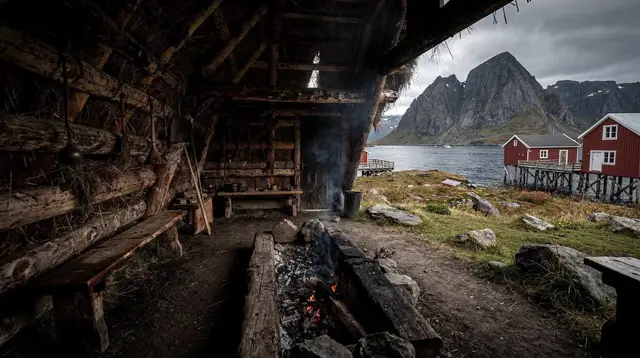
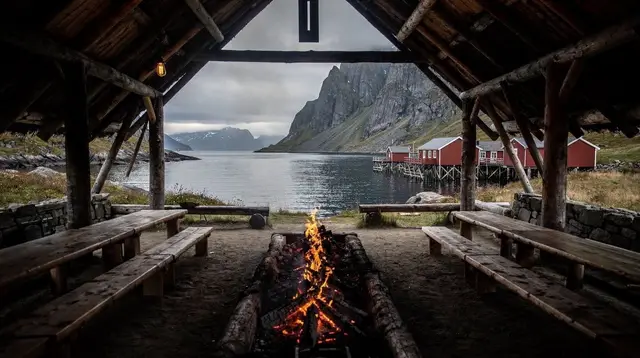
At Borg, on Vestvågøya, archaeologists uncovered the foundations of what turned out to be the largest known Viking-age longhouse in Scandinavia — roughly 83 meters long, belonging to a chieftain whose household controlled significant trade and resources in the region. The museum built around that discovery includes a full-scale reconstruction of the longhouse, populated with costumed interpreters during the main season, alongside more conventional exhibition space covering the archaeological finds themselves.
The value of Lofotr isn’t just the Viking history in isolation — it’s the context it gives for why Lofoten mattered at all a thousand years ago. The wealth visible in that longhouse came substantially from control of fishing and trade routes along this coast, the same fundamental resource — cod — that still shapes the local economy through the modern skrei fishery. Seeing the scale of that Viking-age household makes the continuity between then and the fishing communities of today, in places like Ballstad or Henningsvær, considerably more legible.
Visiting works differently depending on the season. During the main summer months, when costumed interpreters are present and the longhouse is fully staffed, a visit tends to run longer and feels more like stepping into an active recreation than a static exhibit. Outside that period, the site is generally still open, but with a quieter, more conventional museum experience — the building and archaeology are there year-round, even if the interpreted activity around it is more seasonal.
Because much of the appeal sits in the reconstructed longhouse itself, a visit here works regardless of weather in a way that outdoor sightseeing doesn’t — useful to know if you’re planning a Vestvågøya day around a forecast that might turn wet or windy, given how quickly conditions here can shift. Pairing a Lofotr visit with a beach stop at Haukland or Uttakleiv earlier or later in the day is a natural way to balance an indoor cultural stop with time outdoors, without the whole day depending on the weather cooperating.
Families traveling with children often find museum days a useful counterbalance to the more physically demanding parts of a Lofoten itinerary — the reconstructed longhouse at Lofotr in particular tends to hold younger visitors’ attention better than a purely static exhibit would, given the scale of the building itself and the presence of costumed interpreters in season. See our Lofoten with kids guide for how a cultural stop like this fits alongside beaches, easier walks, and other lower-effort activities across a family itinerary.
The fishing village museum at Å
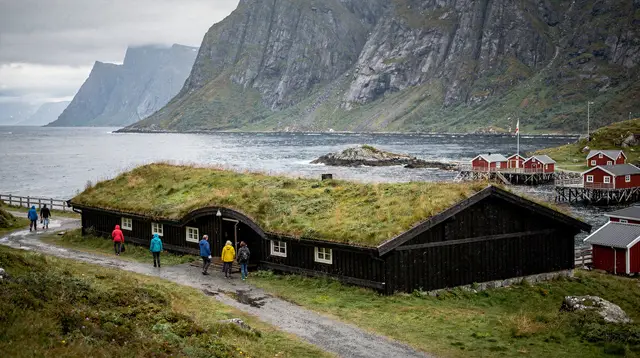
At the very end of the E10, Å i Lofoten is both a functioning small settlement and, in parts, an open-air museum preserving original fishing village buildings — boathouses, a bakery, workers’ quarters, and equipment tied directly to the historical cod fishery. Unlike Lofotr, which reconstructs a specific find, the museum at Å works by preserving what was largely already there: original rorbuer, a working stockfish-drying operation nearby, and buildings that give a tangible sense of what daily life for a fishing family here looked like across recent generations rather than in the distant past.
Because Å sits at the literal end of the road, a visit here pairs naturally with the western end of a Moskenesøya day — Reine, Hamnøy, and Reinebringen are all a short drive back along the same route, and the Moskstraumen current is visible from nearby viewpoints as well.
A visit here rewards slower pacing than a conventional single-building museum, since the value is largely in walking between original structures rather than moving through one continuous exhibit hall. Give yourself time to actually stop at each building rather than treating it as a quick photo circuit — the boathouses, the bakery, and the workers’ quarters each tell a different part of the same story, and rushing through misses the cumulative effect of seeing them together.
Å’s position at the literal end of the road also means it’s exposed to the same fast-changing coastal weather as anywhere else in the archipelago, so a visit planned for a clear afternoon can turn considerably colder and windier by the time you’re walking between the outer buildings. Dressing in layers, even for what looks like a short museum stop, avoids cutting the visit shorter than you intended because of a wind that wasn’t in the forecast when you set out.
Narvik War Museum
Narvik, on the mainland route into Lofoten via road or the Ofoten railway, was the site of significant fighting during the Battle of Narvik in 1940, one of the earliest major engagements of the Second World War in Norway and a turning point in the campaign for control of the region’s iron ore shipping routes. The war museum there covers this history directly, with artifacts, personal accounts, and context on why this particular port town mattered strategically at all.
This isn’t a Lofoten museum in the strict sense — Narvik sits on the mainland gateway rather than the islands themselves — but for visitors routing through Narvik on the way in or out, or with any interest in the wartime history of northern Norway, a visit to the Narvik War Museum is a substantive, well-documented stop rather than a minor detour.
Getting to Narvik itself, whether by the E10 and connecting roads or via the Ofoten railway, is as much a part of the regional context as the museum content itself — the same iron ore route that made Narvik strategically significant during the war is still in active use, and the railway journey through the mountains behind the town gives a sense of why this particular corridor mattered enough to fight over. Travelers arriving in Lofoten via Evenes airport, which sits closer to Narvik and Harstad than to the islands proper, are often better positioned to add this stop than those flying directly into Svolvær or Leknes.
Because the museum sits within the town itself rather than at a remote site, it’s straightforward to combine with a wider look at Narvik — the railway heritage, the harbor, and the surrounding fjord scenery — rather than treating the museum as an isolated stop bolted onto a transit day.
Comparing the three
| Museum | Location | Focus | Best paired with |
|---|---|---|---|
| Lofotr Viking Museum | Borg, Vestvågøya | Viking-age longhouse and archaeology | Leknes, Ballstad |
| Fishing village museum | Å i Lofoten | Preserved fishing village, stockfish tradition | Reine, Moskstraumen |
| War museum | Narvik | Battle of Narvik, WWII | Evenes airport, mainland routes |
Smaller cultural stops worth knowing about
Beyond the three major sites, smaller cultural and craft venues exist around the archipelago and can round out a museum-focused day. a glass jewelry workshop in Kabelvåg offers a hands-on craft experience rather than a passive museum visit, useful for travelers who want to make something rather than only look at exhibits. For a lighter, less historically weighted stop, an entry ticket to the Magic Ice Bar with a welcome drink is a novelty attraction rather than a cultural or historical site, worth knowing about as something different to do on an evening rather than confusing it with the museums covered above.
Sámi culture in the wider region
None of the three main museums above focus specifically on Sámi culture, which is present in the broader Nordland and Troms region rather than concentrated within the Lofoten islands themselves. If that’s a specific interest, see Sámi culture in northern Norway for where that history and present-day culture is most accessibly presented, generally further from the archipelago itself.
Using museums as a weather-proof backbone
Because Lofoten’s weather can turn within the hour, and few outdoor activities here come with a genuine guarantee, museum stops are worth building into an itinerary deliberately rather than treating them as an afterthought for a rained-out day. Unlike a hike, a kayak trip, or a beach stop, none of the three main sites above depend on clear skies to be worthwhile, which makes them a reliable anchor for a day when the forecast looks uncertain in either direction.
That doesn’t mean saving all three for a single bad-weather day — Lofotr and Å in particular sit far enough apart that combining both into one day adds significant driving without much time to actually absorb either site. A more workable approach treats each museum as its own half-day, folded into whichever day of a longer itinerary makes sense geographically, rather than clustering them together purely because the weather that day happened to be poor.
Fitting museums into a longer itinerary
For a first Lofoten trip built around the standard Austvågøya-to-Moskenesøya route, Lofotr fits naturally into a Vestvågøya day, and the museum at Å fits just as naturally into whichever day already reaches Reine and the western villages, since backtracking specifically for either museum adds driving that a well-sequenced itinerary shouldn’t need. The Narvik War Museum is different in kind — it only makes sense if your route already passes through Narvik as an arrival or departure point, rather than as a dedicated day trip from within the islands themselves, given the distance involved.
Anyone planning a trip specifically around cultural and historical sites, rather than fitting museums around an otherwise landscape-focused itinerary, should treat that as reason enough to allow an extra day or two beyond the standard route, rather than compressing three substantial sites into days already built around driving and outdoor activities.
Practical notes
Expect an entry fee at each of the major sites, and check opening hours ahead of a visit, particularly outside the main summer season, since reduced winter hours are common at smaller cultural sites across the region. None of these museums require advance booking for general entry in the way a guided tour does, though workshops and specific activities, like the glass jewelry session mentioned above, typically do.
Photography is generally permitted inside these museums for personal use, though flash and tripod use may be restricted around specific artifacts or reconstructions — check on arrival rather than assuming blanket permission, since policies can vary by site and by exhibit. Gift shops and small cafés are common at the larger sites, useful for a break partway through a visit, though neither should be relied on as a substitute for bringing your own food and water if you’re combining a museum stop with a longer day of driving elsewhere on the same route.
If you’re combining a museum day with photography around the western villages, a private photo tour covering Hamnøy and Reine can be scheduled around a stop at the museum in Å, since both sit within the same short stretch of the E10.
For background on the fishery that both Lofotr and the Å museum draw on, see stockfish and skrei and fishing villages of Lofoten, and for the Viking-age site itself in more depth, see the Lofotr Viking Museum guide.
Taken together, these three sites are less a checklist to complete than a way of reading the rest of the trip differently. A rorbu in a working harbor, a rack of drying stockfish, or a stretch of coastline that once mattered enough to fight over all read differently once you’ve spent an hour in a museum built specifically to explain why. Treating even one of these stops as part of the itinerary, rather than skipping straight to the landscape, tends to change how the rest of the archipelago is experienced rather than simply adding a rainy-day activity to the list.
Museums in Lofoten — frequently asked questions
Is the Lofotr Viking Museum only for people interested in Vikings specifically?
No — it also explains why Lofoten was a significant power center in the Viking Age at all, which connects to the region’s fishing wealth and trade routes, giving useful context beyond the Viking period itself.
How much time should I set aside for the museum at Å?
Enough for at least an hour or two, since it spans several original buildings across the preserved fishing village rather than a single hall.
Is the Narvik War Museum relevant if I’m only visiting the Lofoten islands themselves?
It’s a detour rather than a stop directly in Lofoten, since Narvik sits on the mainland gateway route, but it’s directly relevant if your trip includes Narvik as an entry or exit point.
Are these museums open year-round?
Opening patterns vary by museum and season; check ahead if you’re visiting outside the main summer months, since some reduce hours in winter.
Can I combine a museum visit with a guided tour?
Yes, several guided day tours and workshops around Lofoten combine cultural stops with other activities, useful if you’d rather not plan museum visits as standalone outings.
Is there an entry fee for these museums?
Yes, expect an entry fee at each of these sites; specific pricing isn’t listed here, so check current rates directly with each museum.
Museum & cultural tours on GetYourGuide
Verified deep-linked GetYourGuide tours. Book through these links and we earn a small commission at no cost to you.
Photos show the destination, not the operator's own images.