The Bird That Almost Wasn't Here Anymore
A shadow crossing the boat before I saw the bird
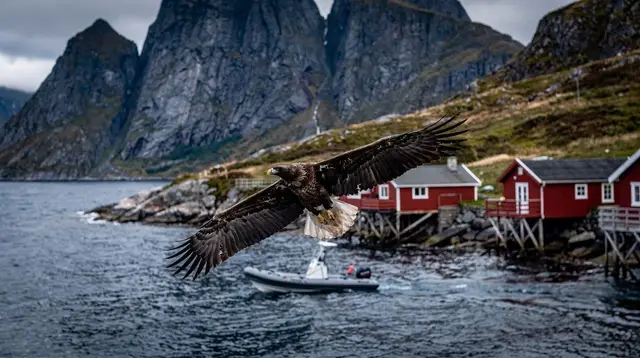
I heard the guide say “eagle” before I actually found it in the sky, which is fairly typical of how this works — the shadow crosses the water first, and only then does your eye catch up and locate the source. When I did, it wasn’t subtle. A white-tailed eagle, wings held nearly flat and enormous against the grey sky above the water near Skrova, banking once and then dropping toward the surface with a speed that didn’t match how lazily it had seemed to be gliding a second earlier. It took a fish, or tried to — I genuinely couldn’t tell from the boat whether the strike landed — and climbed away with the same unhurried wingbeat it had arrived with.
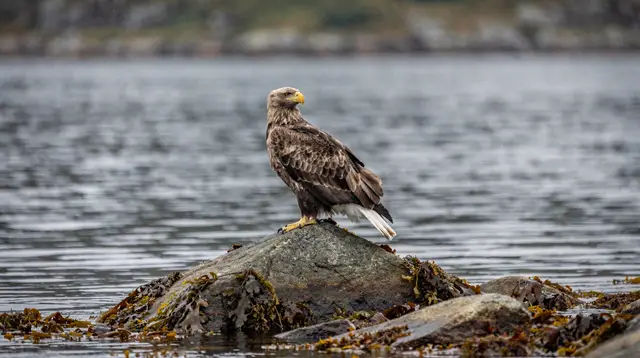
Europe’s largest bird of prey, and for a long stretch of the last century, a species that had been hunted, poisoned, and pushed out of most of the continent it used to occupy. That’s not a detail I knew before this trip. I’d assumed, the way I think most people do, that seeing a huge raptor over Arctic Norwegian water was simply what this coastline has always looked like. It isn’t, quite. It’s what this coastline looks like again.
Persecuted almost everywhere, but not quite gone here
The broad outline of the white-tailed eagle’s decline across twentieth-century Europe is well documented, if not something I’ll attach specific numbers to here: shot as a perceived threat to livestock and fish stocks, affected by the same pesticide contamination that hit other large raptors hard in the mid-1900s, and squeezed out of huge stretches of its former range. In much of Western Europe the bird was effectively gone for generations. Countries that once had breeding populations spent decades with none at all.
Norway’s coast, and this stretch of it in particular, held on to a population when so much of the rest of the continent didn’t. I don’t think that was foresight so much as remoteness — a coastline this sparsely populated, this difficult to access for most of its history, simply had fewer opportunities for the bird to be wiped out entirely. Whatever the reason, it meant that when European conservation programs later needed a source population to reintroduce white-tailed eagles into places like Scotland, where they’d disappeared completely, they came here, to a coast that had never quite let the species go.
Legal protection followed, eventually, along with the broader decline of the pesticides that had done so much of the damage elsewhere. The population here recovered to the point that this part of Norway is now regularly described as home to one of the larger concentrations of white-tailed eagles anywhere in Europe. I’m not going to put a number on that, because I don’t have one I trust, and because the exact figure matters less than the plain fact of it: a bird that came close to vanishing from an entire continent is common enough along this specific coast that a boat trip built around finding one is a realistic, bookable activity rather than a hopeful long shot. Our sea eagle safari guide goes into more detail on how these trips are actually run and what to expect.
What the boat trip is actually like
The RIB boats used for this kind of safari are fast, open, and low to the water, which sounds uncomfortable and often is, a little — but it’s also exactly what makes the eagles feel close rather than distant. A sea eagle and nature safari run from the waters around Svolvær moves along the coastline and out toward the smaller islands where the birds nest and hunt, cutting the engine periodically to drift and watch rather than plowing straight through. Guides on these trips generally know specific stretches of coast where sightings are more consistent, though — and this is worth saying plainly — no wild animal sighting on any specific trip is ever guaranteed, eagles included. What you’re booking is a good chance in the right habitat, not a promise.
Skrova, the smaller islands around it, and the mouth of the Trollfjord are among the areas where these boats tend to spend time, partly for the eagles and partly because the same stretches of coast host other seabirds worth watching for. If you’re building a wider wildlife-focused day around Lofoten rather than a single activity, our wildlife guide and puffins and seabirds guide cover what else is realistically visible depending on the season. Further north, Andenes and the wider whales of Vesterålen guide cover a different marine wildlife trip entirely, if eagles turn out to be the start of a broader interest rather than a one-off outing.
Why it stuck with me more than I expected
I’ve been on wildlife boat trips before that felt more like a checklist than an encounter — find the animal, take the photo, move on. This one didn’t, and I think it’s because of the backstory sitting underneath the sighting. Watching an animal that was, within living memory, disappearing from most of a continent, fish successfully in open water off an Arctic Norwegian island isn’t just a nice photo. It’s evidence that a specific, deliberate choice — to stop shooting them, to phase out the chemicals that were poisoning them, to protect what population remained — actually worked, on a timescale slow enough that most people who benefit from it never think about it at all.
I don’t want to overstate what a single boat trip proves. But it’s rare to get to watch a conservation outcome happen in real time, rather than read about it after the fact, and that’s more or less what a sea eagle safari off this coast turns out to be. If you want to pair it with another wildlife encounter on the same trip, a summer snorkeling trip alongside grey seals is a different kind of close encounter with a species that had its own history of being hunted along this coast.
If you’re planning a wider trip around this coastline, our guides to Skrova and the Trollfjord cover the areas these boats typically pass through, and the Svolvær destination guide has the practical details for basing yourself nearby.
Sea eagle safaris on GetYourGuide
Verified deep-linked GetYourGuide tours. Book through these links and we earn a small commission at no cost to you.
Photos show the destination, not the operator's own images.