Kayaking in Lofoten: Levels, Seasons, and Conditions
Do I need kayaking experience to paddle in Lofoten?
No. Most guided trips run in sheltered fjords and harbours and are designed for first-timers, with guides adjusting the route to conditions and group ability. Open-coast or more exposed paddling is a different matter and generally requires prior experience or a guide willing to take that on.
Why kayaking suits Lofoten specifically
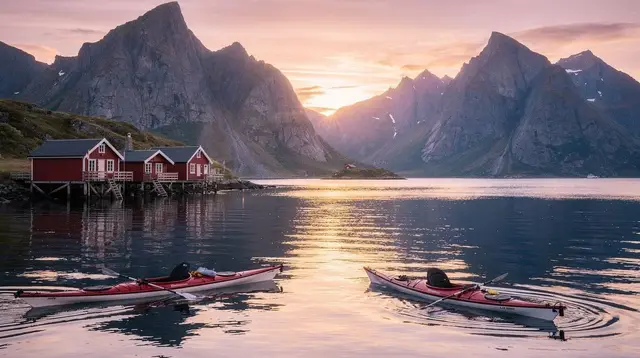
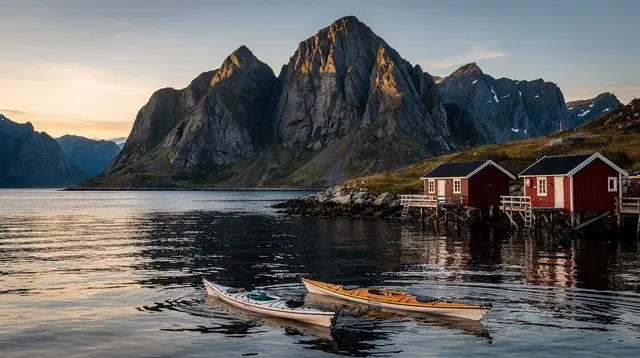
A kayak puts you at sea level, inside the fjords, at a pace and angle that no boat tour or road viewpoint replicates. The steep granite walls of Reine’s surrounding fjord, the working harbour at Ballstad, or the open water off Svolvær all look genuinely different from a kayak than from shore, simply because you’re moving slowly, quietly, and close to the water’s surface. That said, kayaking here is shaped entirely by conditions that can shift within the hour, which makes the question of guided versus independent paddling, and which season to go, worth taking seriously rather than assuming any calm-looking fjord stays that way.
Skill levels and what they actually mean here
Most visitor-facing kayaking in Lofoten is pitched at beginners and falls into a handful of practical categories:
| Level | What it involves | Typical setting |
|---|---|---|
| First-timer / family | Short paddle in sheltered, near-flat water, guide leads the whole way | Harbours, inner fjords |
| General visitor | A few hours paddling a scenic fjord route, some open water | Reinefjord, coastal inlets |
| Experienced paddler | Longer routes, more exposed water, faster pace | Coastal stretches, weather-dependent |
The overwhelming majority of guided trips sold to visitors fall into the first two categories. Genuinely advanced, open-coast paddling is less commonly packaged as a standard tour, partly because conditions on Lofoten’s outer coast can turn dangerous quickly and partly because most visitors aren’t looking for that kind of trip in the first place.
Seasons for kayaking
Summer — roughly June through August — is the most reliable season for kayaking here: daylight runs nearly around the clock during the midnight sun period, water temperatures are at their least punishing (which still means cold), and sea conditions are, on average, calmer than in the darker months. A midnight sun kayaking tour through Reinefjord takes advantage of exactly this — paddling under a sun that doesn’t set, at an hour that would be unthinkable for the activity almost anywhere else.
Kayaking outside summer is possible and is offered by some operators, generally for visitors specifically seeking the stark winter scenery — snow-covered peaks reflected in the fjord — rather than as a default choice. Winter paddling requires more careful weather judgement and shorter outings as a rule, given the shorter daylight window and colder water.
What guided trips actually provide
Most guided kayaking operators provide the kayak, paddle, and cold-water clothing (a wetsuit or drysuit, generally), which matters because the water around Lofoten is cold enough, even at the height of summer, that appropriate protection isn’t a nicety. a sea kayaking experience departing from Svolvær is a straightforward example of a guided outing built around a defined route, equipment included, and a guide managing pacing and safety throughout.
For those staying on Vestvågøya, a guided sea kayaking tour from the working harbour at Ballstad offers a different setting — paddling out among an active fishing fleet rather than a purely scenic fjord — while a broader guided day trip that bundles sea kayaking with other stops around Lofoten suits visitors who want the paddling as part of a wider day out rather than the sole activity.
Reinefjord: the most commonly paddled route
Reine and its surrounding fjord are probably the single most frequently kayaked stretch of water in Lofoten for visitors, and for good reason: the fjord is relatively sheltered, the surrounding peaks are dramatic at close range, and the village itself makes a natural start and end point. See kayaking in Reinefjord for route-specific detail on what that particular paddle involves.
Where kayaking doesn’t happen
It’s worth being direct about this: guided leisure kayaking does not operate near genuinely hazardous water, most notably Moskstraumen, the tidal current off the southern tip of Moskenesøya. That current can overpower a kayak in the wrong conditions and sits well outside the scope of any standard tour. If you’re drawn to that stretch of coast, a boat trip with an operator experienced in the local tides is the appropriate way to see it, not a kayak.
Combining kayaking with other activities
Kayaking pairs naturally with a broader day of sightseeing rather than needing to be the entire itinerary. a highlights day trip departing from Reine covering some of the archipelago’s most photographed spots is one way to combine a shorter paddle with other stops in the same day, useful if your schedule doesn’t allow a dedicated half or full day just for kayaking.
Weather, cancellations, and flexibility
Because sea conditions here change quickly, guided kayaking trips are routinely shortened, rerouted, or postponed based on the day’s forecast — this is standard practice, not a sign of a poorly run operation. Build slack into your schedule around a booked kayaking trip rather than stacking it tightly against a flight or ferry departure, and see weather in Lofoten for a fuller picture of how quickly conditions here can shift.
If you’d rather see the fjords from a larger, more stable vessel on a day when kayaking conditions look marginal, boat trips from Svolvær and RIB versus classic boat cover the alternative options and how they compare.
Where to base yourself for kayaking
Basing yourself near Reine or Hamnøy puts you closest to the most-paddled fjord routes, while a Svolvær base works well if you’re combining kayaking with other boat trips and a wider spread of activities. See where to stay in Lofoten for how these bases compare, and getting around Lofoten for reaching departure points if you’re relying on public transport rather than a rental car.
Reading sea conditions before you commit to a paddle
Wind, not rain, is the condition that most often decides whether a kayak trip runs as planned. A fjord that looks glassy at breakfast can develop a chop within the hour once wind funnels down between the surrounding peaks, and that chop matters more to a low-sitting kayak than it would to a larger tour boat covering the same water. Guides watch this constantly rather than treating the morning forecast as settled for the day, adjusting the route toward more sheltered stretches of a fjord, shortening the outing, or postponing entirely if conditions turn against the plan. Independent paddlers without that local read on how a specific fjord behaves under wind are taking on a judgment call that a guide makes as a matter of routine.
What a guide is actually managing on the water
Beyond route choice, a guide on a Lofoten kayaking trip is managing group pacing, watching for anyone struggling with the cold or the paddling itself, and making the call on when a route needs to shorten or turn back. None of this is dramatic under normal conditions, which is part of why guided kayaking here can feel like a low-key activity even though real judgment is happening constantly in the background. That judgment is the actual product being sold in a guided trip, more than the kayak or the wetsuit — equipment is replaceable and roughly standard across operators, but reading a specific fjord’s conditions on a specific day isn’t something a rental agreement can substitute for.
Gear beyond what’s provided
Most guided operators supply the kayak, paddle, and cold-water protective layer, but what you wear underneath and bring along still matters. A warm base layer under a provided wetsuit or drysuit, gloves suited to cold, wet hands on a paddle shaft, and footwear that can get wet without becoming a problem for the rest of the day are all worth arranging before a trip rather than assuming the operator’s equipment covers every layer. None of this needs to be specialized gear bought specifically for Lofoten — ordinary cold-weather layers used elsewhere translate directly here — but arriving without them and relying entirely on what’s provided leaves less margin if a trip runs longer than expected or conditions turn colder than forecast.
Combining kayaking with a wider day
A single kayaking outing, even a shorter one, tends to anchor a day rather than being one of several activities squeezed into it, simply because getting to and from a launch point, briefing, and changing in and out of wetsuits all take real time around the paddling itself. Pairing a morning kayak trip with an afternoon spent walking through a nearby village, or vice versa, tends to work better than trying to combine kayaking with a second water- or weather-dependent activity on the same day, since a delay or cancellation in one cascades into the other more easily than it would with a land-based plan as the second half of the day.
Shoulder seasons versus deep winter
Spring and autumn sit between the calm, reliable conditions of summer and the harder judgment calls of deep winter, and guided kayaking in these shoulder months can offer a reasonable middle ground — colder water than summer, but without the shortest daylight or the coldest air of the core winter months. Deep winter paddling, where it’s offered at all, is aimed specifically at visitors seeking the stark snow-covered scenery rather than a default choice, and it comes with a correspondingly shorter operating window and a guide’s judgment call weighing more heavily on whether a given day is workable at all.
Booking, cancellations, and building in slack
Because sea conditions change quickly here, treat a booked kayaking trip as provisional rather than fixed, especially if it’s scheduled near the start or end of your stay in Lofoten. Operators routinely reschedule or shorten trips based on the day’s conditions, and a traveler who’s built a tight connection — a flight, a ferry, another booked activity — right up against a kayaking slot risks losing more than the paddle itself if the weather forces a change. Building a spare half-day into a longer itinerary around any water-based activity, kayaking included, is the simplest way to absorb a weather-driven reschedule without it derailing the rest of the trip. This is standard practice across guided outdoor activities in this part of Norway, not a sign that a specific operator is poorly run, and it’s worth going in expecting it rather than being surprised when a forecast check the morning of a trip changes the plan.
Cold water: the constant across every option
Whatever the season, cold water is the one condition that never fully goes away in Lofoten, thanks to the Gulf Stream keeping the sea from freezing but not from staying cold year-round. This is the reason cold-water clothing is standard rather than optional across every operator, and it’s also why capsizing, while uncommon on guided trips in sheltered fjords, is treated seriously rather than as a minor inconvenience — cold water shortens the amount of time a person can function effectively if they do end up in it. Guides plan routes and pacing with this in mind by default, which is part of why sheltered fjords and harbours, rather than open coastline, make up the overwhelming majority of what’s offered to visitors in the first place.
It’s also the reason experience level matters more here than it might in warmer paddling destinations elsewhere — a beginner who’s comfortable in a kayak on a calm lake back home is still a beginner in Lofoten’s water temperature, and the cold, not the paddling technique itself, is what a guide is weighing most heavily when deciding whether a given group and route are a safe match for the day’s conditions. That single distinction — technique versus temperature — is worth keeping in mind when comparing your own paddling background against what a given tour actually requires.
Kayaking in Lofoten — frequently asked questions
Is kayaking in Lofoten cold?
Yes, even in summer the water is cold enough that a wetsuit or drysuit, provided by guided operators, is standard rather than optional.
What’s the best season for kayaking in Lofoten?
Summer, roughly June through August, offers the calmest conditions and longest daylight, including midnight sun trips. Guided paddling also runs outside summer for those specifically wanting winter scenery.
Can beginners kayak in Reinefjord?
Yes, guided trips in Reinefjord and similar sheltered fjords are commonly aimed at people with no prior kayaking experience, though a guide will always assess conditions on the day.
Do guided tours provide equipment?
Typically yes — kayak, paddle, and appropriate cold-water clothing are usually included in a guided booking; check the specific tour’s inclusions before assuming.
Is it possible to kayak near Moskstraumen?
No, not as an independent or guided leisure activity — the tidal current there is genuinely hazardous and outside the scope of standard sea kayaking trips.
How long do guided kayak trips usually run?
Guided trips vary from a few hours to a full evening, depending on the operator and route; check the specific tour’s duration before booking if timing matters for your day.
Can I rent a kayak and go without a guide?
Independent rental exists in some locations, but given how quickly weather and sea conditions change here, a guided trip is the more cautious choice unless you already have sea kayaking experience and local knowledge.
Kayaking tours on GetYourGuide
Verified deep-linked GetYourGuide tours. Book through these links and we earn a small commission at no cost to you.
Photos show the destination, not the operator's own images.