Kayaking Reinefjord: A Different View of the Same Mountains
Is kayaking Reinefjord worth it if I've already hiked Reinebringen?
Yes — the two experiences show the same mountains from opposite ends of the scale. Reinebringen looks down on the fjord from above; kayaking puts you at water level beneath the same peaks, closer to the cliffs and with a different sense of their actual height.
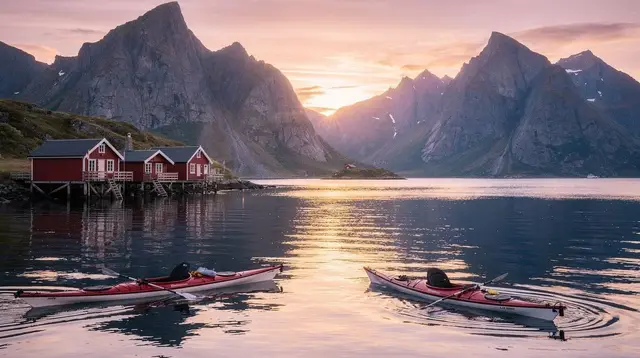
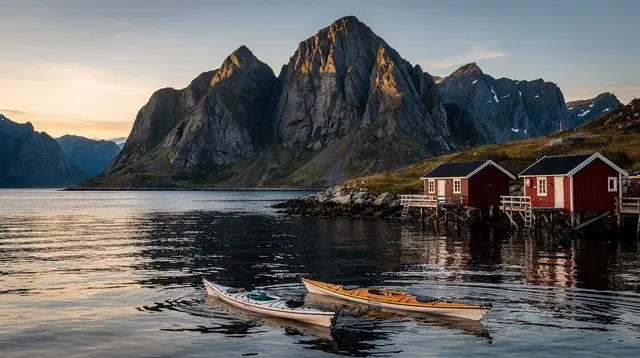
There’s a specific moment that kayakers on Reinefjord tend to describe the same way, regardless of season: paddling under a cliff face that looked modest from the road, and realizing at close range how tall it actually is. Photographs from the Reinebringen viewpoint compress the fjord’s scale — everything reads as a single flat composition of water and peaks. From a kayak, at water level, the same landscape stops being a composition and becomes a place you’re small inside of.
Why the water view is genuinely different, not just a marketing line
The Reinebringen hike — 1,566 stone steps built by Nepalese sherpas, climbing above Reine — gives you the view most people associate with Lofoten: the village, the fjord, and the surrounding peaks laid out below in a single frame. It’s a real payoff for a genuinely strenuous climb, covered in more detail in our best hikes guide.
Kayaking Reinefjord inverts that relationship entirely. Instead of looking down at the water from a height, you’re on it, and the mountains rise directly out of the sea around you rather than receding into a photographable backdrop. Sound carries differently over water — the slap of your own paddle, occasional birdcalls off the cliffs, the particular quiet of a fjord with no road noise. You also see parts of the coastline that aren’t visible or reachable from the E10 at all: coves, small waterfalls feeding directly into the sea, and rock faces that from the road are just distant grey shapes.
| From Reinebringen (hiking) | From Reinefjord (kayaking) | |
|---|---|---|
| Vantage point | Above, looking down | At water level, looking up |
| Physical effort | High — a genuinely steep 1,566-step climb | Low to moderate — paddling technique matters more than fitness |
| What you see | The whole fjord and village as one composition | Cliff faces, coves, and detail invisible from above |
| Weather sensitivity | Wind and cloud affect the summit view | Wind and swell affect whether trips run at all |
| Best paired with | A clear day for the summit view | Calmer water, any season |
What you’ll actually see, by season
Reinefjord looks different depending on when you paddle it, and the differences go beyond simply colder or darker. During the skrei season, roughly January through April, working fishing boats are a normal part of the view from the water, out after the arctic cod that has drawn people to this stretch of coast for centuries, and the drying racks - hjell - visible on shore near Reine and Hamnøy carry the stockfish that results. Paddling here in that window means sharing the fjord with an active fishery rather than a purely scenic backdrop, which is a genuinely different experience from a summer trip where the water is mostly given over to visitors.
Summer’s midnight sun, roughly late May to mid-July, replaces that working backdrop with an entirely different kind of light: an evening paddle under a sun that never properly sets casts long, low shadows across the cliffs for hours rather than the brief window of golden light most places only get around sunset. What you don’t get in summer is any chance of aurora - the sky never gets dark enough - so anyone hoping to pair the two needs to visit in the shoulder months either side of the skrei and midnight-sun seasons, when the fjord still runs its guided trips without either extreme.
Getting to the water
Most guided trips on Reinefjord depart from Hamnøy or Reine itself, both reachable only by the E10 - this stretch of Moskenesøya doesn’t have public transport dense enough to rely on for a fixed tour departure time, so a rental car or a transfer arranged through the operator is the practical way to arrive. Travelers coming in via the Bodø–Moskenes ferry land close by, at Moskenes itself, which makes this one of the more convenient activities to slot into an arrival or departure day rather than requiring a special detour once you’re already settled elsewhere on the islands.
Basing yourself in or near Reine, Hamnøy, or Sakrisøya for a night or two
- in a rorbu, the red fisherman’s cabin on stilts common across the region - puts the put-in point within a short drive rather than a long one, which matters most for the early-morning or late-evening departures that make the best use of calm water and, in summer, the long light.
Why the fjord behaves differently from the open coast
A fjord like Reinefjord is more sheltered than the open coastline further out, which is part of why guided kayaking concentrates here rather than on the exposed, wave-facing beaches elsewhere in the archipelago, such as Unstad or the beaches out toward Vesterålen. That shelter doesn’t mean the water is calm by default, though - wind funneled between the steep peaks on either side of the fjord can build quickly even when the open sea beyond looks settled, and Lofoten’s core practical rule still applies here as much as anywhere: conditions can shift within an hour. Guides watch this closely and adjust routes or timing accordingly, which is part of why an independent rental is much less common here than a guided trip - reading how wind moves through this specific stretch of water takes local knowledge that isn’t obvious from a general forecast alone.
What a guided trip on Reinefjord actually involves
Sea kayaking on Reinefjord is almost always run as a guided experience rather than an independent rental, and for good reason: fjord conditions here can shift with little warning, and a guide who knows the local wind patterns and safe landing points matters more than it might on a sheltered lake. A guided kayaking tour on Reinefjord departing from Hamnøy is one of the more established options, covering a route along the fjord with stops to take in the cliffs at closer range than a longer paddle would allow.
Shorter sessions exist too, useful if you’re fitting this in around other plans in the area. A 3-hour guided kayak tour departing from Reine itself covers a solid stretch of the fjord without requiring a full day, which works well if you’re also planning a hike or a visit to Hamnøy or Sakrisøy on the same day.
Winter changes the equation but doesn’t rule it out. A winter kayaking tour on Reinefjord run with full guiding and gear puts you on calmer water than summer’s midnight-sun conditions in some respects, with snow-covered peaks adding a different character to the same cliffs — worth considering if you’re visiting during the polar night season and want an activity that doesn’t depend on daylight hours.
For visitors here during the midnight sun window, roughly late May to mid-July, an evening or late-night paddle on Reinefjord takes advantage of light that never fully fades — a genuinely different atmosphere than a daytime trip, with the low, constant light casting long shadows across the water for hours rather than minutes.
What to bring, and what not to worry about
Guided operators supply the kayak, paddle, spray skirt, and a drysuit or equivalent cold-water protection — this isn’t an activity where you show up in your own gear. What you’re responsible for is dressing in warm layers underneath what’s provided, since even in summer the water and wind off Reinefjord stay cold. Bring a waterproof bag or case for a phone or camera if you want photos; hands-free options work better than trying to operate a device mid-paddle.
No swimming ability requirement beyond basic comfort in water is typically needed for a guided trip, since the drysuit and buoyancy aids handle safety in the event of a capsize, and guides keep groups within manageable conditions. That said, this isn’t a completely passive activity — some paddling stamina helps, particularly on the longer 3-hour-plus routes.
What a beginner’s first minutes on the water look like
Guides typically start with a safety briefing on land - covering the drysuit or gear provided, basic paddling strokes, and what to do in the unlikely event of a capsize - before anyone gets in a kayak. Getting in and out at the dock is usually the most awkward part of the whole outing for a first-timer, more than the paddling itself, so a slow, guided entry rather than rushing it removes most of the fumbling. Once on the water, guides keep pace with the group rather than the fastest paddler, and the first stretch is usually flatter, more sheltered water before working toward the cliffs, which gives newcomers a chance to get comfortable with the boat’s balance before conditions get more interesting.
Choosing a two-hour, three-hour, or longer session
The length of a Reinefjord kayaking trip changes what fits around it in the rest of the day. A shorter two-hour guided option covers a meaningful stretch of the fjord’s cliffs without eating into a full day, useful if the plan also includes a hike or a walk through Reine and Hamnøy on the same day. The longer three-hour session described above goes further along the fjord and gets closer to some of the more remote cliff faces and coves, at the cost of leaving less daylight or energy for anything else that day.
Neither length is inherently the better choice - it’s a trade-off between how much of the fjord you want to cover from the water and how much of the day you want left over for Reinebringen, a village walk, or simply resting before the next day’s plans. Travelers combining kayaking with a demanding hike on the same trip, rather than the same day, generally get more out of both than those trying to fit a strenuous climb and a full afternoon on the water into a single day.
Wildlife you might see from the water
White-tailed sea eagles are a realistic sighting from a kayak on Reinefjord, since the birds hunt along this kind of coastline and a low, quiet kayak doesn’t disturb them the way a motorized boat can. Seeing one is never guaranteed on any specific trip - nothing about wildlife here is promised - but the fjord’s undisturbed cliffs and quiet water make it a reasonable setting for a sighting compared with busier stretches of coast. Our sea eagle safari guide covers dedicated wildlife-watching trips if seeing eagles specifically, rather than kayaking itself, is the priority.
Photography from a moving kayak
Shooting photos from a kayak is a different exercise than photographing the same cliffs from land or from the Reinebringen viewpoint. A waterproof case or a strap that keeps a phone or camera secured to your body matters more here than any particular lens or setting, since a dropped device in a fjord isn’t recoverable. Guides will generally pause paddling at the best vantage points rather than expecting photos mid-stroke, and low, direct light - either the long summer evenings under the midnight sun or the low winter sun during skrei season - tends to flatter the cliffs more than the harsher light of the middle of a summer day. Our photo spots guide for Reine and Hamnøy covers the equivalent land-based viewpoints if you want to compare the two perspectives directly.
Combining kayaking with the rest of a Moskenesøya day
Reine, Hamnøy, and Sakrisøy sit close enough together that a kayaking session fits naturally alongside a walk through the villages or a shorter hike. If you want a single guided day that strings several of these elements together rather than arranging each separately, a highlights tour covering Reine, Hamnøy, and other scenic stops gives a broader overview of the area, useful context if this is your first visit to this side of the archipelago. Our photo spots guide for Reine and Hamnøy also covers where to shoot from if photography is a priority alongside the paddling.
Reinefjord kayaking questions answered
Do I need prior kayaking experience?
No. Guided trips on Reinefjord are generally designed for beginners, with instruction on basic paddling technique given before departure. Some general comfort with being on the water helps, but formal experience isn’t a requirement.
What happens if the weather is bad on the day of my booking?
Operators typically monitor conditions closely and will delay, reschedule, or cancel a trip if wind or swell make the fjord unsafe. Build some flexibility into your schedule if kayaking is a priority, since Lofoten’s weather changes within the space of an hour and can affect any given day’s plans.
Is Reinefjord kayaking suitable for kids?
This depends on the specific operator’s age policy and the child’s swimming ability and comfort with cold water; check directly with whichever tour you’re considering rather than assuming a blanket rule.
How cold is the water?
Cold year-round, in line with Arctic coastal waters generally. Guided trips provide drysuits or equivalent protection specifically because of this, so the water temperature itself isn’t something you need to plan around beyond dressing warmly underneath the provided gear.
Can I kayak Reinefjord in winter?
Yes, with guided operators running winter-specific trips that account for shorter daylight and colder conditions. See the polar night guide for how limited daylight in December and January affects scheduling.
Is kayaking better than hiking Reinebringen, or should I do both?
They show different things and aren’t really substitutes for each other. If time allows, doing both — the climb for the overhead view, the paddle for the water-level one — gives a fuller sense of the fjord than either alone.
Kayaking tours on GetYourGuide
Verified deep-linked GetYourGuide tours. Book through these links and we earn a small commission at no cost to you.
Photos show the destination, not the operator's own images.