RIB Boat or Classic Boat: Choosing the Right Cruise for the Season
Should I book a RIB boat or a classic covered boat in Lofoten?
RIB boats are faster and get closer to wildlife and tight coastlines but expose you fully to wind, spray, and cold. Classic covered boats are slower and calmer, with shelter, seating, and often a toilet or cabin, making them the more comfortable choice for winter, families, or longer trips.
Two very different ways to see the same coastline
Almost every boat trip on offer around Lofoten and the wider Vesterålen region falls into one of two categories: an open, rigid-hulled inflatable boat (a RIB) built for speed and maneuverability, or a larger, covered classic boat built for stability, shelter, and passenger comfort. The scenery on offer — fjord walls, sea eagles, whales, seal colonies, coastal villages — often overlaps between the two, so the real decision isn’t really about where you go, it’s about how you experience getting there. That distinction matters more here than in many other boating destinations, because Arctic Norway adds two variables most travelers underestimate: genuinely cold air even in summer, and weather that can shift from calm to blustery within an hour.
This guide breaks down the practical differences — speed, cold exposure, accessibility, and how the choice should shift with the season — rather than simply listing tour options.
What a RIB actually is
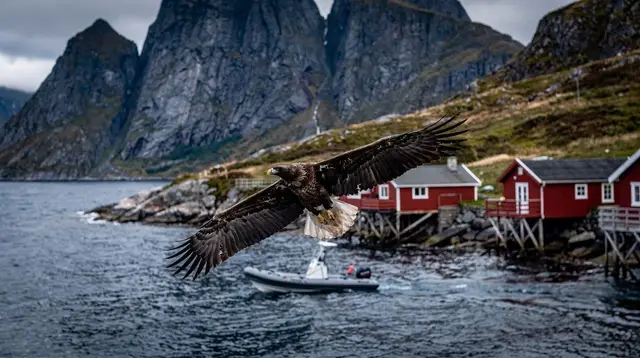
A RIB (rigid inflatable boat) pairs a rigid hull with inflatable tubes around the sides, giving a boat that’s light, fast, and highly maneuverable in a way a larger displacement hull can’t match. In Lofoten and Vesterålen, RIBs are used for wildlife-focused trips — sea eagle safaris, seal colonies, tighter coastal inlets — where speed and the ability to reposition quickly matter more than passenger comfort. Seating is typically on saddle-style benches with handholds, passengers sit in the open with no cabin or roof, and operators generally issue full-body flotation survival suits, which double as wind and spray protection.
a RIB-based seal and seabird safari departing from Nyksund is a good example of the format: several hours on an open, fast boat, covering more distance and more separate sighting spots than a slower classic vessel would manage in the same window, with the operator adjusting the route in real time based on where wildlife is actually active that day.
A similar trip closer to Bodø, a RIB tour combining the Saltstraumen tidal current with sea eagle watching, shows the other side of the RIB’s usefulness: it can safely approach the edges of a genuinely powerful tidal phenomenon (see our Saltstraumen day trip guide for what that current actually is) at a distance and angle that would be harder to manage with a larger, slower boat.
What a classic boat actually is
“Classic boat” here covers the range of larger, covered vessels used for scenic cruises: enclosed cabins with seating, often multiple decks, sometimes a toilet, and in some cases food or drink service on board. These boats trade the RIB’s speed and agility for stability, shelter from wind and spray, and room to move around during a longer trip. They’re the standard choice for the flagship scenic cruise in the region — the run into the Trollfjord, a narrow sea arm off Svolvær roughly two kilometers long with an entrance barely a hundred meters wide, framed by steep mountain walls on both sides.
a classic covered boat cruise into the Trollfjord departing from Svolvær is the traditional way to see that fjord: a multi-hour trip with time to move around the boat, step outside onto deck for photos, then retreat to shelter and warmth in between. A newer variant on the same route runs aboard a silent electric ship, applying the same classic-boat comfort model with a quieter propulsion system, which some passengers and operators note allows wildlife along the route to react less to the boat’s approach compared with a conventional engine.
For more on this specific route, our dedicated Trollfjord cruise guide and broader roundup of boat trips departing from Svolvær cover route variations and what else typically appears along the way.
Speed and duration
RIBs cover distance fast — often reaching double the practical cruising speed of a classic covered boat — which changes what a tour can fit into a given time window. A three-hour RIB safari can realistically cover more separate stops (a seal haul-out, a sea eagle perch, a stretch of open coastline) than a three-hour classic cruise, which spends more of its time transiting at a gentler pace.
That speed comes with a trade-off beyond comfort: a fast RIB in open water amplifies the sensation of chop and swell, meaning the ride itself is a more physical experience, sometimes closer to the sensation of an amusement-park ride than a scenic cruise. Classic boats, moving slower and sitting lower and heavier in the water relative to their length, generally produce a calmer, more predictable ride over the same sea state.
| RIB boat | Classic covered boat | |
|---|---|---|
| Typical speed | Fast, built for quick repositioning | Moderate, built for a steady cruise |
| Typical trip length | 1.5 to 4 hours | 2 to 6+ hours |
| Shelter | None — fully open, survival suit provided | Enclosed cabin, deck access optional |
| Best for | Wildlife safaris, tight coastlines, RIB-specific routes like Saltstraumen | Trollfjord cruises, longer scenic routes, mixed-age groups |
| Physical demand | Higher — bracing against motion at speed | Lower — seated, stable |
Cold exposure: the factor most visitors underestimate
Air temperature on open water, especially at speed, feels considerably colder than the same temperature on land, due to wind chill compounding with boat speed. Even in the mildest part of summer, when air temperatures might sit in the low teens Celsius thanks to the Gulf Stream’s moderating effect, an open RIB moving at speed across open water can feel genuinely cold, which is why full-body survival suits are standard equipment rather than an optional extra.
Classic covered boats remove most of this variable: a cabin blocks wind entirely, and even the open deck sections are typically positioned to allow retreating indoors within seconds. This is one of the clearest reasons the seasonal recommendation below leans toward classic boats for winter travelers, and toward RIBs mainly for those who specifically want the wildlife-safari format regardless of season.
Regardless of boat type, dress in real layers underneath whatever the operator provides — a survival suit or a boat’s shelter blocks wind and water, it doesn’t generate warmth on its own. For the wider context on how quickly conditions shift in this region, see our guide to weather in Lofoten; a boat trip is one of the outdoor activities most directly affected by sudden wind or precipitation changes.
Accessibility and who each format suits
Boarding a RIB typically means stepping down into an open boat and finding a saddle-style seat, then bracing with handholds as the boat moves — a format that assumes reasonable mobility, balance, and tolerance for a physical ride. Many operators set minimum age limits for RIB trips for exactly this reason, and travelers with mobility limitations, very young children, or anyone prone to motion discomfort in choppy conditions are generally better served by a classic boat.
Classic boats offer level or gently sloped boarding in most cases, proper seating, handrails, and shelter, making them the more practical choice for families with young children, older travelers, or larger mixed-ability groups. a whale watching trip aboard a classic catamaran departing from Andenes illustrates the format well: a stable, multi-hour platform suited to standing, moving around, and watching for whales over a longer window without the physical demand of an open RIB. For more on that specific activity, see our whale watching at Andenes guide.
Which format suits which activity
Not every activity is offered in both formats, and the type of experience on offer often follows naturally from the activity itself:
- Sea eagle and wildlife safaris — commonly run as RIB trips because covering more coastline quickly improves the odds of a sighting; see our sea eagle safari guide for how these safaris typically operate.
- Trollfjord cruises — traditionally run as classic covered boats given the trip length and the appeal of being able to move around and photograph from a stable deck; some operators now also run faster RIB variants for travelers who want a shorter, more intense version of the same route.
- Whale watching — offered in both formats depending on operator and region; Andenes trips lean toward classic catamarans for the multi-hour search process, while some regions offer faster RIB-based alternatives for a shorter outing.
- Saltstraumen — RIB boats are common here specifically because the tidal current’s edges and eddies reward a maneuverable, fast boat able to approach safely and reposition; see our Saltstraumen day trip guide.
- Fishing trips — a different category again; a wildlife-focused RIB trip is not the same product as a dedicated fishing charter, which typically uses a working fishing boat rather than either format described here.
Seasonal recommendation
Summer (roughly June to August): both formats work well. Midnight sun conditions mean daylight is rarely a constraint, and air temperatures, while still cool by most travelers’ standards, are the mildest of the year. This is the easiest season to choose a RIB purely for the faster, more active format, since cold exposure is at its lowest annual level (though never negligible).
Shoulder seasons (spring and autumn): classic boats become the safer default recommendation for most travelers, since wind and temperature variability increase and daylight hours shorten. RIB trips still run, but expect more layers, more spray, and a higher chance of operators adjusting or canceling routes for weather.
Winter (roughly December to March): classic covered boats are the practical choice for most visitors, given genuinely cold air temperatures compounded by wind chill at speed, and much shorter daylight hours limiting the practical operating window overall. RIB trips do still run through winter for travelers specifically seeking that format, generally with full survival-suit gear and a shorter, more intense outing than a summer equivalent.
Combining both on a longer trip
Nothing prevents booking one of each across a multi-day itinerary — a classic Trollfjord cruise for the flagship scenic route, and a separate RIB wildlife safari for sea eagles or seals, treating them as genuinely different activities rather than competing options for the same slot. Travelers building a longer trip around the Harstad and Narvik area sometimes combine a RIB-based wildlife trip earlier in a stay with a slower classic-boat cruise later on, using the RIB’s speed for active wildlife searching and the classic boat’s comfort for a more contemplative final outing.
For a broader look at how boat trips fit into a wider Lofoten or Vesterålen plan, our guides to getting around the region and day trips from Lofoten cover logistics beyond the boat choice itself, and travelers weighing water-based activities more broadly may also want to compare against kayaking, which offers a slower, self-powered alternative to both boat formats described here.
Frequently asked questions about choosing a RIB or classic boat
Is a RIB boat safe in Lofoten’s weather?
Reputable operators monitor conditions closely and cancel or reroute trips when wind and swell make a RIB unsafe, since these open boats are more exposed to sea state than a covered vessel. Given how quickly weather changes here, cancellations and itinerary adjustments are normal rather than a sign of a poorly run operation.
Do I need special clothing for a RIB boat tour?
Most operators provide a flotation survival suit, which handles wind and spray, but you should still dress in warm layers underneath, since a suit blocks wind and water rather than generating heat itself. Classic boats generally don’t require a survival suit since passengers are more sheltered.
Which is better for seasickness, RIB or classic boat?
Neither type eliminates motion in open water, but classic boats tend to be more stable in swell due to greater size and weight, and offer somewhere to sit still and look at a fixed horizon, which helps some people. RIBs move faster over the same conditions, which some passengers find more jarring.
Can older travelers or young children go on a RIB boat?
Many operators set minimum age limits and expect reasonable mobility for RIB trips, since boarding involves climbing into an open boat and bracing against motion at speed; check the specific tour’s requirements before booking. Classic covered boats are generally the easier choice for young children, older travelers, or anyone with mobility or balance concerns.
Do RIB boats go somewhere classic boats can’t?
RIBs can access shallower water and tighter coastline than larger classic vessels, and their speed allows them to cover more distance in a shorter tour, useful for reaching dispersed wildlife like seal colonies or sea eagle territory. Classic boats trade that flexibility for size, stability, and shelter.
Is one type of boat better for photography?
Classic boats offer a steadier shooting platform and shelter to handle a camera without spray, useful for longer lenses and slower shutter speeds. RIBs get you physically closer to the subject and lower to the water, which can produce a more dramatic angle if you can keep gear dry and stable at speed.
What time of year should I choose a classic covered boat over a RIB?
In winter, when wind chill at speed becomes a serious factor and daylight hours are short, a classic covered boat is generally the more comfortable and practical choice for most travelers. RIBs work in winter too, but expect full exposure gear and a shorter, more intense outing rather than a relaxed one.
Fjord cruises on GetYourGuide
Verified deep-linked GetYourGuide tours. Book through these links and we earn a small commission at no cost to you.
Photos show the destination, not the operator's own images.