A Thousand Years of Dried Cod: The Trade That Built Bergen and Fed Europe's Lent
The Smell Before the Story
I noticed the smell before I understood what I was looking at. Driving into a small harbor on Vestvågøya in late winter, the air had a particular sharpness to it, somewhere between low tide and something closer to leather. It came from the wooden A-frames strung along the shoreline, hung end to end with split cod, heads sometimes still attached, drying in the wind. Nobody had mentioned the smell in advance, and it took me a day or two to stop noticing it and start reading the racks — the hjell — as the oldest continuously running export business I’d ever stood next to.
Stockfish, tørrfisk in Norwegian, is cod that’s been split, hung, and left to dry in the cold, wind-scoured air of the Lofoten winter and spring, with no salt and no smoke — just weeks of exposure until the moisture is gone and what’s left keeps for years. It sounds almost too simple to have shaped the economic history of an entire coastline, but it did, and the racks I was looking at on Vestvågøya are the same basic technology that’s been in continuous use here for roughly a thousand years.
How a Drying Rack Built a City
The trade runs back to the Viking Age, when Norwegian traders were already exporting dried cod south, but it was the Hanseatic League that turned it into something closer to an industry. From the fourteenth century onward, Bergen — hundreds of kilometers south of Lofoten — became the trading hub where German merchants bought stockfish wholesale and shipped it onward across Europe. The Hanseatic merchants’ quarter in Bergen, the Bryggen, exists in the form it does today largely because of this trade; the wooden warehouses that line the waterfront were built to store and process fish that had dried on racks up here, a thousand kilometers north, months earlier.
What made stockfish valuable wasn’t just that it kept without refrigeration, though that mattered enormously in an era without any. It was also that the Catholic calendar demanded it. Lent, and the many other fasting days scattered through the liturgical year, prohibited meat but not fish, and a continent that didn’t have reliable access to fresh fish for a third of the year needed something that traveled. Dried cod from an Arctic archipelago, produced by a population that measured in the low thousands, ended up on tables in Italy, Spain, and Portugal — countries that had never seen a Norwegian winter — because it solved a specific religious and logistical problem that fresh fish couldn’t.
I found that detail more affecting than I expected to, standing by the racks. The connection between a fishing village on a Norwegian island above the Arctic Circle and, say, a Lenten meal in a Mediterranean city hundreds of years ago isn’t the kind of thing you’d guess just from looking at a fish hanging on a wooden frame. But that frame, more or less unchanged, is the actual machinery that made the connection work.
Skrei: The Fish That Makes the Whole Thing Possible
None of this works without a specific fish arriving at a specific time. The skrei — mature Arctic cod that migrate south from the Barents Sea to spawn along the Lofoten coast — show up reliably between January and April, in numbers dense enough to have supported a fishery here for as long as anyone’s kept records. I’d read about the skrei season before arriving, but seeing the timing tied directly to the racks made it click in a way the reading hadn’t: the hjell aren’t hung constantly, they fill up in a specific window because the fish only arrive in a specific window. I’ve written more about that season and what it’s actually like to be here for it in a separate piece on the skrei season, and the mechanics of how the fish is caught and processed are covered in more practical detail in the stockfish and skrei guide.
What’s Still Here, and What Isn’t
The trade isn’t a museum piece. Stockfish production continues in Lofoten today, still concentrated around the same fishing villages that supplied it centuries ago — Svolvær, Henningsvær, Ballstad, Stamsund — and much of what’s produced still gets exported, largely to Italy, where it remains a genuine culinary staple rather than a curiosity. What’s changed is the scale and the visibility. The racks I saw on Vestvågøya are a fraction of what would have lined this same coast a century ago, and the industry now shares space with tourism, boat charters, and second-home development in a way it didn’t when it was effectively the only economy the islands had.
For a fuller sense of how that history sits alongside the region today, the fishing village museum at Å i Lofoten preserves the buildings and equipment from the trade’s working era, and it’s a useful stop if the racks along the road leave you wanting the fuller version rather than a roadside glimpse. The broader question of how these villages functioned, and how many of them still do, is covered in fishing villages of Lofoten, and the wider set of regional museums, stockfish-related and otherwise, is in museums in Lofoten.
Seeing It for Yourself
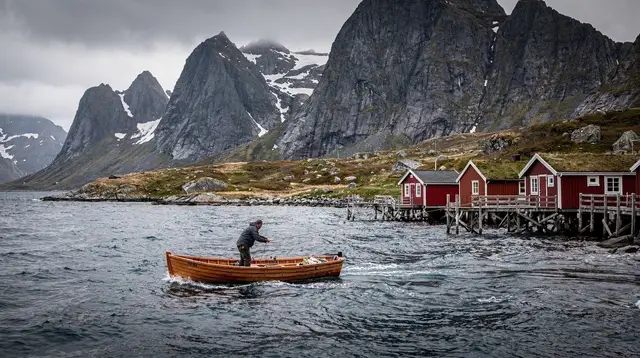
If you’re here during the drying season, which overlaps with the darker months, the racks are visible from the road in most of the fishing villages without needing to seek them out specifically — Svolvær, Henningsvær, and the harbor at Reine all have stretches where you’ll pass them. Seeing them from the water rather than the road adds a different angle on the working coastline, and a boat trip along the shore near Svolvær is a reasonable way to combine that with the sea eagles that are common along the same stretch:
a boat safari from Svolvær along the coast, past the working harbors where the drying racks standBecause stockfish season runs through the darkest and coldest months, most visitors chasing it are also here for the aurora, and the two overlap naturally on a single trip. An evening tour that combines the hunt for clear sky with some local food and drink is a fitting way to end a day spent looking at the racks:
an evening tour that pairs the search for the northern lights with local snacks and drinksIf the sky doesn’t cooperate on a given night, there’s usually another chance later in the same stay, since aurora visits and the drying season both stretch across the same winter window:
a guided evening tour tracking clear, dark sky for the northern lightsWhat I Took Away From It
I didn’t expect a drying rack to be the thing I thought about most on that trip, but it was. Most of what draws people to Lofoten is visual — the peaks, the fjords, the light — and the stockfish trade is easy to drive past without registering, especially if you don’t already know the smell means anything. Once you do, it’s hard to unsee: every rack still standing along that coast is doing the same job it’s done for something close to a thousand years, feeding a market that mostly has no idea where its dried cod actually came from. For general context on how the region’s food culture sits around that trade today, food in Lofoten is worth a look before you go looking for the racks yourself, and best time to visit Lofoten covers how the drying season lines up against the rest of the year if you want to plan a trip specifically around seeing it.
Food & drink tours in the Lofoten Islands on GetYourGuide
Verified deep-linked GetYourGuide tours. Book through these links and we earn a small commission at no cost to you.
Photos show the destination, not the operator's own images.