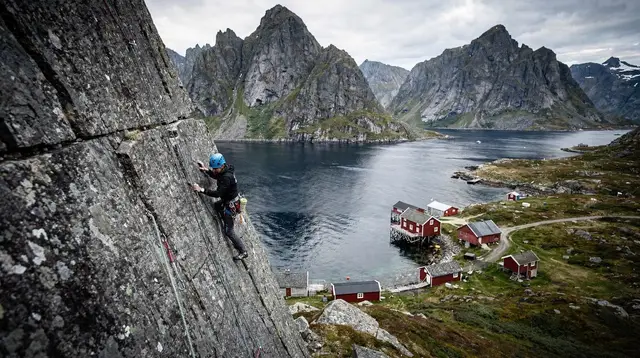
Climbing in Lofoten: Granite, Svolværgeita and Grades
Do I need to be an experienced climber to climb in Lofoten?
For the well-known routes on peaks like Svolværgeita, yes — these are multi-pitch granite climbs that assume real prior experience, and most visitors without that background join a guided route rather than attempting one independently. Guided options exist specifically because the terrain and exposure don't suit complete beginners.
The Rock That Shapes Everything
Lofoten’s peaks are granite, and that single fact explains most of what makes them a climbing destination rather than just a hiking one. Granite fractures into sharp, angular faces and clean crack lines rather than crumbling or rounding off the way softer rock does, which is why so many of these summits look like they were cut rather than eroded. It’s the same underlying geology behind the dramatic skyline you see from the water approaching Svolvær, and it’s the reason the region draws technical climbers alongside the much larger number of visitors who only ever look up at these peaks from below.
Svolværgeita: The Route Everyone Asks About
Above Svolvær stands Svolværgeita — “the Goat” — a rock spire named for the two horn-like summit points at its top. It’s the single most recognized climbing objective in the archipelago, not because it’s uniquely difficult by climbing standards elsewhere, but because of what waits at the summit: a narrow gap between the two horns that climbers traditionally jump across, with genuine exposure below on both sides. That jump has become something of a local landmark in itself, photographed and talked about well beyond the climbing community.
Getting there in the first place is a multi-pitch granite climb, which means it assumes rope work, protection placement and general granite-climbing competence rather than being an activity you pick up on the spot. This isn’t presented to alarm anyone away from it — climbers with the right background do it regularly — but it’s an honest answer to “can I just climb this,” which is no.
What Level of Experience Actually Applies
There’s a real gap between “wants to climb Svolværgeita” and “is prepared to climb Svolværgeita independently,” and it’s worth being blunt about which side of that gap most visitors are on. Multi-pitch granite routes with real exposure at the top assume you’ve climbed similar terrain before, are comfortable managing rope systems across multiple pitches, and have the judgment to make good calls if weather shifts partway up — which, on this coastline, it regularly does.
If that’s not your background, the honest options are a guided ascent with a certified guide, which exists specifically to make routes like Svolværgeita accessible to people who don’t already have the technical grounding to lead it themselves, or a different objective entirely. There’s no shame in the second option — the view of Svolværgeita from below, or from a hiking trail nearby, is itself one of the more striking sights around Svolvær.
Getting to the Climb
Svolværgeita rises directly above Svolvær, which means there’s no separate approach logistics to plan the way there would be for a more remote objective — the town itself, reachable by its local airport or by road along the E10, is the base for everything here. Guided operators running routes on the spire are based in town, and for most visitors booking a guided ascent rather than approaching independently, that means gear, transport to the base of the route, and instruction are bundled together rather than something to arrange separately.
Independent climbers still need their own rack, rope and protection, none of which is reliably available to rent locally in the way ski or snowshoe equipment might be elsewhere in the archipelago — bring what you need, or confirm availability with a local operator well before your trip rather than assuming you’ll sort it out on arrival.
Guided Versus Independent Climbing
| Independent climbing | Guided ascent | |
|---|---|---|
| Experience needed | Established multi-pitch granite background | Some fitness and comfort with exposure; technical skill not assumed |
| Equipment | Your own rack, rope, protection | Typically provided by the guide or operator |
| Route knowledge | Self-navigated | Managed by someone who knows the specific line |
| Best for | Climbers with a track record on similar rock | Visitors without a climbing background who still want the summit |
For most travelers reading a guide like this one rather than already owning a climbing rack, the guided route is the realistic path to actually standing at Svolværgeita’s summit rather than just photographing it from a boat or a trail. a guided mountain climbing route up Svolværgeita is built around exactly this gap — fitness and comfort with exposure matter more than a climbing résumé, since the technical work is handled by the guide. For visitors who want the full experience built out further, including more instruction along the way, an extended ascent of Svolværgeita with a certified guide covers the same summit with more time spent on technique and preparation before the exposed section at the top.
Beyond Svolværgeita
Svolværgeita gets the attention, but it isn’t the only granite in Lofoten — the same sharp, sea-adjacent peaks repeat throughout the archipelago, and climbers with local knowledge find plenty beyond the one route every visitor has heard of. This guide focuses on Svolværgeita specifically because it’s the objective almost everyone asks about first, but if you’re already at the level where independent multi-pitch climbing is realistic for you, it’s worth researching further options directly with local guiding operators rather than treating one peak as the whole picture.
What repeats across these other peaks is the same underlying character: clean crack systems where the granite has fractured cleanly, sections of exposed slab between them, and a setting where the rock drops essentially straight to the sea rather than into a gentler valley. That proximity to open water is as much a part of the experience as the climbing itself — weather rolling in is visible from higher up long before it arrives, which is useful information if you know to look for it, and easy to miss if you’re focused entirely on the rock in front of you.
Rampen: A Via Ferrata Alternative Near Bodø
Not everyone drawn to this region’s vertical terrain wants — or is ready for — an unassisted multi-pitch granite climb. Near Bodø, one of the main gateway towns for reaching the archipelago, a via ferrata route works the same kind of steep rock but with fixed cables, rungs and anchor points built into the route itself, which changes the experience considerably. Climbers clip into the fixed line as they move, which manages the fall risk in a way that free climbing granite doesn’t, and it opens the terrain to people with reasonable fitness and a tolerance for exposure but without prior rope-climbing experience.
a guided via ferrata route up the Rampen wall near Bodø is the practical way to do this — via ferrata terrain still assumes a guide manages the technical side and the group’s pacing, particularly for anyone doing it for the first time. It’s a reasonable stop if you’re routing through Bodø on the way to or from the islands and want a vertical experience without committing to the background Svolværgeita assumes.
How a Guided Day Actually Runs
A guided climbing day here doesn’t start with rope work — it starts in Svolvær itself, where the guide typically meets the group, checks equipment and fitness expectations, and walks through the plan for the day before anyone leaves town. From there, reaching the base of the route on Svolværgeita usually means a walking approach rather than any kind of lift or shortcut, which is worth factoring into your own fitness expectations separately from the climbing itself — tired legs at the base of a multi-pitch route make the technical part harder than it needs to be.
The climb itself is broken into pitches, with the guide managing rope work, protection, and pacing between each one. The summit gap between Svolværgeita’s two horns comes at the very end, after the technical climbing is essentially done, which is part of why guided operators can offer it to people without a climbing background — by that point, the guide has already assessed how the group is handling exposure and pacing, and the final move is managed accordingly rather than treated as a formality. Descent typically retraces the approach, and a full day given over to this, rather than treating it as a quick add-on to other plans in Svolvær, is the realistic expectation.
Weather and Timing
Summer’s long daylight hours and comparatively milder conditions make it the most practical season for a full route, giving climbers more margin if a pitch takes longer than planned or weather forces a pause partway up. As with everything outdoors in this region, conditions can shift within an hour, and that risk is amplified on an exposed granite face rather than reduced by being partway up it — build weather margin into any climbing day here the same way you would for any exposed hike in the archipelago.
In practice, that means checking conditions the morning of the climb rather than relying on a forecast made days ahead, and treating a clear, calm start as a good sign rather than a guarantee that will hold for the several hours a multi-pitch route takes. Wet granite is meaningfully more slippery than dry granite, and rain moving in partway up changes both grip and visibility — reasons enough that most guided operators build flexibility into their scheduling rather than running on a fixed daily slot regardless of conditions. Our broader guide to summer in Lofoten covers how the season’s long light and generally calmer weather (relative to the rest of the year, with the Gulf Stream keeping conditions milder than the latitude would suggest) shapes outdoor plans across the archipelago, climbing included.
What to Bring, Beyond the Rack
For independent climbers, the equipment list is what you’d expect for granite crack and face climbing: your own rack, rope, and protection suited to the specific route, plus normal alpine layering underneath a harness rather than anything specialized to this region. The one local variable worth planning around is temperature — even in summer, conditions here run cooler than most inland climbing destinations at the same time of year, and a belay stance exposed to wind can get cold fast even when the air temperature alone sounds mild.
Guided climbers generally have technical equipment provided, which shifts the packing question toward personal layering and footwear instead. Our Lofoten packing guide covers general layering logic for the archipelago’s fast-changing weather, and most of that advice applies directly to a day spent on an exposed granite face, where there’s less shelter than almost anywhere else in this guide.
If Climbing Isn’t Quite Your Trip
Not every visitor drawn to Lofoten’s peaks wants to climb them, and that’s a completely reasonable position — the same granite skylines that draw climbers are also what make hiking trails like Reinebringen and the region’s broader best hikes worth doing on their own terms, without a rope in sight. Photographers, too, tend to find plenty to work with just from the base of these peaks; our photography guide covers where those views work best.
For a wider view of climbing options across the archipelago beyond what’s covered here, our climbing category page collects the operators and objectives we track region-wide, which is worth checking if Svolværgeita and Rampen aren’t quite the fit you’re looking for.
A Realistic Way to Decide
If you’re still weighing whether climbing belongs in your Lofoten trip at all, the honest way to decide is by being specific about which of the two routes covered here actually matches your background, rather than defaulting to whichever sounds more impressive. Anyone with genuine multi-pitch granite experience already knows whether Svolværgeita’s independent line is realistic for them; everyone else is choosing between a guided ascent of the same peak and the more accessible via ferrata near Bodø, and that choice comes down to how much exposure and physical effort you actually want rather than which one photographs better afterward.
Either path is a full day built around one objective, not something to squeeze between other plans in Svolvær or Bodø. Treating it that way — as the anchor of a day rather than an add-on to it — is what makes the guided versions of both routes work as well as they do for visitors without a climbing background.
Frequently Asked Questions About Climbing in Lofoten
What kind of rock is Lofoten climbing on?
Granite, which gives the region’s peaks their sharp, sheer character and is a large part of why they attract climbers in the first place, alongside hikers who never leave the ground.
Is Svolværgeita a beginner climb?
No. It’s a multi-pitch route above Svolvær that assumes prior climbing experience, and the exposure at the top — including the space between its two summit horns — isn’t something to approach without proper preparation or a certified guide.
Can beginners try climbing in Lofoten at all?
Guided climbing experiences exist for people without an established climbing background, typically on routes selected and managed for that purpose, with equipment and instruction provided rather than assumed.
What should I bring if I’m climbing independently?
Your own rack, rope and protection suited to granite crack and face climbing, along with the general preparedness this guide’s hiking safety advice applies to any exposed terrain here: weather changes fast, so build in margin.
Is there a climbing season in Lofoten?
Summer’s long daylight and milder temperatures make it the most practical season for extended routes; conditions outside summer are more demanding and less commonly used for the region’s well-known multi-pitch climbs.
Where is climbing based in Lofoten?
Svolværgeita, above Svolvær, is the most recognized objective, but it isn’t the only granite in the archipelago — the general character of steep, sheer peaks close to the sea repeats across the islands.
Climbing & via ferrata experiences on GetYourGuide
Verified deep-linked GetYourGuide tours. Book through these links and we earn a small commission at no cost to you.
Photos show the destination, not the operator's own images.